
- Locations
- Interviews
- Luxury Home
- Luxury Lifestyle
- Luxury Travel
- Luxury News
- Events
- More
- Magazine

A sword can outlive the purpose for which it was made. Centuries after it was carried into battle, a surviving blade may still preserve evidence of the people who forged it, the materials they used, and the military world in which it belonged.
Historic swords interest both collectors and historians for this reason. Their blades can reveal something about metalworking, while hilts, decoration, and inscriptions can help place an object within a particular period or tradition. A sword can therefore serve as a record of technology, craftsmanship, and culture.
Blade shape, hilt construction, and decoration allow researchers to compare one surviving object with others from the same period or region.
The Metropolitan Museum of Art, for example, holds a Germanic or Scandinavian sword dated to about 850–900 whose blade bears the inscription Ulfberht. The museum connects the name with a swordsmith thought to have worked in the Middle Rhine region and notes that the name and style were later imitated by other craftsmen. The sword is about 96 centimetres long, with a 79.5-centimetre blade.
The inscription is valuable to historians, but it also shows why caution is necessary. Ulfberht swords were not identical. Metallurgical research has found differences in their materials and construction, and scholars continue to debate how the Ulfberht name should be understood.
Medieval swords show similar variation. Differences in blade profile, point shape, grip length, and fittings help researchers distinguish swords made in different periods. Once a weapon survives beyond its original use, those details become historical evidence that can be studied alongside archaeological finds, written sources, and artwork.
Swordmaking involved a series of technical decisions. Smiths had to work with the iron and steel available to them, shape the blade, form suitable edges, and build a hilt capable of surviving use. Methods varied by region and period.
Pattern welding is one of the techniques most closely associated with early European swords. In broad terms, it involved forge-welding different pieces of iron and steel into a composite structure. Bands could be arranged or twisted before welding, and grinding and polishing the finished surface exposed contrasting layers that produced the familiar patterns. The Smithsonian's Museum Conservation Institute describes European pattern welding in similar terms.
The pattern is striking, but it should not automatically be treated as proof of a superior blade. An experimental study published in Archaeometry found no significant improvement in the mechanical properties of the materials it tested and concluded that the main effect appeared to be decorative. Other experimental work has been more cautious, so the exact mechanical role of pattern welding remains open to discussion.
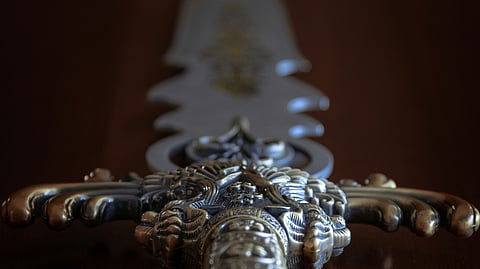
Fittings deserve attention as well. Guards protected the hand, while pommels helped secure the hilt and could influence the sword's balance. Silver inlay, engraving, and other decoration could also make a weapon distinctive.
Many Viking Age swords were double-edged weapons with broad blades and relatively compact hilts, but surviving examples vary considerably.
The Ulfberht sword at the Metropolitan Museum is a useful case study. Its inscription, silver-decorated hilt, and documented dimensions make it more than a familiar image of a Viking sword. It is evidence of a particular swordmaking tradition and of the resources available to its maker.
Research also shows that pattern welding was only one method used by Viking smiths. Surviving blades demonstrate a range of materials and construction methods, so it would be misleading to suggest that all Viking swords were pattern-welded.
The term “longsword” covers a broad group of medieval weapons rather than one standardized design.
A hand-and-a-half sword in the Metropolitan Museum, dated to about 1400–1430, measures 124.8 centimetres overall, with a 97.8-centimetre blade. Its steep point and stiff construction indicate that it was primarily intended for thrusting and could be used to pierce gaps in armor.
Another Metropolitan Museum sword, dated to about 1400–1450, measures 146.1 centimetres and weighs about 2.35 kilograms. Its strongly tapering blade and central ridge reflect the importance of thrusting as well as cutting in later medieval combat.
These examples show why medieval swords cannot be reduced to one shape. Blade geometry, grip length, and point design changed as the demands placed on weapons changed.
The Roman gladius was shorter than later medieval swords, but its compact form suited the close-range conditions of Roman infantry combat.
The British Museum identifies the Mainz type as an early first-century AD form with a relatively long point, indicating a strong emphasis on stabbing. Later in the first century, the Pompeii type emerged with a blade of similar length but more parallel edges and a shorter point.
Roman military writers placed strong emphasis on thrusting rather than wide slashing movements. The British Museum notes that Roman tacticians regarded stabbing as preferable because the swinging motion of a slash could expose the attacker. This helps explain why a relatively short sword could be effective in close combat without reducing its design to a single cause.
The gladius changed over time, with archaeological evidence showing variation in blade length and width. The transition from the Mainz form to the Pompeii form therefore illustrates that Roman sword design was not fixed for centuries.
For many collectors, interest in swords begins with a particular period or culture. The attraction may come from military history, metallurgy, craftsmanship, or the opportunity to study a surviving design.
Comparison is part of the appeal. A Viking sword, a later medieval longsword, and a Roman gladius represent different approaches to materials, blade geometry, and combat. Studying them together makes those differences easier to understand.
That can turn collecting into a form of research. Questions about who made a sword, how it was constructed, what materials were available, and why its design changed can tell a more useful story than a dramatic legend attached to the object.
Modern historical-style swords occupy a different category from archaeological originals. Contemporary makers have access to modern steels, machinery, and centuries of accumulated research, so their work should not be confused with authentic artifacts.
That distinction does not make modern interpretations less interesting. A carefully made reproduction can give collectors a way to explore the proportions and visual character of an earlier design while remaining clear about what is modern.
For collectors interested in these historical forms, Battling Blades' sword collection includes contemporary pieces inspired by Viking swords, medieval-style longswords, and Roman gladii.
Historic swords continue to attract attention because several kinds of evidence can survive in the same object. Their materials preserve clues about technology, their fittings show changes in design, and their dimensions can help researchers understand how weapons were intended to be used.
The Ulfberht sword, the late medieval longsword, and the Roman gladius belong to very different periods, yet each reflects the choices made by its makers in response to materials, technology, warfare, and culture.
That is what gives historic blades their lasting appeal. Their value is not dependent on dramatic battle stories. A well-documented sword can be compelling simply because it gives us something concrete to study: how people worked metal, designed weapons, and adapted those designs to the world around them.
Inspired by what you read?
Get more stories like this—plus exclusive guides and resident recommendations—delivered to your inbox. Subscribe to our exclusive newsletter
The products and experiences featured on RESIDENT™ are independently selected by our editorial team. We may receive compensation from retailers and partners when readers engage with or make purchases through certain links.