
- Locations
- Interviews
- Luxury Home
- Luxury Lifestyle
- Luxury Travel
- Luxury News
- Events
- More
- Magazine

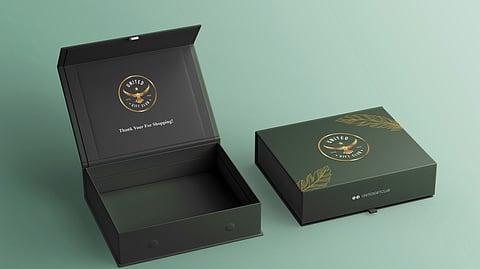
In luxury, the experience often begins before the product itself is revealed. The weight of a box, the texture of its paper, the precision of its construction and the way it opens can all influence how a customer perceives what is inside. For premium brands, packaging is no longer simply a protective layer around a product. It is part of the brand experience, and increasingly, part of the product itself.
Stanislav Krykun, founder of DST-Pack, has built his business around this shift. Rather than focusing on standardized packaging solutions, his company works with brands that want something developed specifically around their product, identity and customer experience. The projects range from luxury gift boxes and cosmetic packaging to elaborate Advent calendars, many of which require custom structures, specialized finishing and careful coordination across several stages of production.
The challenge in building a business around this kind of work is that customization does not naturally lend itself to scale. Every project can have different dimensions, materials, quantities and deadlines. For Krykun, the answer has been to create more efficient systems behind the scenes while preserving the flexibility clients expect from a boutique packaging partner.
A luxury packaging concept can look perfect on a screen and still present significant challenges once it reaches production. Materials behave differently at scale, structures need to support the weight of the products they contain, and finishing techniques must be applied consistently across hundreds or thousands of pieces. The distance between a creative concept and a commercially viable product is therefore considerable.
This is where Krykun sees one of DST-Pack's key roles. The company is not simply producing a finished design supplied by a client; it often becomes involved in translating an idea into a structure that can actually be manufactured.
"Clients usually know their product and their brand extremely well, but they are not necessarily packaging specialists," Krykun explains. "They may have a very clear idea of the look and the experience they want to create. Our job is to help turn that idea into something that works physically and commercially."
That process can involve selecting the appropriate board or paper, developing internal inserts, adjusting dimensions, considering assembly requirements and determining which finishing techniques are realistic for the intended production quantity. Sampling is an important part of the process, giving the client an opportunity to evaluate the physical product before committing to full production.
For premium packaging, that physical stage is particularly valuable. Digital renderings can communicate shape and appearance, but they cannot fully reproduce the feel of a material, the resistance of a magnetic closure or the experience of opening a carefully engineered structure.
Few packaging categories illustrate the evolution of the market better than the Advent calendar. Once primarily associated with inexpensive chocolate-filled cardboard designs, the format has become a sophisticated seasonal product for beauty, fragrance, food, lifestyle and luxury brands.
Modern calendars can contain 24 or 25 individual products, often with different shapes and dimensions. The packaging may incorporate drawers, doors, windows, trays or removable compartments, while the exterior itself can be designed to resemble a book, cabinet, house or another distinctive object.
For brands, the appeal is obvious. Unlike conventional packaging, an Advent calendar creates repeated interaction. The customer returns to it day after day, turning the packaging into part of the seasonal experience rather than something that is immediately discarded.
"An Advent calendar is essentially packaging and customer experience combined," says Krykun. "The structure has to work technically, but it also has to create anticipation. Every compartment becomes part of the story."
That combination makes the category particularly demanding from a manufacturing perspective. Internal dimensions need to be precise, products must remain secure during transportation and the finished calendar has to be practical enough to assemble and ship. At the same time, brands expect a premium visual result capable of supporting their positioning.
This is precisely the type of project where a boutique manufacturer's flexibility can become an advantage. Instead of adapting a brand's products to an existing standard model, the packaging can be developed around the actual requirements of the campaign.
For many growing manufacturers, scale eventually leads to standardization. While this can make operations more efficient, it can also reduce the flexibility that made a company attractive to premium clients in the first place.
Krykun takes a different view of scaling. He believes the answer is not to make every product more standardized, but to make the process of managing custom projects more structured.
"Scaling does not mean that every client should receive the same packaging," he says. "It means that we need better systems for handling different projects."
That distinction allows the company to maintain a high degree of customization while improving efficiency in areas such as project management, production coordination, quality control and logistics.
It is an approach that reflects a broader change in the luxury sector. Consumers increasingly expect products to feel distinctive, while brands are under pressure to create experiences that differentiate them in crowded markets. Standardized packaging may be efficient, but it does not always deliver the sense of exclusivity that premium brands are trying to achieve.
For a boutique packaging company, the opportunity is to provide the best of both worlds: access to international manufacturing capabilities combined with a more personal, flexible approach to individual projects.
Packaging production is increasingly global. A project may begin with a brand in France, Germany, the United Kingdom or another European market, involve manufacturing partners in Asia, and ultimately be delivered to warehouses or distribution centers somewhere else in the world.
Managing such a project requires more than manufacturing capacity. It requires coordination.
For the client, the process needs to remain understandable even when the supply chain behind it is complex. Product specifications, artwork, samples, production schedules, quality control and shipping all need to be coordinated without creating unnecessary friction.
"From the client's perspective, they want one clear process," Krykun explains. "They shouldn't have to manage every individual supplier involved in producing their packaging."
This has become increasingly important as brands work with tighter deadlines and more complex campaigns. Seasonal projects such as Advent calendars are particularly sensitive because delivery dates are fixed by the calendar itself. A delay of several weeks can have a direct impact on a brand's ability to launch and sell the product.
Krykun therefore places considerable emphasis on setting realistic expectations early in the process. Production capacity, material availability and transportation schedules all need to be considered before a final deadline can be confirmed.
For an international packaging business, transparency can be as important as price.
Luxury packaging is often associated with visible elements such as foil stamping, embossing, textured papers, premium printing or magnetic closures. Yet the perception of quality is frequently determined by details that are less obvious.
A lid that closes precisely, a drawer that moves smoothly, an insert that holds a product securely or a board that has the right level of rigidity can make a significant difference to the overall experience.
This is why Krykun believes that complexity should never be added simply for the sake of making packaging look more impressive.
"The goal isn't to create the most complicated packaging possible," he says. "The goal is to create something that feels premium and works properly."
That philosophy is particularly relevant when packaging is being produced at scale. A prototype can be perfect, but repeating that result consistently across hundreds or thousands of units requires careful control over materials, printing, die-cutting, finishing and assembly.
Quality therefore needs to be considered throughout production rather than treated as a final inspection.
For brands operating in the luxury segment, this consistency is critical. Packaging is an extension of their reputation, and inconsistencies that might be acceptable in a mass-market product can be highly visible in a premium one.
The growth of e-commerce has arguably made packaging more important rather than less. When a customer buys online, they do not experience the physical environment of a flagship store or boutique. The package becomes one of the first tangible expressions of the brand once the purchase arrives.
This has contributed to the rise of the unboxing experience, particularly in beauty, fashion, food and lifestyle markets. Packaging is photographed, filmed and shared, extending the customer's interaction with the brand beyond the original purchase.
For luxury companies, this creates an opportunity to turn packaging into a marketing asset.
A distinctive structure can become recognizable. A carefully designed opening sequence can create anticipation. A premium material can communicate craftsmanship before the customer has even used the product.
The most effective packaging does not simply protect what is inside; it reinforces the story the brand is trying to tell.
This is one reason Krykun believes packaging should be considered earlier in the product development process rather than added at the very end.
"When packaging is treated as part of the overall product experience from the beginning, there are many more possibilities," he says. "You can design the structure around the product instead of trying to make the product fit into a box that already exists."
As premium brands continue to invest in physical customer experiences, the demand for distinctive packaging is unlikely to disappear. At the same time, clients are becoming more sophisticated. They expect high-quality production, international logistics, realistic lead times and a partner capable of handling the technical details behind a creative concept.
For DST-Pack, this creates an opportunity to continue developing as a specialist rather than competing purely on production volume. The company's focus on custom packaging allows it to work on projects where flexibility, communication and problem-solving are as important as manufacturing capacity.
Krykun's vision for growth is therefore less about becoming a conventional mass-market packaging supplier and more about building a scalable infrastructure around a boutique service.
The distinction is subtle but important. The company can grow its production capabilities, strengthen its international network and manage larger projects without losing the willingness to approach each brief individually.
In an industry where premium brands are constantly searching for ways to stand apart, that flexibility can be valuable.
Ultimately, luxury packaging is about much more than materials and printing techniques. It is about creating an experience that feels considered from the first interaction. For the brands operating at the highest end of the market, every detail contributes to that perception.
Krykun's approach is built around understanding those details while making the complicated process behind them easier for the client. As packaging continues to move closer to the center of brand experience, that combination of customization, manufacturing expertise and personal service may prove to be one of the most important advantages a boutique packaging house can offer.
Inspired by what you read?
Get more stories like this—plus exclusive guides and resident recommendations—delivered to your inbox. Subscribe to our exclusive newsletter
The products and experiences featured on RESIDENT™ are independently selected by our editorial team. We may receive compensation from retailers and partners when readers engage with or make purchases through certain links.