
- Locations
- Interviews
- Luxury Home
- Luxury Lifestyle
- Luxury Travel
- Luxury News
- Events
- More
- Magazine

A three-day conference can put an agency team in front of several hundred people. What separates the agencies that book work from it and the agencies that come home with a spreadsheet nobody touches is rarely the booth. It is the qualification work that happens in the ninety seconds after someone stops walking.
Agencies have a harder qualification problem than most exhibitors. A software vendor sells one thing to one buyer. A marketing, creative, digital, PR, staffing, or event agency sells a service catalog to a fragmented set of buyers with wildly different budgets and timelines. A brand director scoping a rebrand and a founder asking about social media management look identical at a badge scan. They are not the same lead.
The fix is process, not enthusiasm. Below is a practical framework for capturing and qualifying stronger leads at industry events, and for making sure the records survive the trip back to the office.
Most agencies have an ideal client profile written somewhere. Far fewer have one specific enough to be usable at a booth by someone under time pressure.
A usable profile is not "mid-market B2B brands." It is a short list of observable signals a rep can check in conversation:
Company size band the agency's retainer model actually fits, expressed as headcount or revenue.
Whether an in-house team exists, since that changes whether the agency is a replacement or an extension.
Budget floor, phrased in a way a rep can ask without it feeling like an interrogation.
Trigger events: funding round, leadership change, product launch, agency review cycle, upcoming event calendar.
Disqualifiers, which teams almost never write down and should. Competitive conflicts and known payment-terms problems belong here.
Write the profile on a single card and give a copy to every person working the booth. Anything longer than one card does not get read on day two.
Booth conversations run short. Three to five minutes is typical, less during a keynote break. Qualification has to be built into natural conversation rather than bolted onto the end of it.
Four questions cover most agency scenarios:
What is on your plate this quarter? Surfaces the service interest without pitching a service line first.
Who handles that today, internally or with a partner? Establishes incumbency and whether a review is realistic.
When does it need to be live? Timeline is a better predictor than stated budget, because timelines are harder to invent on the spot.
Who else weighs in on picking a partner? Reveals the buying committee before the follow-up sequence starts.
Answers should be captured as structured fields, not free text. A rep who types a paragraph at 3pm on day two will type nothing at all by 5pm. Dropdowns and toggles get filled in. Open text boxes get skipped.
Agency booths tend to be staffed by whoever was available. That produces five generalists all having the same surface-level conversation.
A clearer split:
Openers stop traffic, scan, and run the four qualifying questions. Volume is their job.
Closers take handoffs on anything that clears the profile. Usually a partner, strategy lead, or new business director who can talk scope credibly.
A floater works the aisles and sessions rather than the booth, which is where a meaningful share of qualified conversations actually start.
One data owner reviews records at the end of each day while memory is intact.
That last role matters more than it sounds. Notes written the night of the event are specific. Notes written the following Monday are generic and largely useless for personalization.
Agencies work a mixed calendar: large industry conferences with official badge systems, regional meetups with printed name tags, private dinners where a business card is still the exchange. A capture method that only works at one of those creates gaps.
There is also a cost dimension. Renting the show's official lead retrieval scanner runs roughly $350 to $735 per rep, per show, based on published 2026 ATD and AAOS exhibitor order forms. A four-person agency booth is somewhere near $800 to $1,000 for a single event before anyone scans anything, and the data those units return is often limited to what the attendee put in a registration form months earlier.
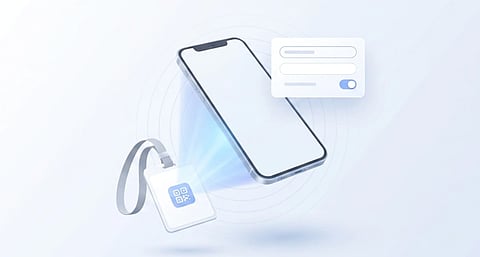
App-based capture removes the rental dependency. Wave Connect, used by more than 200,000 professionals and teams, is one example of a lead capture solution for trade shows built around that model: reps scan badges, paper business cards, and QR codes from the app at any show without an organizer badge kit or rental agreement, then organize the resulting contacts by service interest, budget band, timeline, campaign, team member, or follow-up priority in one shared workflow. The practical benefit for an agency is that leads from the trade show floor, the sponsored panel, and the client dinner all land in the same pool rather than three disconnected exports.
Two operational details are worth checking in any tool an agency evaluates. The first is offline capability, because convention center Wi-Fi fails predictably during peak hours. The second is what happens to the contact record after the scan. Badge data is frequently incomplete or out of date. Wave Connect runs each scan through what it calls Waterfall Lead Enrichment, which passes the record through multiple enrichment providers plus AI search to verify email, cell and office phone, LinkedIn profile, and office address. The company also prices event lead capture per enriched lead rather than by subscription or per user, with published rates starting at $10 pay-as-you-go and 10 free enriched leads to try, and does not charge when enrichment returns nothing verified.
No enrichment layer replaces qualification. A verified phone number on a bad-fit lead is still a bad-fit lead. Enrichment solves the deliverability problem, not the judgment problem.
This is where agencies gain the most and invest the least. A contact record with a name and email is a mailing list entry. A record tagged with service line, budget band, timeline, and a one-line note is a briefing document for whoever writes the follow-up.
A workable tagging scheme for agency teams:
Service interest: brand, paid media, content, PR, staffing, event production, web build.
Priority: hot, nurture, or not a fit, decided at the booth rather than later.
Timeline: this quarter, this year, exploratory.
Source: event name plus campaign, so multi-event attribution works at the end of the year.
Follow-up owner: the named person responsible, assigned on the spot.
Custom qualifier fields in a capture app make this a few taps. The note field should hold one specific detail: a competitor they mentioned, a deadline, a person they name-dropped. That single line is what makes the follow-up email read like a continuation rather than a template.
Event leads lose value fast. The window where a prospect still remembers the conversation is short, and manual CSV cleanup routinely burns most of it.
Direct CRM sync with custom field mapping into HubSpot, Salesforce, or Zoho matters here specifically because agency qualifiers are non-standard. Service interest and budget band need to land in the fields the agency's pipeline reporting already uses, not in a generic notes blob nobody filters on.
Three habits help:
Sync nightly rather than once at the end of the event, so follow-up can start on day two.
Map qualifier fields before the show, not after. Retrofitting mappings across 300 records is where data quality dies.
Confirm the platform meets the agency's client security requirements. SOC 2 Type II certification and SSO or SCIM support come up quickly in enterprise and regulated-sector work.
Shared team access is worth checking too. When every staffer contributes to one lead pool rather than a personal list, the agency ends the show with a single reviewable dataset instead of four partial ones.
Agencies that treat events as a repeatable channel rather than a series of one-off appearances tend to converge on the same practice: a defined profile, four questions, clear booth roles, structured capture, and a CRM handoff that happens within 24 hours.
Tooling supports that process and speeds up the mechanical parts. It does not create the process. An agency that has not decided what a good lead looks like will collect the same weak records faster.
The agencies pulling real pipeline from conferences in 2026 are the ones treating a badge scan as the start of qualification rather than the end of it. Once the profile, the questions, and the tagging scheme are settled, the tooling decision gets a lot simpler, and the post-event follow-up stops being a scramble.
Inspired by what you read?
Get more stories like this—plus exclusive guides and resident recommendations—delivered to your inbox. Subscribe to our exclusive newsletter
The products and experiences featured on RESIDENT™ are independently selected by our editorial team. We may receive compensation from retailers and partners when readers engage with or make purchases through certain links.