
- Locations
- Interviews
- Luxury Home
- Luxury Lifestyle
- Luxury Travel
- Luxury News
- Events
- More
- Magazine

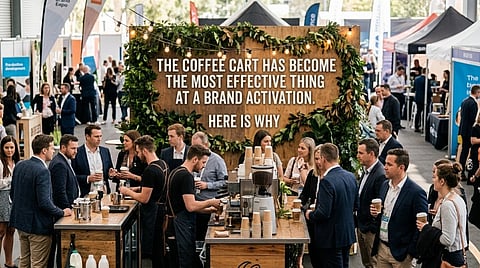
At a pop-up or a launch, the average guest stays about 6 minutes. Put an espresso cart in the room and that number roughly triples, because a drink made to order takes 3 to 4 minutes to arrive and people do not leave while they are waiting for something with their name on it. That single fact explains why coffee carts have moved from an afterthought to a line item on most experiential budgets in the last two years.
Here is what the cart is doing for the brands that use it well, and how to set one up so it earns its place.
Every activation has the same weakness. People arrive, look, photograph, and leave. The brand gets a glance and the agency gets a foot traffic number that does not translate into anything.
A coffee cart changes the physics of the room. Guests order, then wait, then hold a warm cup, and all three of those stages keep them inside the space. Operators who track this consistently see guests linger 15 to 20 minutes around the cart. That is enough time for a product demo, a conversation with staff, or a second look at whatever the activation is selling.
"Free coffee" is the most honest incentive in event marketing. Nobody needs convincing. A branded cup with a logo on the sleeve is a better handout than a tote bag because people carry it around the event, across the street, and into the office photo.
The best setups put the cart at the edge of the space, not the center. It pulls people from the walkway in, and once they are inside with a drink, the rest of the activation does its work.
A barista pouring latte art is one of the few things at an event that strangers will photograph without being asked. Brands that have run carts at multiple activations report that the coffee content outperforms the product content on social, which is a strange sentence until you have watched it happen.
Custom drink names, a colored syrup that matches the brand palette, a stenciled logo on the foam, or printed cups are the low-cost ways to make sure every one of those photos carries the brand.
Operators like Basileia Coffee, who have run carts for Lululemon, Puma and Madewell activations, will ask for three things before anything else.
Power. A commercial espresso machine wants a dedicated 20 amp circuit. Professional carts either run on two standard outlets across separate circuits or bring a quiet battery bank. Ask which, and whether they have worked a space with no accessible power.
Water. A real cart arrives with fresh tanks, a waste tank and inline filtration. If a vendor asks where the sink is, that is a flag.
Volume. One barista on a two group machine sustains 60 to 80 drinks an hour with a tight menu. If you expect more than 150 guests in a two hour window, book a second barista or a second cart. A line people enjoy and a line people abandon are 20 feet apart.
Send the floor plan, the run of show and the expected headcount a week out. Agree the menu together and keep it short: espresso, americano, latte, cappuccino, one signature drink. Fifteen syrups stall a line. Decide who provides cups, napkins and trash service so the client hears one answer from everyone.
If the activation runs multiple cities at once, which is increasingly common for national launches, book a coffee cart for brand activations from an operator that can staff several carts on the same day, rather than piecing together a different vendor in each market.
A two hour cart with one barista and a 100 drink minimum runs from about $900 to $1,800 depending on the market and the level of branding. Against a typical activation budget that is a rounding error, and it is the one line that reliably changes how long people stay.
The brands getting the most out of this are not treating the cart as catering. They are treating it as the hook, and building the rest of the space around the 15 minutes it buys them.
Inspired by what you read?
Get more stories like this—plus exclusive guides and resident recommendations—delivered to your inbox. Subscribe to our exclusive newsletter
The products and experiences featured on RESIDENT™ are independently selected by our editorial team. We may receive compensation from retailers and partners when readers engage with or make purchases through certain links.