
- Locations
- Interviews
- Luxury Home
- Luxury Lifestyle
- Luxury Travel
- Luxury News
- Events
- More
- Magazine

Shipping a car typically costs between USD 1,000 and USD 1,500. Short trips start at around USD 500, and cross-country moves can run past USD 2,000. Kelley Blue Book's most recent quote survey puts the average for a 1,000-mile trip at USD 1,020, or about USD 1.02 per mile, on an open carrier. Your own price depends mainly on distance, route, vehicle size, trailer type and timing.
This guide breaks down what you can expect to pay, why two quotes for the same car can differ by hundreds of dollars, and how to compare offers without getting caught by a low headline price. Every figure below comes from a named, independent source, listed in the methodology section at the end.
Kelley Blue Book collected quotes from eight transport companies to ship a 2025 Honda Accord on an open carrier. Its results show how the total price rises with distance while the cost per mile falls:
ConsumerAffairs reaches a similar picture, with prices ranging from about USD 500 for short cross-state trips to more than USD 1,700 for cross-country moves.
Doubling the distance doesn't double the price. A large part of every shipment is fixed: dispatching a carrier, loading and unloading, and the detour to reach your address. Those costs are spread over more miles on a long haul.
Route estimates from FreightWaves (updated May 29, 2026) show how distance and route popularity combine. They are for a standard, operable sedan on door-to-door open transport.
A coast-to-coast move usually costs more than USD 1,400. Shorter runs on busy corridors, such as New York to Florida, can come in under USD 900.
FreightWaves estimates these transit times, counted from pickup:
Add time for carrier assignment. FreightWaves notes that carriers usually need one to five business days to arrange pickup, so budget two to seven extra days.
Bigger and heavier vehicles take up more space and weight on a carrier, so they cost more to move. FreightWaves' estimates by vehicle type:
ConsumerAffairs found the same pattern in its own quotes: USD 650 to 825 for a sedan between Massachusetts and Florida, against USD 850 to 1,200 for an SUV, van or pickup over the same distance. Lift kits, oversized tires, roof racks and other modifications can push the price higher still, so mention them when you request a quote.
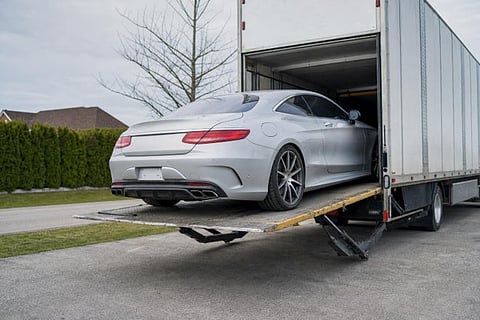
Open transport carries your car on the multi-level trailers you see hauling new cars to dealerships. It is the most common and cheapest option. Your car is exposed to weather and road grit, much as it would be if you drove it.
Enclosed transport puts your car inside a covered trailer, shielding it from weather and debris. These trailers carry fewer vehicles, which is why the price is higher. FreightWaves puts the premium at typically 30% to 60% over open shipping.
Choose open transport if you are shipping an everyday car with standard ground clearance and a factory finish. Consider enclosed transport if the car is rare, freshly painted or wrapped, very valuable, or sits low to the ground. For a low car, ask whether the assigned trailer has a liftgate rather than assuming every enclosed trailer does.
Longer trips cost more in total but less per mile. In Kelley Blue Book's survey, the per-mile rate fell from USD 1.50 at 500 miles to USD 0.56 at 2,500 miles.
Major corridors between big metro areas attract the most carriers, which keeps prices competitive. Rural pickups or deliveries often cost more because a truck has to leave the main highway to reach you.
SUVs, vans and pickups take up more room and weight capacity than a sedan, so they cost more.
FreightWaves says a non-running vehicle typically adds USD 150 to 300 because it needs a winch or other loading equipment. Tell the company upfront. Hiding it can lead to a refused pickup or an extra charge on the day.
Enclosed shipping typically costs 30% to 60% more than open.
Prices are usually highest in spring and summer. ConsumerAffairs reports that summer shipments can cost USD 200 to 300 more per trip. It also notes that winter shipments in areas with bad weather can cost more.
A flexible pickup window gives the company more time to find a carrier already heading your way. A tight or last-minute date usually means paying more to attract a truck quickly. Expedited service can shorten the pickup window to 24 to 48 hours, but FreightWaves describes it as the most expensive option.
Most car shipping companies you find online are brokers. A broker arranges your shipment and assigns it to a carrier. The carrier owns the truck and physically moves your car. Some companies do both, so check the terms before you book to see which you're dealing with.
Either way, you can check the business through the FMCSA's SAFER Company Snapshot, which you can search by DOT number, MC number or company name.
A useful quote is built from the same details every time:
Pickup and delivery ZIP codes
Year, make and model, plus any modifications
Whether the vehicle runs
Open or enclosed transport
Your first available pickup date and how flexible you can be
Online quote forms are built around these details. Cross Auto Transport, for example, asks for both ZIP codes, the year, make and model, whether you need an enclosed trailer or the car is inoperable, and your first available date. Give every company you contact identical answers. That is the only way to see whether a price difference is real or just reflects a different service.
Treat the averages in this guide as a benchmark, not a quote. When an offer comes in well below the ranges above, ask what it includes and what could change after booking. Before you book, get these in writing:
The total price, including any fees for expedited pickup, special loading, storage or a failed delivery attempt.
Payment terms: whether a deposit is required, when it is charged, whether it's refundable, and how the balance is paid at delivery.
Timing: whether the pickup and delivery dates are estimates or guaranteed.
This is the part most cost guides skip, and it matters as much as the price.
Carrier cargo insurance is the coverage that pays for damage to your car. Federal registration alone doesn't guarantee it. In the FMCSA's insurance filing table, the cargo insurance filing requirement for non-hazardous for-hire property carriers is USD 0. The required filing is for public liability, which covers damage the truck causes to other people and property.
A broker's USD 75,000 bond doesn't cover damage to your car. FMCSA requires brokers to file a USD 75,000 surety bond or trust fund. Its January 16, 2026 rule changes were designed to make sure funds are available for unpaid freight charges.
So before pickup, ask for the assigned carrier's cargo policy and check:
the per-vehicle limit and the deductible
whether loading and unloading are covered
whether aftermarket parts or wraps are excluded
how claims are filed
Also ask your own auto insurer how your policy treats the car while it's with a carrier.
Choose open transport unless your car truly needs an enclosed trailer. Enclosed typically costs 30% to 60% more.
Book ahead and stay flexible on dates. A wider pickup window helps the company match your car with a truck already on your route.
Avoid the busiest seasons. Spring and summer are usually the most expensive times to ship.
Consider terminal-to-terminal service. If a company offers it, dropping off and collecting the car at a terminal can cost less than door-to-door delivery.
Use a major pickup point. If you live far from main highways, meeting the driver near a larger road or city can lower the price.
Get the car running first. A non-running vehicle typically adds USD 150 to 300.
Compare like for like. Send every company the same vehicle, route, trailer type and dates, and compare the total payable amount, not the headline number.
Driving can look cheaper until you add up fuel, hotels and food. The estimates below assume:
500 miles of driving a day
25.5 mpg, the EPA's model year 2024 new-vehicle average with electric and plug-in hybrid models excluded
gas at USD 4.02 a gallon, AAA's national average on November 8, 2026
the federal standard travel rates for fiscal year 2027: USD 113 a night for lodging and USD 68 a day for meals
On cash alone, driving usually comes out cheaper, but the gap narrows a lot on a coast-to-coast move. These driving figures also leave out the days off work, tire and brake wear, the miles added to the car, and the risk of a breakdown or accident. Shipping often wins if your time is limited, you're moving more than one car, or you'd rather fly and keep the miles off the vehicle. If the car is part of a larger out-of-state move, ask for a pickup window that fits around your other moving dates.
This guide uses published figures rather than our own quotes, so you can check every number:
Costs by distance: Kelley Blue Book's survey of quotes from eight transport companies for a 2025 Honda Accord on an open carrier (article updated November 2026).
Route costs, transit times, vehicle-type costs, the open vs enclosed comparison and the non-running surcharge: FreightWaves (updated May 29, 2026). Its figures reflect typical market rates for a standard, operable sedan on door-to-door open transport.
Overall price range, vehicle-type quotes and seasonal increases: ConsumerAffairs (updated March 25, 2026), based on quotes from leading auto transport companies.
Insurance and bond requirements: the FMCSA insurance filing requirements table and its broker and freight forwarder financial responsibility guidance.
Driving costs: our own calculation from AAA's national average gas price (November 8, 2026), EPA's Automotive Trends Report and GSA's fiscal year 2027 per diem rates.
The sources gathered prices in different ways and at different times, so their ranges don't match exactly. Prices also change with fuel costs, season and carrier supply. Use these figures to judge whether a quote is reasonable, not to predict your exact price.
Once the car is picked up, a trip of 2,000 miles or more usually takes 7 to 10 days, according to FreightWaves. Carrier assignment typically adds another two to seven days before pickup, especially in peak season or on less common routes.
Typically 30% to 60% more than open transport. For a 1,000-mile trip, FreightWaves estimates USD 650 to 800 open against USD 1,000 to 1,200 enclosed.
Shipping a car to Hawaii means an ocean crossing, so it costs more than most mainland moves. moveBuddha's 2026 data puts it at about USD 1,400 to 2,400 to Hawaii and USD 1,000 to 2,000 from Hawaii back to the mainland. Oversized vehicles, container service and remote island delivery cost more.
The carrier's cargo insurance is the policy that covers damage to your car, but federal rules don't require ordinary car carriers to file it. Ask for the carrier's policy limit, deductible and exclusions before pickup. Note any existing damage on the Bill of Lading, and inspect the car before you sign at delivery.
Some companies allow a limited amount, usually in the trunk, while others require the car to be empty. Personal items are often not covered by the carrier's cargo insurance, so check the company's written rules and ship valuables separately.
Tipping is optional, and there's no industry standard amount. If the driver communicated well, handled the car carefully and delivered on time, a tip is a way to say thanks. Inspect the car before you hand anything over.
Ask for the company's legal name and DOT or MC number, then search the FMCSA's SAFER Company Snapshot. If a broker books your shipment, ask for the assigned carrier's details too. Then make sure the company that shows up at pickup matches them.
On fuel, hotels and meals alone, driving usually costs less. On a coast-to-coast move, the gap narrows considerably once you count lodging and meals, and that's before time off work and wear on the car. See the comparison table above.
Inspired by what you read?
Get more stories like this—plus exclusive guides and resident recommendations—delivered to your inbox. Subscribe to our exclusive newsletter
The products and experiences featured on RESIDENT™ are independently selected by our editorial team. We may receive compensation from retailers and partners when readers engage with or make purchases through certain links.