
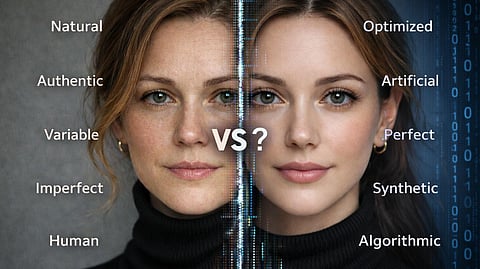
Are AI Headshots Hurting Your Credibility?

In a digital-first business environment, first impressions are often formed long before a conversation ever begins. Profiles, thumbnails, and headshots have become the modern handshake. They signal credibility, effort, and trustworthiness in a matter of seconds. As artificial intelligence tools make it easier than ever to generate polished images, a growing question is emerging across professional circles. At what point does convenience begin to erode authenticity.
To explore this shift, I spoke with Chris Gillett, a nationally-regarded headshot specialist and expression coach who works with executives, attorneys, and entrepreneurs to refine what he calls the visual handshake. His perspective cuts through the surface-level appeal of AI-generated images and examines what they may be signaling beneath the polish.
Below is a bit of our conversation.
You describe a moment where something felt off when viewing an AI headshot. What stood out to you?
I was in the middle of exchanging LinkedIn messages with a young woman who had pitched her company’s services to me when I got a weird feeling. I wasn’t sure she was real. Her headshot was polished. Good lighting. Clean background. But it almost looked too perfect. It was like a Stepford wife drifting into the uncanny valley. It felt off, almost like a scam. It felt so off-putting that I moved on without them. My reaction wasn't analytical, it was instant and automatic.
You say a headshot is more than just an image. What role does it really play?
Your headshot is not a decoration. It’s a signal. It’s fine to ask if you like your headshot. You should. The more important question, however, is what impression is it making on the people who see it. In other words, what is it signaling? Because people don't study your photograph they react to it. In my example above, the woman's headshot was signaling inauthenticity.
What message do AI-generated headshots send in a professional context?
Look, I'm a headshot photographer so I obviously have a very heavy bias in this situation. Years ago when I finally got a good headshot of myself it changed how I felt about myself. It closed my self-acceptance gap to a manageable level. Doing that for other people became highly addictive and I still love it like it's brand new. Having said that, an AI headshot signals low effort. It tells me that you are a low effort, path of the least resistance person. In a hiring or business context, people rarely assume that's the only place you cut corners. This isn’t the type of person I want to do business with or hire.
How should professionals think about first impressions when choosing a headshot?
Remember that it is great to ask whether you like your headshot or not, but it is even more important to ask what it signals. Do you look confident, like you are good at what you do? Do you look likable, like a person I would enjoy working with? Does the ratio of confidence to liability need to be weighted in favor of one or the other? When I work with clients these are things that we deliberately craft to make the best first impression for them. With AI headshots people are typically only asking does this resemble me closely enough and do I like it.
You make a strong comparison between AI images and trust. Why is authenticity so critical?
I sure hope you wouldn't catfish somebody on a dating app. Why in the world would it be acceptable to do it in business? We all know that we tend to do business with people that we like and trust. How can I trust you if your digital handshake is fake? Trust is fragile and first impressions either build it or quietly erode it. If you're not willing to show me your real face, it tells me something about your level of candor and confidence. If you are a high-achieving person, somebody who works hard, is disciplined, and has achieved real personal growth, it seems like a crime against nature to dilute that into a computer-generated hallucination of what you really look like. I try to take good care of myself and to some extent my face reflects that. I love it when I can see it in my headshots. Your face is a scoreboard of your habits. Why would you replace it with fiction?
What is lost when someone chooses an AI-generated image over a real photograph?
I find it hard to imagine someone feeling real pride in an AI generated image of themselves. That would be weird. I love it when my clients look at themselves in their headshots and feel proud just as I did when I got that first good headshot of myself. If you think that a real photograph looks better than you typically look, congratulations that's the best version of yourself. If you think that an AI headshot looks better than you typically look, you are presenting a version of yourself that isn’t a real. I’d trade a dozen fake headshots for one real, good one as it is honest and intentional.
Is there ever a place for AI headshots?
I understand that for some people who are tight on time and resources, fake pictures might be a good solution for certain situations, but for me and for the type of people I admire it is bizarre. Unfortunately, some people are just not going to get it. I have a friend who used to do network news. She is very smart and media-savvy. A few months ago on LinkedIn I saw that she had posted an AI photograph of herself. I texted her catfisher. She said I know, but with a little bit of makeup and good lighting it's not too far off. I told her if you really think that, you're not catfishing me, you are catfishing yourself.
As AI continues to reshape how professionals present themselves online, the temptation to optimize appearance is only growing. Yet as Gillett’s perspective makes clear, the real currency in business remains unchanged. Trust, credibility, and authenticity are still what drive connection.
In a world of increasingly polished digital personas, the question is no longer whether your image looks good. It is whether it feels real. Because in the end, your headshot is not just a photo. It is a signal. And people are paying attention.
Inspired by what you read?
Get more stories like this—plus exclusive guides and resident recommendations—delivered to your inbox. Subscribe to our exclusive newsletter
The products and experiences featured on RESIDENT™ are independently selected by our editorial team. We may receive compensation from retailers and partners when readers engage with or make purchases through certain links.