
- Locations
- Interviews
- Luxury Home
- Luxury Lifestyle
- Luxury Travel
- Luxury News
- Events
- More
- Magazine

At a Glance
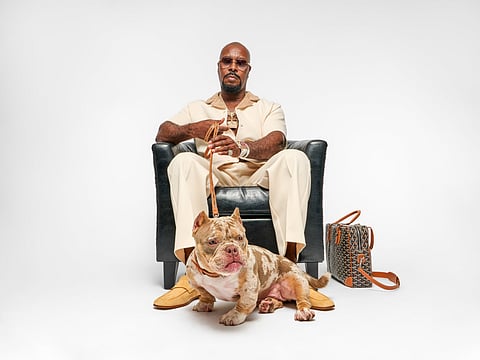
Bully Lifestyle: Hustle and Bloodline is a six-episode docuseries from entrepreneur and filmmaker Demetrius A. Matthews that goes inside the world of French Bulldogs, English Bulldogs, American Bulldogs and American Bullies, where the most prized dogs change hands for hundreds of thousands of dollars. Matthews bred Old English Bulldogs for roughly two decades and built a six-generation bloodline of his own. He made the series as a participant rather than a pundit, giving equal time to breeders, veterinarians, families and the shelter advocates who believe no one should be breeding at all.
We first spoke with Matthews in April about his memoir, Code Switch. This conversation began with a German Shepherd named Pep and moved through a $400,000 dog, an editor who took his pilot apart, and a Miami scene where owners arrive at dog shows in Lamborghinis. Along the way, he explained why he self-financed the series and released it on his own platform. The dogs in it, he told us, were bred for the film before a single episode was cut.
I've had dogs my whole life. I was a quiet kid who asked a lot of questions, and my mom noticed that when I had an animal, I opened up. When she got me a dog, that dog became my best friend. I used to talk to her. Her name was Pep, and she was a German Shepherd.
The bulldogs came later, as an adult. I wanted a smaller dog, but I wanted a muscle dog, so I bought an English Bulldog from a breeder. She was beautiful: the wrinkles, the big face, the short legs, that build. Her name was Precious.
Once we started going to the vet, I noticed that every time I was there, someone else walked in with a bulldog. One of the women at the clinic finally told me, "When you all walk in the door, we say cha-ching." She said, "I'm guessing you paid about $3,500 for this dog. Before she's a year old, you'll be out another $4,500." These dogs have a hard time breathing, and many of them need surgery on their airways. Some have joint problems. Precious had hip dysplasia, and she needed a $6,000 surgery before she turned one.
The breeder was honorable. She offered to take Precious back, and when I told her I couldn't send her back, she reimbursed most of the surgery. But we also learned we couldn't take Precious out on hot days. We had to baby her.
That's when I really fell in love with these dogs. They have human expressions, those big round eyes. And I started thinking these would be incredible animals if they could breathe well, if they could run and jump and swim. If they could just be a dog. So I decided I wanted to breed a better bulldog.
About 20 years ago I came across Old English Bulldogs, and I started calling breeders. They spent hours with me on the phone, teaching me everything they knew. When I said I wanted to start breeding, they told me, "The dogs you have now, you probably shouldn't breed. Find the best female you can." I told them I didn't want a couch potato. I wanted a dog I could take out. That started my quest.
To make a long story short, by the time I finished designing my own bloodline, I was ranked third in the country. The bulldog I have now is an ABKC grand champion, and she has produced other champions. People reached out from Australia, Germany and Italy for my bloodline. I had a rule that I didn't sell to breeders. I wanted my dogs in homes, with families, and I was trying to improve every generation.
There's a yearly race at Canterbury Park horse track, and one of my dogs, Xena, won it four years ago. A bulldog racing at a horse track. She turned eight this year, and she still placed.
Breeding takes time. It means dealing with people and finding the right homes, and I burned out. I decided to step back, but I had all these beautiful dogs I'd created, and I wanted to keep the bloodline going. So I started looking into cloning. I'm in the process of cloning some of my dogs now, and we talk about all of that in the series.
Then, about five years ago, I lost a dog named Legacy. She died on the operating table during a C-section. That took my world out from under me. I said, I'm not breeding anymore. I'm done.
But I had friends all over the world, from Japan to China to California, and I didn't want to walk away from that community. People come from every walk of life, and they're united around these dogs. I don't think the world knows how beautiful it is. I've seen rival gang members in California meet at an event held in a building everyone treated as neutral ground. One of them came up to me afterward and said it was the first time he had ever talked with someone from the other side without fighting. They were talking about a dog. So I decided to make a film about this world.
No. Everything I've done has come out of passion. The first time I picked up a professional camera, it was to photograph my dogs. One of my mentors told me, "If you're going to be in the dog game, you need a good camera." So I bought a Canon and taught myself to use it. This was before Facebook, when we posted pictures on message boards.
The cameras shot video, so I started making home videos: me in the kitchen feeding the dogs, trips to the vet. Fifteen years ago, I never thought I was making a movie. I just wanted to document my dogs, because I had so many generations of them. I produced two other documentaries before this one, and I always said I would finish my dog documentary. It kept taking the back seat.
I had a video recording studio business that was really more of a charity. I wanted to get kids off the streets in Chicago and Minneapolis, so I built studios in malls where they could come in and learn green screens, how to run a camera, how to mix on a keyboard and how to shoot their own YouTube videos. These kids wanted to be rappers, and I thought maybe I could teach them to make their own movies. I hired college interns, programmers and film producers to work with them, and I charged about $75 for a mixtape, just enough to get them into the building.
Then, five or six years ago, I lost my nephew to gun violence. I stepped away from the music. I had all this recording equipment, and I asked myself what I was going to do with it. So I called Mr. Kling.
He was our teacher for three consecutive years, sixth through eighth grade. By the time we graduated high school, we were testing at college levels in math, science and reading. He came from an affluent family and was on his way to becoming an attorney, but he had a child on the way, took a public school teaching job for extra money, and stayed for 35 years. He drove an hour each way to teach us in a neighborhood where gunshots were part of daily life, every day for three years. When people ask me how I made it out of Chicago, I point to my parents and Mr. Kling. Our class has doctors, math professors, psychologists and aldermen, from a class nobody expected to make it.
I drove from Minneapolis to Chicago with my assistant and my younger brother, and we spent five days with him. I was going to put the film on YouTube for my classmates. Then one day I walked past the Twin Cities Film Festival office and went in. They told me submissions had closed two weeks earlier and to come back next year. I asked them to just watch the trailer. In it, Mr. Kling tells us we're going to be judged by the way we speak and the way we write, by a society that doesn't expect us to be competent. The director came out of his office and told me I had been very polite, but very tenacious. I hadn't left. He asked to see the trailer again. Two weeks later the film was in the festival, and it was nominated for best independent documentary. It was my first film.
Bloodline comes from showing and breeding, where pedigree is everything. I always bred for myself. I never set out to make money off the dogs; the money was a byproduct. I charged a high price for my puppies because I wanted to know people could take care of them, and because I wanted to be prestigious. I wanted to be the Maserati and the Bentley of the bulldog world. I didn't mass-produce, and I didn't let just anyone into my program. The people I did let in, I worked with hand to hand.
What you see on a pedigree isn't always what you get. I had an eye for it. I could look at a dog and see that it needed a bigger rear end, and then travel to find a dog that had one. Old English Bulldogs let you combine registered dogs, so I could pair a bulldog with great breathing and a smaller rear with an English Bulldog that had a big rear and decent breathing. I kept making combinations, correcting and pulling back, until I had a six-generation line. That's the bloodline.
The hustle, I found in Miami. When I relocated, my Old English Bulldogs weighed 85 to 100 pounds, too big for the space and too much for the heat. Then I started interviewing breeders there for the documentary. They told me they paid $50,000 for a dog, $40,000 for a Frenchie, that they sold puppies for $20,000. I thought it was fluff. Then I dug in and verified the stories, and they were true. I ended up in mansions. One breeder paid $400,000 for an American Bully that died within weeks because of its health. He went back to the same breeder, paid $250,000 for another dog imported from France, and was making about $100,000 every two weeks from stud services.
I wanted to get to the bottom of it. Some of these dogs couldn't run, couldn't jump, could barely move. I thought, what is this world? These guys are hustling. And I thought, I can make a better dog, a healthier dog. So I went back to the lab and created my own line, the little merle dogs you see in these photographs. They go to shows. They swim in my pool. They can breathe.
I'm not selling puppies anymore. I just want to live the bully lifestyle. I want to take pictures, walk fashion shows with my dogs and make beautiful coffee-table books.
Because I don't know everything. Everyone who has one of my puppies went through a background check, and we checked their references with their vets. But every time I talk to a different breeder, I keep myself open to learn. I'm an enthusiast. I love the bloodlines. I also think a lot of people shouldn't breed, and there are breeders out there who are very good at what they do. Some of them are my mentors.
I approached this like the Discovery Channel. I didn't know the American Bully world at all, or Frenchies. I brought what I knew about Old English Bulldogs to the table and asked questions about everything else. I was learning in those interviews too.
I wanted to be the Maserati and the Bentley of the bulldog world.
Demetrius A. Matthews
I also wanted veterinarians in it, because their opinions deserve a place at the same table, and people who run shelters and are against breeding. When someone says nobody should breed because there are too many dogs out there, that's valid. Everyone has a voice in the series. That's how I wanted it. I don't want to encourage people to breed. I want someone to watch it and say, "I thought I wanted to breed, but that's a lot of work." There's money in it, but if you're in it for the money, it won't work. You have to love dogs.
It started with my own veterinarian. When I relocated to Florida, I brought five dogs. I wasn't breeding; they were my pets, but they were struggling with allergies from the humidity and the grass. On the first visit, she asked if I was a breeder, and I said yes, these are my fifth-generation dogs. The temperature in the room dropped. She was cold and standoffish. I kept going back. On the fourth visit, she told me, "We don't see breeders. Period. But you love your dogs so much, and you take such good care of them, I have to see you." Her assistant told me they had never worked with a breeder before.
About eight months later, I asked if I could interview them for the documentary, to hear why they don't work with breeders. They told me horror stories: people equating dogs with money, coming in with spreadsheets, treating dogs like numbers. I told them there was nothing they couldn't say. I wanted to hear all of it, because I was learning too. Today she's one of my best friends. She invited me to her farm.
There was pushback from the other side as well. I got hate mail on Instagram. One woman told me to get a job and stop profiting off dogs. Some breeders were very leery. One told me he never invites people to his house, but we hit it off, and he brought me back to his home for an interview. Most people were standoffish at first, and once they started talking, they warmed up.
I'm not promoting dog breeding. I'm promoting healthy dog breeding, if you are going to breed, and I'm showing what a healthy dog looks like. I have a bulldog running a race at a horse track in 85-degree summer heat. That's unheard of.
A lot of the families I interviewed own my dogs, and people call me all the time. One woman called to tell me her dog lived to 13. A bulldog, 13 years old. My dogs are living to 12 and 13, and I have an 11-year-old in my program right now.
When I have a litter, I take the best pick male and female and place them in family homes for free. That way I don't have 20 dogs in kennels, and they grow up in a real home. The families agree to be part of my program, and I have about four years to decide whether to breed those dogs. Some I do, some I don't, but we always stay in touch.
I’m not promoting dog breeding. I’m promoting healthy dog breeding, if you are going to breed.
Demetrius A. Matthews
In the series, you meet families whose dogs are eight years old now, talking about how good they are with their kids. Most of them say the same thing: anytime there's a problem, they call Demetrius, and I have time to talk. I know the bloodline, so I usually know what's wrong or what food they should stop feeding. When someone says, "Thank you, I love my dog," four or five years later, that warms my heart. That's why I do it.
I have about 15 years of footage, around 40 terabytes. My editor and I, who had worked together on other projects, cut a 90-minute pilot. I thought it was beautiful. Then I brought in outside professionals, editors with HBO and Netflix experience, because I didn't want a team of people just like me. One of them came in from California and chopped the film up. I was so upset. He said, "You like it because this is your world. You're a bulldog enthusiast. My wife is not going to sit down and watch this." That's tough to hear.
We went back and forth. I told him he had missed so much, to take two weeks and look at everything we had, and I would respect his opinion even more. Then my main editor had a mild stroke. I kept him on payroll. I told him, get better, just let us know where all the bodies are buried, because he had the hard drives. We had to build a new editing team in the middle of it.
There were days I wanted to cry. We rebuilt the series about four times. But now, if you don't like dogs, you'll watch it for the fashion. If you don't care about fashion, you'll love the puppies. It has mass appeal, and I needed people to humble me to get there.
It's who I am. That's the bully lifestyle. A lot of breeders don't care about walking their dogs through the mall, but you see puppies out shopping with their owners everywhere. If I had it my way, my dog would be with me every minute of the day. I took him to a massage appointment once, and he was snoring. It didn't bother me. It bothered the massage therapist.
Miami pops everything off, because there's so much fashion and lifestyle here. I didn't want the series to be only about the dogs. I wanted to infuse it with the lifestyle, the way a sushi restaurant does a Thai infusion. I love photography, so I did photo shoots with the dogs. I sensationalized some of it: the dogs in handbags, the coffee-table book. I love coffee-table books, so why not put my dogs in one?
I needed people to humble me to get there.
Demetrius A. Matthews
So it was deliberate, and it's also who I am. But if the documentary were all fashion and luxury items, I would come off as a materialist, a show-off. That's not who I am. I'm a disciple of Mr. Kling. I'm humble. I speak at universities, I give back to charities, and I go into communities to do outreach and gang intervention. So that's in the documentary too.
Bully Lifestyle is still in its infancy. I have relationships with Amazon Prime and Tubi, which host Kling, and we're in conversations with Netflix. But on my own platform, I control the quality. Some platforms take a 4K film and compress it to 720p, and that's why so much streaming content looks fuzzy. I'm a perfectionist. I wanted it to be beautiful and clear.
My own platform also lets me tell people who Bully Lifestyle is, attach the merchandise, and use the data to market better and grow the audience. The end goal is a major platform, but the life cycle I researched starts on your own platform and moves to streaming after. I self-financed this. No investors. It's my passion project, my baby, and I didn't want to hand it to a studio and lose my rights. And I'm working on season two.
What I didn't expect was what came after. I did all this filming, day in and day out, all these late nights. I even bred dogs specifically so they could be in the film. They were in my imagination before they became real. Then I learned I had to market it: speaking engagements, interviews, the books and the film. That's a whole other job. Thank God for TARA, Ink. They're really helping me.
My background is accounting and computer science. I'm a techie. I'm a nerd. I've owned an IT firm for going on 20 years, doing cybersecurity and data warehousing, and I go back to school every few months just to keep up with new technology. The cameras were just another part of that.
When Kling was nominated, I told a writer I'd met that I didn't go to film school. I didn't even understand how I got there. He said, "But you're a business owner." That's the answer to your question. I can problem-solve, delegate and complete a project. I built all of this while running one of my core businesses, which has 150 employees. I don't drink. I don't smoke. I don't go out. This is my fun. And I don't overrate myself. If I know I can't do something, I hire someone who can.
They were in my imagination before they became real.
Demetrius A. Matthews
One of the beauties of having my own platform is that I can go back in and make changes until it's right. I plan to keep the series there for the next three to six months so I can keep refining it.
The bigger lesson was learning to let go. I taught myself cinematography, and I own all my equipment, so when I hired a crew, I would set up every camera myself and show them how to use it. One of my directors of photography asked me, "Have you ever seen a director set up all his own cameras?" I'm a perfectionist, and it was hard for me to let go. I was setting up cameras, adjusting lighting, framing shots, interviewing and filming, all at once. Nobody told me when my tie was crooked. So I learned to hire experts, including someone whose only job is to make sure I look right on camera. Now I have a really good team. All I have to do is come in with my dog and do the interview.
My mom keeps me humble. And I still talk to Mr. Kling every week. He has been part of every project. He's a literacy person, so on every book we go back and forth. Between Mr. Kling, my mom and me, we've been on conference calls just discussing a single paragraph.
I'm surrounded by some really good mentors, and that keeps the courage in me. Jacob & Co. is behind my watch collection. I have a real appreciation for those watches and the artistry that goes into every piece, and now we're working on a Bully Lifestyle jewelry line with Jacob & Co.
I purchased pieces from Bottega Veneta and worked with their representatives to create iconic looks for the Bully Lifestyle book shoots. I also featured pieces from Versace, and Versace invited me to its ambassador dinner. All of this started because I went shopping for clothes to wear in some photographs.
It's right in front of us. Everywhere we go, we see a beautiful dog, a Frenchie that someone probably paid $5,000 to $10,000 for. But no one sees what's behind it: the breeder who created that dog and everything that breeder goes through.
When I came to Miami, it electrified everything. In Minnesota, you might have a dog show once or twice a year. In Miami, people pull up to the shows in Lamborghinis with their dogs. I said, this is a movement, a new one, and it has taken the culture to another level. If this is a movement, I want in. I want to do a photo shoot. I want to do an art book. Let's take this thing to the top.
All six episodes of Bully Lifestyle: Hustle and Bloodline are streaming now for $24.99, exclusively at BullyLifestyle.tv. The episodes are "The Beginning," "The Hustle," "Bloodlines," "Family Ties," "In the Spotlight" and "The Movement." The companion coffee-table book, Bully Lifestyle: A Maximalist Expression, is available at Books & Books in Bal Harbour.
Inspired by what you read?
Get more stories like this—plus exclusive guides and resident recommendations—delivered to your inbox. Subscribe to our exclusive newsletter
The products and experiences featured on RESIDENT™ are independently selected by our editorial team. We may receive compensation from retailers and partners when readers engage with or make purchases through certain links.