
- Locations
- Interviews
- Luxury Home
- Luxury Lifestyle
- Luxury Travel
- Luxury News
- Events
- More
- Magazine
- Contact Us

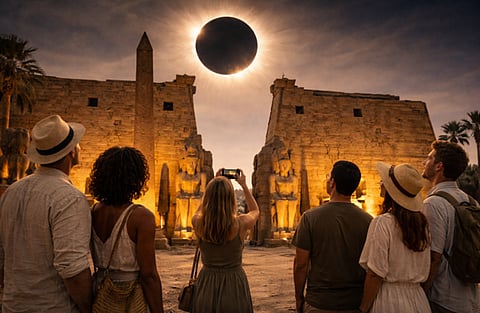
On August 2, 2027, one of the most spectacular astronomical events of the century will unfold directly over Egypt. A total solar eclipse — with a path of totality that passes through Luxor, Aswan, and Abu Simbel — will plunge these ancient sites into darkness for over six minutes, the longest totality duration anywhere on Earth for that eclipse.
For astronomy enthusiasts, Egypt 2027 is already circled on the calendar. For everyone else, this is a rare opportunity to witness a celestial event in one of the world's most dramatically beautiful landscapes. Here is everything you need to understand about solar eclipse Egypt tours 2027, from the science of the event to the practical realities of booking and travel.
A total solar eclipse occurs when the Moon passes directly between Earth and the Sun, casting a shadow — called the umbra — across a narrow band of Earth's surface. Within this path of totality, the Sun's disk is completely obscured, revealing the corona (the Sun's outer atmosphere) in a halo of pale light around the Moon's silhouette.
The 2027 eclipse is exceptional for two reasons. First, the path of totality passes over some of the most accessible and dramatic landscapes in the world: northern Africa, the Red Sea, the Arabian Peninsula. Second, and most significantly, the maximum duration of totality reaches 6 minutes and 23 seconds near Luxor — far exceeding the 2-to-3-minute totalities that most eclipse chasers encounter in a lifetime.
For context, the 2024 total solar eclipse over North America had a maximum duration of about 4 minutes 28 seconds. The 2027 event is nearly two minutes longer, which is extraordinary.
The eclipse path covers parts of Morocco, Spain, Libya, Egypt, Sudan, and Saudi Arabia. Egypt's Upper Nile region — and specifically the city of Luxor — sits near the center of the path and close to the point of maximum duration. This makes it one of the best places on Earth to observe the event.
Beyond the astronomical alignment, Luxor offers a backdrop that no other eclipse location can match. Watching totality from the banks of the Nile, with the columns of Karnak Temple visible in the near distance, is not something that happens at most eclipse events. Aswan and Abu Simbel — further south along the Nile and also within the path — add similarly remarkable settings.
The August timing also means clear skies are statistically very likely. Egypt's summer months see minimal cloud cover over Upper Egypt, making the risk of being clouded out significantly lower than eclipse events in temperate climates.
Eclipse tours are a specialized travel product that combines astronomy programming with conventional sightseeing. For the 2027 event, most solar eclipse Egypt tours will be structured around one or more of the following components:
Positioning at the observation site: Tours handle the logistics of getting participants to a scientifically optimal viewing location within the path of totality, with clear sightlines and away from light pollution.
Astronomy briefings: Many tours include lectures or presentations by professional astronomers or astrophysicists covering the science of the eclipse, what to expect during each phase, and how to observe safely.
Eclipse safety equipment: Certified solar eclipse glasses (ISO 12312-2 compliant) are typically provided. During the brief moment of totality, these are not needed — but they are essential during the partial phases before and after.
Photography guidance: Some tours specifically cater to eclipse photographers, with guidance on camera settings, solar filters, and techniques for capturing the corona.
Sightseeing integration: Tours generally combine the eclipse event with pre- or post-eclipse sightseeing in the region, including Luxor temples, the Valley of the Kings, and Nile cruises.
All three sites offer excellent totality duration, but each has a different character as an eclipse-viewing destination.
Luxor is the most logistically convenient and offers the largest range of accommodation, restaurants, and infrastructure. The city and its surrounding monuments are well-equipped to handle large numbers of visitors. Totality duration here is approximately 6 minutes and 20 seconds.
Aswan, further south, provides a slightly longer totality and a quieter atmosphere. The city's Nubian character, its gardens and islands in the Nile, and the proximity to Philae Temple make it a compelling choice for travelers who want a less hectic experience around the event.
Abu Simbel, near the Sudanese border, is the most dramatic option. The two colossal temples of Ramesses II and Nefertari — already famous for their biannual solar alignment events — will be wrapped in the eclipse shadow. The combination of ancient solar architecture and a total eclipse is arguably unmatched anywhere on the eclipse path. The trade-off is logistics: Abu Simbel is accessible mainly by short flight from Aswan, and accommodation is very limited.
Planning ahead for the 2027 eclipse gives travelers the widest range of choices. Specialized eclipse tours began appearing in the market as early as 2023, and the selection of itineraries, cruise options, and observation experiences has grown considerably since then.
For travelers who want premium options — particularly Nile cruise berths and eclipse-specific tours with expert astronomers, specialized observation positions, and river-facing viewpoints — booking in early-to-mid 2026 gives access to the full range of these experiences. General package tours covering the Luxor and Aswan region are also well worth exploring during this window, as the variety is at its broadest.
Travelers who prefer more flexibility can also explore options closer to the event date, with a wide range of accommodation styles available across Luxor and Aswan to suit different budgets and preferences.
For most international travelers, the eclipse itself justifies the journey to Egypt — but few will want to limit their trip to a single event. The natural structure of a broader Egypt itinerary maps very well onto an eclipse trip.
A two-week itinerary might spend the first few days in Cairo (Pyramids, Egyptian Museum, Islamic Cairo), then fly to Luxor for temple sightseeing and the eclipse event, followed by a Nile cruise to Aswan. Resources like Egy Vacations offer itinerary frameworks that cover this combination in detail — helpful for travelers who want to understand what a realistic two-week Egypt trip looks like around the eclipse window.
Alternatively, travelers who want to position the eclipse as the climax of the trip might spend the first week on a Nile cruise from Aswan northward, arriving in Luxor just before August 2nd for the event, then continuing to Cairo for the final segment.
August in Upper Egypt is hot — genuinely and significantly hot. Temperatures in Luxor and Aswan regularly exceed 40°C (104°F) during the day. The eclipse occurs in the morning (totality is expected around mid-morning local time), which means temperatures are still rising at the moment of the event. This is actually favorable from an observation standpoint: daytime heating drives cloud formation, but in the Egyptian desert, cloud formation is minimal even at peak heat.
Practical considerations for August travel in Egypt:
Hydration is non-negotiable: Carry water at all times during outdoor activities.
Sun protection: Between the ordinary sun and the extreme temperatures, high-SPF sunscreen, hats, and loose long-sleeved clothing are standard.
Early morning scheduling: The eclipse's timing actually favors early risers — an 8–9am totality means the worst afternoon heat is still ahead when the event concludes.
Flexible accommodation with air conditioning: Non-negotiable for August in Upper Egypt. Confirm AC availability before booking.
Looking directly at the Sun during any phase of a solar eclipse other than totality will cause permanent retinal damage. Eclipse glasses (ISO 12312-2 compliant) are required during the partial phases — before and after totality.
During totality itself — and only during totality — it is safe to look at the eclipse with the naked eye. The corona is visible, stars appear, the horizon glows with the colors of a 360-degree sunset, and temperatures drop noticeably. This window lasts up to 6 minutes 23 seconds in 2027 near Luxor.
When the diamond ring effect reappears at the end of totality, eclipse glasses must go back on immediately. Reputable eclipse tours manage this timing carefully, with guides announcing the phases.
The 2027 total solar eclipse over Egypt is a convergence of factors that won't occur again in the same place for generations. A six-minute-plus totality over ancient Nile temples, under statistically clear skies, in a country that offers one of the richest travel experiences in the world — it is, by any measure, one of the most compelling eclipse events in living memory.
Whether you approach it primarily as an astronomical event or as the centerpiece of a broader cultural journey through Egypt, the key is planning ahead. The sites will still be there after the eclipse. The eclipse itself will not.
Inspired by what you read?
Get more stories like this—plus exclusive guides and resident recommendations—delivered to your inbox. Subscribe to our exclusive newsletter
The products and experiences featured on RESIDENT™ are independently selected by our editorial team. We may receive compensation from retailers and partners when readers engage with or make purchases through certain links.