
- Locations
- Interviews
- Luxury Home
- Luxury Lifestyle
- Luxury Travel
- Luxury News
- Events
- More
- Magazine
- Contact Us

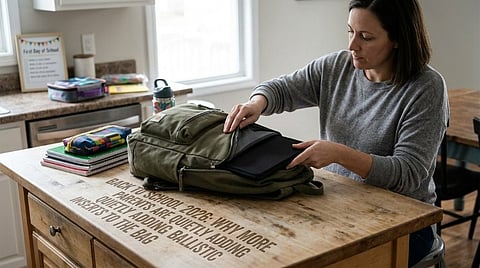
Somewhere between the sneakers and the graphing calculator, a new item has started showing up on back-to-school lists. It does not get announced at the school gate or posted in the class group chat. A parent slides a thin panel into the laptop sleeve of a backpack, zips it shut, and that is the end of it. No drama, no speech. Just one more quiet thing handled before the first bell.
This is not a fringe habit anymore. The body armor market is worth roughly $3 billion in 2026, and the fastest-growing slice of it is not military or law enforcement. It is ordinary civilians buying protection for everyday life. Backpack inserts sit near the center of that shift, largely because they ask so little of the person carrying them.
The notable part is how undramatic the decision has become. For a lot of families, adding a ballistic insert now belongs in the same mental category as a smoke detector or a car seat: something you buy once, hope you never think about again, and do not treat as a statement about how you see the world.
It helps to name what this is and what it is not. It is not a prediction. Nobody installs a smoke detector because they expect a fire tonight. They install it because the cost of being ready is low, the cost of being caught unready is very high, and the two are badly out of balance. Preparedness, at its calmest, is just closing that gap.
A backpack insert fits that logic almost exactly. It weighs about as much as a hardcover book. It does not change how the bag looks or how the day feels. A child carries it to school and back without ever knowing it is there. If the item is never needed, and statistically it almost certainly will not be, nothing has been lost except the price of the panel. That asymmetry is the whole argument, and it is a quieter one than the headlines around it tend to suggest.
Strip away the marketing and a ballistic insert is a flat, semi-rigid panel, usually somewhere between the size of a tablet and a sheet of letter paper. Most are built from woven aramid fibers (the same family as Kevlar) or pressed polyethylene. They slip into the padded laptop compartment of a standard backpack, so there is nothing to strap on, adjust, or explain. Positioned against the back panel, a well-fitted insert sits over the part of the torso that matters most.
Weight and thickness are where the good ones separate from the rest. A quality soft-armor panel runs under a pound and stays thin enough that the bag closes normally. This matters more than it sounds. If an insert is heavy or stiff enough that a kid notices it, plenty of kids will eventually leave the bag behind, and a panel in the hall closet protects no one. The best insert is the one that gets carried every day without a second thought.
This is where a little plain knowledge saves money and prevents mistakes, because the labeling in this category can be confusing, sometimes on purpose.
Body armor is sorted into levels by what it can stop. The dividing line that matters most is soft armor versus hard armor. Soft armor is rated for handgun rounds. Hard armor, which means rigid plates, is rated for rifle rounds and runs much heavier and thicker. For an insert meant to disappear into a school bag, you are almost always looking at soft armor.
Within soft armor, the sensible civilian standard is Level IIIA. In plain terms, a IIIA panel is tested to stop the common handgun calibers, up to and including rounds as powerful as the .44 Magnum, while staying thin and light enough to carry all day. It is the level most people picture when they think of discreet, everyday protection. It is also honest to say what it does not do: soft IIIA armor is not built to stop rifle fire, and no reputable maker claims otherwise. Knowing that boundary is part of buying well. It is a reason to set realistic expectations, not a reason to overspend on rifle plates a child cannot comfortably carry.
If you want to see what a properly specified panel looks like, this line of bulletproof backpack inserts is rated to Level IIIA and sized to drop into a standard bag, which makes it a useful reference point for the weight, thickness, and coverage you should expect before you compare anything else.
One caveat trips up a lot of shoppers, so it is worth stating plainly. The National Institute of Justice, the body that sets these standards, tests and certifies body armor for law enforcement. It does not certify backpacks, blankets, or briefcases. That means a product advertised as an "NIJ-certified bulletproof backpack" is describing something that, as a certification, does not exist. What you actually want is a panel whose ballistic material is independently tested to the Level IIIA standard at an accredited laboratory, with results the maker is willing to show you. The honest brands are specific about their testing. The rest lean on a logo and hope you do not ask.
Finally, mind the total load. A ballistic panel is light, but it is not weightless, and it is going into a bag that already tends to run heavy. The American Academy of Pediatrics recommends a child's backpack stay under 15 percent of their body weight. Add the insert, then weigh the whole packed bag against that number. If you come in over, the fix is fewer textbooks, not a thinner panel.
Parents often worry more about the conversation than the object. The reassuring news is that there does not have to be one. An insert lives in the bag the way a seatbelt lives in the car: present, unremarkable, and effective without anyone having to think about it.
For younger children, most families simply say nothing, and there is nothing evasive about that. For older kids who notice and ask, the calm framing tends to land best: it is a safety feature, like the smoke detector at home, and it is there precisely so nobody has to spend energy worrying. Handled that way, the panel does its job without becoming a source of anxiety, which is the entire point of buying one.
None of this is about living braced for the worst. It is closer to the opposite. Families adding a ballistic insert are not more frightened than anyone else. They have found a way to set one worry down, quietly, for roughly the price of a good backpack, and then get back to the ordinary business of the school year: the permission slips, the growth spurts, the lost water bottles.
Bought once, zipped in, and mostly forgotten. That is exactly what a good safeguard is supposed to be.
Inspired by what you read?
Get more stories like this—plus exclusive guides and resident recommendations—delivered to your inbox. Subscribe to our exclusive newsletter
The products and experiences featured on RESIDENT™ are independently selected by our editorial team. We may receive compensation from retailers and partners when readers engage with or make purchases through certain links.