
- Locations
- Interviews
- Luxury Home
- Luxury Lifestyle
- Luxury Travel
- Luxury News
- Events
- More
- Magazine

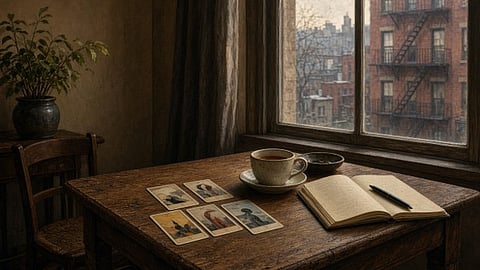
This summer, one of New York’s most serious research libraries put playing cards at the center of its galleries. From June 26 to October 4, 2026, the Morgan Library & Museum ran “Tarot! Renaissance Symbols, Modern Visions,” an exhibition that brought its fifteenth-century Visconti-Sforza cards together with the portion of the same deck held by the Accademia Carrara in Bergamo. In a city that sells wellness in every possible format, from infrared saunas to sound baths, it was telling that a major museum treated tarot as a subject worth a full exhibition.
The interest is not limited to art lovers. A Pew Research Center survey conducted in October 2024 found that nearly a quarter of Americans aged 18 to 29 consult tarot cards at least once a year, compared with 11% of all adults and just 3% of those 65 and older. Among LGBT adults the share reached 33%. Pew noted that these practices have built their own social media cultures, especially since the pandemic.
Online, the framing has shifted from fortune-telling toward reflection. AstriOnLine, a site covering astrology, tarot and numerology, describes its tarot section as “one question, one spread, a mirror of images for exploring the situation you are living through.” That language, a mirror rather than a crystal ball, is close to how many New Yorkers now talk about the cards.
The city has a deeper connection to modern tarot than most people realize. Pamela Colman Smith, the artist who drew the deck now known as the Rider-Waite-Smith tarot, enrolled at the newly founded Pratt Institute in Brooklyn in 1893, at the age of 15. In 1909 the occultist Arthur Edward Waite commissioned her to illustrate his deck, and she completed the artwork in about six months. Her scenes, with figures on every card including the numbered ones, became the template for countless decks that followed.
Today the barrier to entry is close to zero. A free tarot reading on AstriOnLine asks only for a name or a pseudonym and a question, then offers six spreads, from a two-card yes-or-no layout to a five-card general reading. The page even warns users not to type health, financial or legal details into the question field, and it is clear that the result is generated by the tool, not an individual session with a card reader.
A facial or a massage happens to you. A tarot spread asks you to do some work. You choose a question, look at the images and decide what they bring up. For people who find traditional meditation slippery, the cards supply a focus: something to look at while thinking about a decision, a relationship or a stuck project.
The traditional meanings leave room for interpretation, and good readers use that room. AstriOnLine’s guide gives a clear example with the Tower, a card many beginners fear. It does not automatically signal disaster, the site explains; it can represent the collapse of a belief, a sudden revelation or a structure that can no longer support change. Read that way, a “bad” card becomes a prompt for an honest question rather than a threat.
Part of the appeal is that the format bends to the question. On AstriOnLine, the three-card love reading looks at your point of view, the other person’s and the direction of the relationship, while explicitly declining to give the cards certainty about someone else’s feelings. The work-and-money spread links an opportunity, a risk and a next step, with a reminder that it does not replace verifiable data or professional advice. That kind of built-in modesty is exactly what a wellness-minded reader wants.
The Morgan holds 35 of the surviving Visconti-Sforza cards, made in Milan between about 1450 and 1480, when the Visconti and Sforza families ruled the duchy. These were luxury objects, gilded and hand-painted, made for card games long before tarot became linked with divination. The 2026 exhibition traced that journey, from courtly game to occult symbol to source material for twentieth-century artists such as André Breton, Remedios Varo and, more recently, Chris Ofili.
Smith herself went largely uncredited for decades, often reduced to a footnote in Waite’s story. Pratt Institute has since mounted an exhibition on her life and work, and The New York Times included her in its “Overlooked” obituary series. Her career went far beyond tarot: she illustrated books, designed for the theater, ran a small press and, according to Pratt, was the first non-photographer to exhibit at Alfred Stieglitz’s Gallery 291 in Manhattan.
Readers and guides agree on one thing: the question shapes the reading. Open questions such as “what should I understand before deciding?” tend to be more useful than “will it definitely happen?” Writing the question down before drawing keeps you from adjusting it to fit whatever appears. It also helps to narrow the theme: guides such as AstriOnLine’s point out that questions that are too broad produce generic readings, while a precise wording makes the symbols easier to connect to real life.
It is tempting to shuffle again when a spread disappoints. AstriOnLine’s FAQ advises against it, noting that repeating a draw until you get an answer you like makes the reading less useful. Better to note the first spread, think about it, and return when the situation has actually changed.
Tarot offers no proof and no certain predictions, and it is not therapy. Used for reflection, it can help sort out feelings and options; for medical, legal or financial decisions, a professional is the right call. AstriOnLine’s tarot page closes on the same note, reminding readers that the reading is symbolic and that “the decisions are always yours.”
Part of tarot’s appeal in New York is portability. It needs no appointment, no membership and no special room, just a deck or a browser tab and ten quiet minutes. The cards themselves are more than five centuries old, yet the way people use them now, as a structured pause for thinking, suits a city that rarely slows down. Whether you meet them in a museum case on Madison Avenue or on your phone, the images still ask the same thing: what are you actually trying to figure out?
Inspired by what you read?
Get more stories like this—plus exclusive guides and resident recommendations—delivered to your inbox. Subscribe to our exclusive newsletter
The products and experiences featured on RESIDENT™ are independently selected by our editorial team. We may receive compensation from retailers and partners when readers engage with or make purchases through certain links.