
- Locations
- Interviews
- Luxury Home
- Luxury Lifestyle
- Luxury Travel
- Luxury News
- Events
- More
- Magazine

Most supplement reviews either sell hard or pick a product apart. This one tries to do neither: it lists exactly what is in each scoop, checks each ingredient against the research, and shares what customers actually say, including the lukewarm reviews.
A note on who is writing: this RestEase review is published by RestEase. That is a reason to be skeptical, so every claim below names its source (all listed at the end), the customer quotes are copied word for word, and the limits get as much space as the benefits. The sections answer the common questions in turn: what is in RestEase Sleep Powder, the RestEase ingredients and their evidence, does RestEase work, RestEase side effects, and is RestEase worth it.
Its main ingredients, ashwagandha, magnesium, L-theanine and chamomile, have modest research support for sleep quality and stress. Zinc and reishi have much less. Customers mostly describe a calmer, more consistent wind-down rather than instant sleepiness, and some notice little change. It suits people whose sleep trouble is stress and a busy mind at night.
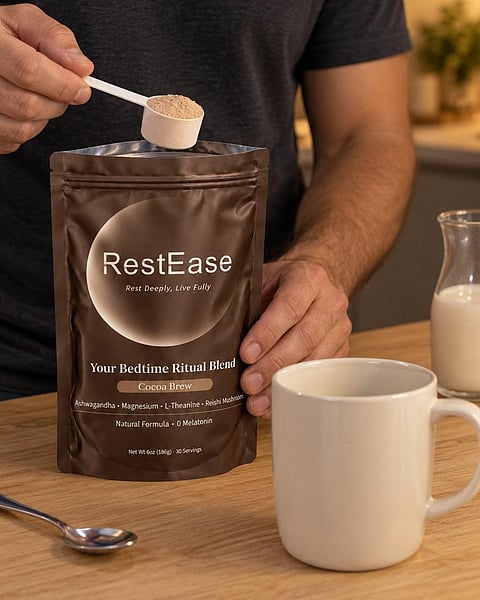
One scoop of RestEase Cocoa Brew stirs into warm water or milk, so it works more like a bedtime drink than a pill.Alt text: Man lifting a scoop of RestEase Cocoa Brew powder from a brown pouch beside an empty white mug and a small jug of milk on a wooden counterPhoto: RestEase
RestEase Sleep Powder is a drink mix that comes in a resealable pouch of 30 servings. One scoop goes into warm water or milk before bed. It comes in three flavors, Lavender, Cocoa and Berry, and is sweetened with monk fruit and stevia, so a serving has 20 calories and no sugar. It contains no melatonin and no caffeine.
Here is the full formula from the Supplement Facts label on the product page:
That is a fuller formula than many sleep powders. It also means six active ingredients, which matters if you already take any of them separately.
The RestEase ingredients fall into two groups: four with human trials behind them for sleep or stress, and two where the evidence is still early.
Ashwagandha has the strongest sleep research of the six. A 2021 meta-analysis of 5 trials and 400 adults found a small but significant benefit for overall sleep, larger at 600 mg a day or more and after 8 weeks or longer. In a 2019 trial of 60 adults with insomnia, 300 mg twice a day for 10 weeks improved sleep quality and time to fall asleep compared with placebo. Extracts differ between products, so results from one study do not transfer exactly.
The evidence for magnesium is real but thin. A 2021 review pooled 3 small trials in 151 older adults and found people fell asleep about 17 minutes faster with magnesium, but rated the evidence as low quality. Glycinate is a gentle form that is less likely to upset the stomach.
L-theanine is an amino acid from tea leaves. In a 2019 trial, 30 adults taking 200 mg a day, the same amount as one scoop, reported better sleep quality and lower stress after 4 weeks than with a placebo. It is not a sedative, which fits what customers describe.
A 2019 meta-analysis of 12 trials found chamomile improved sleep quality. The one trial that looked at insomnia itself found no significant change, so chamomile is best seen as a gentle aid rather than a treatment.
These two have the least support for sleep. A 2017 review describes how zinc may influence sleep, but most of that work is in animals and observational data, so it is early. Zinc itself is an essential mineral with a clear role in the body, and 10 mg sits well under the 40 mg daily upper limit set by the NIH Office of Dietary Supplements.
Reishi is a mushroom with a long history in traditional Chinese medicine. A scientific overview of reishi notes that human research is limited, and claims about sleep come mostly from animal studies. Treat both as supporting ingredients rather than the reason to buy.
Does RestEase work? Based on the research above, the honest expectation is a gradual, modest effect on how calm you feel at night and how easily you drift off. Customer reviews line up with that. The quotes below are copied exactly as customers wrote them.
"I don't get instantly sleepy or anything, but about 30 mins later I usually notice I'm not as restless. subtle, but OK"Customer review: actually pretty calming"wanted something that didn't make me feel sedated. this is more gradual and that works better for me."Customer review: good without feeling heavy
"once I make this I stop checking work stuff. maybe half the benefit is the routine, but either way it helps me chill out."Customer review: nice little reset"I coach clients until 8 or 9 some nights, so I'm tired but still wired when I get home. RestEase has been a nice way to slow things down without feeling heavy the next morning."Customer review: helps me come down after late sessionsWhat RestEase Does Not Do
A fair RestEase review has to include the limits. It will not override a sleep disorder, a late coffee, or a bedroom that is too warm. Some customers are clear about this:
"Keeping this realistic, I absolutely still have nights where I wake up at 3 AM. RestEase hasn't erased that. I do feel like getting to sleep is easier though, and I'm less restless at the beginning of the night."Customer review: I still wake up sometimes"I felt nothing on my sleep, but mornings become more clear for me"Customer review: cut off the morning coffee"I think wellness products get overhyped really easily. This hasn't transformed my entire existence. What it has done is make bedtime calmer, more consistent and honestly a little nicer. That's enough for me."Customer review: not life changing, just genuinely helpful
Many customers describe the effect as gradual: less restless at the start of the night rather than suddenly sleepy.Alt text: Woman sitting up in bed under a white duvet reading a book in a warmly lit bedroomPhoto: cottonbro studio / Pexels
Taste decides whether people keep using a nightly drink, and it comes up often in reviews. The Cocoa flavor is popular with warm milk, and Berry surprised at least one skeptic:
"Berry sounded like the flavor I'd like least because I usually hate fake berry anything. It's actually pretty mellow. Not super fruity, not super sweet. I ended up finishing that pouch first."Customer review: Berry won me over
For people who dislike capsules, the drink format is the main draw:
"I'm terrible at swallowing supplements and eventually stop taking anything that feels medicinal. Drinking something before bed feels much easier for me to stick with."Customer review: good for people who hate pills
On packaging, one reviewer liked that the pouch reseals well but felt the shipping box was bigger than it needed to be. Mix one scoop into a mug of warm water or milk about 30 to 60 minutes before bed, and give it at least 2 to 4 weeks, since most of the ingredient studies ran for a month or longer.
The doses in RestEase are in the range used in studies, and the trials above reported mostly mild side effects, such as an upset stomach or drowsiness. Still, RestEase side effects depend on the person, and some people should check with a doctor first:
Pregnant or breastfeeding: ashwagandha is not recommended, according to the NIH Office of Dietary Supplements.
Liver problems: rare cases of liver injury have been linked to ashwagandha supplements.
Thyroid conditions: ashwagandha may raise thyroid hormone levels.
Prescription medicines: especially sedatives, thyroid medicine, or drugs that suppress the immune system.
Other zinc or magnesium supplements: add up your totals so you stay under the daily upper limits.
Ragweed or daisy allergy: chamomile is in the same plant family.
Stop taking it and talk to a doctor if you notice yellowing skin or eyes, dark urine, or unusual tiredness. RestEase is not habit-forming and contains no melatonin, so there is no hormone to wean off.
A pouch of 30 servings costs $64.99 as a one-time purchase, about $2.17 a night. With a monthly subscription, it is $44.99, about $1.50 a night, and the subscription can be skipped or cancelled. The product page also lists a 30-day money-back guarantee.
So is RestEase worth it? That depends on what you compare it to. Buying ashwagandha, magnesium glycinate and L-theanine as separate capsules can cost less, but means several pills a night. RestEase is worth it mainly if you want those ingredients in one drink you will actually take, and if a warm bedtime ritual appeals to you. One customer put the value simply:
"I grew up with warm drinks being a whole comfort thing. This fits that vibe perfectly."Customer review: Cocoa + warm milk is eliteThe Writer's Take: Why RestEase Earns Its Place on the Nightstand
After going through the label, the studies and every customer review in this article, the overall picture is a positive one. RestEase does what a good evening supplement should do. It uses ingredients with real research behind them, at doses close to the ones studied, and it skips the shortcuts.
Three things stand out. First, the formula is thoughtful. The 600 mg of ashwagandha sits right at the dose where the 2021 meta-analysis saw the clearest benefit, and 200 mg of L-theanine is the same amount used in the 2019 trial. Second, it is melatonin-free, so it supports the body's own wind-down instead of adding a hormone, and several customers point out that they wake up without feeling heavy or sedated. Third, it is easy to keep taking. A warm, sugar-free drink in three flavors turns a supplement into a ritual, and the reviews suggest that ritual is a big part of why people stick with it.
The honest caveat actually makes the case stronger. RestEase is gentle: it calms the evening rather than forcing sleep. For anyone whose nights are cut short by stress and a mind that will not switch off, that is exactly the right kind of help. It is a well-made, carefully dosed product that people enjoy using night after night, and that is why this review lands firmly on the positive side.
Best for stress-related restlessness at bedtime, for people who want to wake up clear-headed, and for anyone tired of swallowing capsules.
The easiest way to start the ritual is the RestEase Sleep Welcome Kit, which pairs the sleep blend with a frother, a mug and an eye mask for the full wind-down.
This RestEase review comes down to fit. RestEase Sleep Powder is a good match if:
Stress, a racing mind or a late, busy evening keeps you from winding down.
You want to avoid melatonin and next-day grogginess.
You prefer a warm drink to swallowing capsules.
The same RestEase review logic works in reverse. It is probably not the right choice if you want to feel sleepy within minutes, if you have signs of a sleep disorder such as loud snoring or gasping at night, or if you already take several of these ingredients. Sleep that stays poor for three months or more is worth raising with a doctor, whatever you try at home.
If a calmer, melatonin-free evening sounds like what your nights are missing, explore the full RestEase range. Shop RestEase
For many people, yes, but gently. Its main ingredients have modest research support for sleep quality and stress. Customers most often describe feeling less restless at night and winding down more easily, while some notice little change.
Each scoop has 600 mg ashwagandha root extract, 300 mg chamomile flower extract, 200 mg magnesium as magnesium glycinate, 200 mg L-theanine, 200 mg reishi mushroom extract and 10 mg zinc as zinc glycinate. It is sweetened with monk fruit and stevia and has no melatonin or caffeine.
No. RestEase is melatonin-free, so it does not add any sleep hormone.
Side effects are usually mild, such as an upset stomach or drowsiness. People who are pregnant or breastfeeding, have liver or thyroid conditions, or take prescription medicines should check with a doctor before using it.
Some people feel calmer within 30 to 60 minutes of a serving. Most of the research on its ingredients ran for 4 to 10 weeks, so give it at least 2 to 4 weeks of nightly use before judging.
It costs about $2.17 a night, or about $1.50 with a subscription. It is worth it if you want several calming ingredients in one bedtime drink. Separate capsules can cost less if price matters most.
Yes, it is designed for nightly use and is not habit-forming. Check with a doctor first if you take medication or plan to use it for many months.
Cheah KL, et al. (2021). Effect of ashwagandha (Withania somnifera) extract on sleep: a systematic review and meta-analysis. PLoS One. PubMed ID 34559859
Langade D, et al. (2019). Efficacy and safety of ashwagandha (Withania somnifera) root extract in insomnia and anxiety: a double-blind, randomized, placebo-controlled study. Cureus. PubMed ID 31728244
Mah J, Pitre T (2021). Oral magnesium supplementation for insomnia in older adults: a systematic review and meta-analysis. BMC Complementary Medicine and Therapies. PubMed ID 33865376
Abbasi B, et al. (2012). The effect of magnesium supplementation on primary insomnia in elderly: a double-blind placebo-controlled clinical trial. Journal of Research in Medical Sciences. PubMed ID 23853635
Hidese S, et al. (2019). Effects of L-theanine administration on stress-related symptoms and cognitive functions in healthy adults: a randomized controlled trial. Nutrients. PubMed ID 31623400
Hieu TH, et al. (2019). Therapeutic efficacy and safety of chamomile for state anxiety, generalized anxiety disorder, insomnia, and sleep quality: a systematic review and meta-analysis of randomized trials and quasi-randomized trials. Phytotherapy Research. PubMed ID 31006899
Cherasse Y, Urade Y (2017). Dietary zinc acts as a sleep modulator. International Journal of Molecular Sciences. PubMed ID 29113075
Wachtel-Galor S, et al. (2011). Ganoderma lucidum (Lingzhi or Reishi): a medicinal mushroom. In: Herbal Medicine: Biomolecular and Clinical Aspects, 2nd edition. CRC Press / Taylor and Francis. ncbi.nlm.nih.gov/books/NBK92757
NIH Office of Dietary Supplements. Ashwagandha: fact sheet for health professionals. National Institutes of Health. ods.od.nih.gov/factsheets/Ashwagandha-HealthProfessional
NIH Office of Dietary Supplements. Zinc: fact sheet for health professionals. National Institutes of Health. ods.od.nih.gov/factsheets/Zinc-HealthProfessional
Inspired by what you read?
Get more stories like this—plus exclusive guides and resident recommendations—delivered to your inbox. Subscribe to our exclusive newsletter
The products and experiences featured on RESIDENT™ are independently selected by our editorial team. We may receive compensation from retailers and partners when readers engage with or make purchases through certain links.