
- Locations
- Interviews
- Luxury Home
- Luxury Lifestyle
- Luxury Travel
- Luxury News
- Events
- More
- Magazine
- Contact Us

The starry sky ceiling has moved beyond novelty status, entering the specification vocabulary of architects and designers working across high-end residential and hospitality projects.
Current installations use fiber optic strands and LED modules set into a seamless stretch membrane, producing a field of light against a flawless surface with no seams or imperfections.
Membrane finish, star density, twinkling behavior, and constellation mapping are all fully customizable, with smart home integration now standard in most professional-grade systems.
The most considered installations treat the ceiling as an experiential element from the outset of design, not as a finishing decision applied after the room takes shape.
The ceiling is having a long-overdue moment. After decades as the most reliably ignored surface in the room, painted white, left flat, expected to recede, a growing number of designers and the clients who trust them are treating the overhead plane with the same intention they bring to a stone floor or a plaster wall. The starry sky ceiling sits at the forward edge of that shift, and its presence in serious interiors signals something worth paying attention to.
This is not, to be clear, a trend driven by novelty. The impulse behind a star ceiling system in a well-designed room is the same one that drives any considered material choice: the belief that the space should produce a particular feeling, and that the ceiling is part of producing it. What has changed in recent years is the technology's ability to deliver on that intent with genuine craft, and the design community's willingness to treat it accordingly.
Interior design at the top of the residential market has been moving toward what designers sometimes call experiential architecture: spaces built not around objects but around states of feeling. A room designed for stillness behaves differently from a room designed for entertainment, even when the furniture is similar. The ceiling is one of the last surfaces to be brought into that conversation, and the star ceiling represents one of the more resolved ways to do it.
The appeal connects to something broader about how high-net-worth clients are approaching their homes. The idea of a room that rewards presence, that changes character when the lights dim, that offers something different to the person lying in bed at midnight than it does at noon, has become a genuine design priority rather than an amenity checklist item. A star ceiling is the overhead equivalent of a fireplace: it does not need to be on to matter, but when it is, it changes everything about being in the room.
The construction behind a starry sky stretch ceiling is worth understanding, not because the mechanics are interesting in themselves, but because they explain why the best installations look the way they do. Thousands of fiber optic strands and LED modules are integrated into a seamless stretch membrane, which is tensioned across the ceiling opening to create a continuous, flawless surface. There are no suspended tiles, no grid lines, no fixing points visible from below, just a field of calibrated light against an unbroken plane.
The membrane finish is a meaningful design decision. Glossy options amplify the depth of the star field, creating a mirror-like quality that makes the ceiling read as infinite. Matte and satin finishes diffuse the light more softly and tend to work better in spaces where the ceiling will be experienced in varying light conditions. The density of the star field, the distribution of brighter anchor points among finer surrounding stars, and the quality of the twinkling effect, produced by a rotating element within the light source, all determine how convincingly the ceiling reads as sky rather than as a pattern.
Modern star ceiling lighting integrates with home automation platforms. Scenes can be programmed, color temperature shifted between warm amber and cool blue-white, and constellation patterns customized to specific astronomical coordinates. The ability to map a star ceiling to the night sky above a particular location on a particular date has become one of the more requested personalizations in high-end residential design: a child's birthdate, a wedding anniversary, the coordinates of a second home.
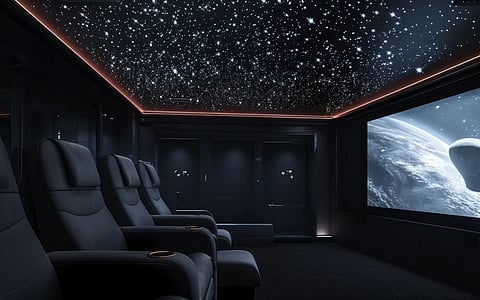
The private home theater was the category's original territory, and it remains its most intuitive application. A contained, light-controlled room with a night sky ceiling overhead transforms the ceiling from a structural necessity into an experiential element that extends the environment beyond the screen. The effect holds even when the projector is off.
Master bedrooms have become equally significant. The ceiling is what a person lying in bed actually sees, and the star ceiling delivers the kind of overhead depth that changes the quality of a room at night in a way that no other finish does. The best residential applications in bedroom contexts are quieter than theater installations, lower density, softer twinkling, warm color temperature, calibrated for stillness rather than spectacle.
Spa rooms and private bath suites have followed, particularly where the stretch membrane's moisture resistance makes it a practical fit as well as an aesthetic one. The hospitality sector has taken notice as well: hotel suites, private dining rooms, and VIP lounges across New York, Miami, and London have incorporated star ceiling systems as signature elements, ones that photograph well on arrival and hold their effect on return visits, which is not something that can be said of most trend-driven finishes.
Among the specialists working at this level of the category, NYCeiling has built a focused practice around custom starry sky stretch ceiling installation for both residential and commercial projects. Their Stars system supports full customization across membrane finish, star density, and dynamic lighting effects including galaxy patterns and constellation mapping, and accommodates both new construction and retrofit applications, the latter an important consideration for renovation projects where ceiling access is limited.
The most common mistake in this category is treating the star ceiling as a finishing decision, something added after the room's design is otherwise resolved. The installations that succeed are those where the ceiling was part of the design intent from the beginning, with star density calibrated to ceiling height, membrane finish selected alongside the room's palette, and smart home integration coordinated during the electrical rough-in rather than retrofitted around it.
Ceiling height matters more than most clients anticipate. A nine-foot ceiling and a fourteen-foot ceiling require fundamentally different configurations to produce a comparable effect at viewing distance. The relationship between density, point size, and height is something a skilled installer addresses at the specification stage; it should not be left to field judgment on installation day.
The spaces that earn a star ceiling are the contained ones: rooms with a clear experiential purpose, where the overhead view is part of the room's function. A star ceiling in a suite with floor-to-ceiling city views competes with itself. The same system in a light-controlled bedroom or a private theater works with the room rather than against it. The question worth asking before specifying is not whether a star ceiling would be impressive, it would be, but whether the room is designed to hold it.
There is a specific pleasure in a room that delivers something unexpected when the lights go down. Not unexpected in a theatrical sense, but in the sense that the space reveals more of itself than its daytime version suggested. The star ceiling is one of the more honest ways to achieve that, it does not pretend to be anything other than what it is, and what it is, executed with care, is genuinely difficult to improve upon.
The trend toward treating the ceiling as a designed surface is not going to reverse. The question for any given project is how far to take it, and for which room. For the ones where the answer is a sky overhead, a private theater, a bedroom built for rest, a spa designed to make time pass differently, the star ceiling remains one of the more resolved choices available at this level.
Inspired by what you read?
Get more stories like this—plus exclusive guides and resident recommendations—delivered to your inbox. Subscribe to our exclusive newsletter
The products and experiences featured on RESIDENT™ are independently selected by our editorial team. We may receive compensation from retailers and partners when readers engage with or make purchases through certain links.