
- Locations
- Interviews
- Luxury Home
- Luxury Lifestyle
- Luxury Travel
- Luxury News
- Events
- More
- Magazine
- Contact Us

Buying an impact socket set online sounds simple until you realize how many options exist and how easy it is to choose the wrong one. The wrong set can strip fasteners, crack under pressure, or simply not fit your tools. Before you add anything to your cart, it pays to slow down and think through what you actually need. These five considerations will help you make a smarter purchase, save money in the long run, and avoid the frustration of a set that fails you on the job.
Drive size is one of the first things to check before you buy any impact socket set. Impact wrenches come in different drive sizes, and not every socket set will be compatible with your tool. The most common drive sizes are 1/4 inch, 3/8 inch, 1/2 inch, and 3/4 inch. Each serves a different purpose, and choosing the wrong one means the sockets simply will not fit your wrench.
Your impact wrench has a specific drive size built into its design, and your socket set must match it exactly. A 1/2-inch drive wrench, for example, is the standard choice for most automotive work, heavy-duty repairs, and lug nut removal. A 3/8-inch drive works better for lighter mechanical tasks. If you own multiple impact wrenches, look for a set that includes drive adapters or consider buying separate sets for each tool.
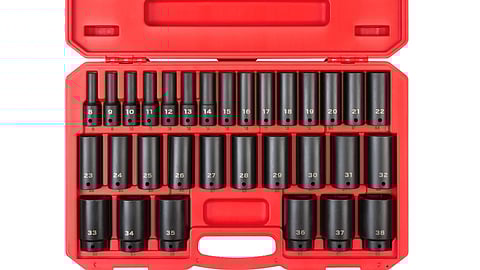
Beyond drive size, also think about the socket range included in the set. A good set covers a wide spread of sizes, from smaller sockets for tight spaces to larger ones for heavy fasteners. A 6-point hex socket kit is worth prioritizing here, since the 6-point design grips fasteners more evenly and reduces the chance of rounding off hex heads under high torque. This matters especially in professional settings where stripped bolts are a real productivity issue.
Impact sockets face forces that regular hand-tool sockets simply are not built for. Standard chrome-vanadium sockets can shatter or crack under the repeated shock and torque of an impact wrench. For impact use, you need sockets made from chrome-molybdenum steel, often labeled as Cr-Mo or CR-MO. This material absorbs high-torque impacts without fracturing, which makes it the industry standard for professional-grade impact tools.
The finish on the socket also matters more than people expect. Most impact sockets come with a matte or black phosphate finish rather than a shiny chrome one. That matte finish resists corrosion, reduces glare in work environments, and is generally more practical for shop use. Chrome-finished sockets may look appealing in a product photo, but they are not designed for repeated impact use.
Wall thickness is another factor to consider. Impact sockets are thicker than standard sockets because that extra material is what allows them to withstand high torque without deforming. If a set looks unusually thin or lightweight for impact use, that is a sign the material quality may not meet the demands of real work. Read product specifications carefully before you buy, and compare wall thickness values across different sets when possible.
One of the most common mistakes people make when they buy a socket set online is ordering the wrong measurement standard. SAE (Society of Automotive Engineers) sockets are measured in fractions of an inch, while metric sockets are measured in millimeters. Depending on what you work on, you may need one or the other, or both.
Vehicles manufactured in the United States have traditionally used SAE sizing, while most vehicles from Asia and Europe use metric fasteners. In practice, but, many modern vehicles use a mix of both. If you work on a variety of cars, trucks, or equipment, a combo set that includes both SAE and metric sizes gives you more flexibility without requiring you to buy two separate kits.
For industrial and construction applications, metric tends to dominate in most parts of the world outside the US. If you are unsure which standard applies to your specific work, look at the fasteners you use most often or check the equipment manual. Buying the wrong standard is a frustrating and avoidable mistake. Many online listings clearly label sets as SAE, metric, or combination, so take a moment to confirm this detail before checkout.
The number of pieces in an impact socket set can range from as few as 10 to well over 100. More pieces do not always mean better value. A 40-piece set that covers the sizes you actually use is far more practical than a 100-piece set filled with sizes you rarely touch. Focus on what your specific work demands rather than chasing the largest number on the label.
Storage organization matters more than most people realize, especially when you work in a shop or on job sites. A set that comes with a well-designed case or tray keeps sockets organized, makes it easy to spot a missing piece, and protects the sockets from dirt and damage between uses. Look for sets where each socket has a dedicated slot, so you always know at a glance whether the set is complete.
Pay attention to how the storage solution is built. Plastic trays vary widely in quality. A flimsy tray that lets sockets fall out or cracks after a few drops, will cause you more problems than it solves. Some sets come with rail-style storage instead of a case, which can be easier to mount on a tool cart or pegboard. Consider your workspace setup and choose storage that fits how you actually work.
Not all socket sets are created equal, and price alone is a poor indicator of quality. Brand reputation gives you a reliable signal about what you can expect from a set before it arrives at your door. Look for brands with a proven track record in professional and trade environments. User reviews from verified buyers are a useful source of real-world feedback, especially reviews from people who describe using the set in demanding conditions.
Warranty coverage is a direct reflection of how much confidence a manufacturer has in its own product. A lifetime warranty tells you the company stands behind the materials and construction. A 90-day or one-year warranty may indicate lower confidence or lower-quality components. Before you buy, locate the warranty information on the product page and read the terms carefully. Some warranties cover defects only, while others cover breakage under normal use.
Also consider post-purchase support. If a socket cracks or a size is missing from the set, how easy is it to get a replacement? Some brands offer individual socket replacements, which is a practical advantage over brands that only sell complete sets. A strong warranty backed by accessible customer support adds real, long-term value to your purchase.
Choosing the right impact socket set online does not have to be a guessing game. Focus on drive size compatibility, material quality, the measurement standard your work requires, practical set size with solid storage, and a brand that backs its product with a meaningful warranty. Take these five factors seriously, and you will land on a set that serves you well for years to come.
Inspired by what you read?
Get more stories like this—plus exclusive guides and resident recommendations—delivered to your inbox. Subscribe to our exclusive newsletter
The products and experiences featured on RESIDENT™ are independently selected by our editorial team. We may receive compensation from retailers and partners when readers engage with or make purchases through certain links.