
- Locations
- Interviews
- Luxury Home
- Luxury Lifestyle
- Luxury Travel
- Luxury News
- Events
- More
- Magazine
- Contact Us

Modern fabrication can copy the look of almost any natural material. High-resolution imaging, large-format printing, advanced surface treatments — all of these can produce panels that are hard to tell apart from natural stone in a photograph. But in an actual room — under changing light, across distance, over time — the difference is immediately clear.
The reason is not visual similarity. It is behavior. The eye does not read surfaces as fixed images. It reads them as fields that interact with light and shift as conditions change. Manufactured surfaces reproduce appearance at one moment. They cannot reproduce what happens to a material system as light moves across it throughout the day.
Natural stone resists what might be called visual closure — the point where the eye has fully processed a surface and moves on. The variability built into its geological structure means there is always more to read. This is not a decorative quality. It is a condition of how the material formed.
The absence of repetition in natural stone is not a design decision. It is a consequence of formation. Granite develops its mineral structure through the slow crystallization of magma. Pressure and temperature shift continuously throughout that process. The result is a material whose internal arrangement — quartz, feldspar, mica, and other minerals — follows no repeating logic. Each slab cut from the same block differs from the next.
This matters because the brain is highly efficient at detecting patterns. When a surface repeats — even subtly — the brain registers it and categorizes the surface as manufactured. The process is largely automatic. When a surface does not repeat, the brain keeps engaging with it, looking for organizing logic. In natural stone, that logic does not exist in the conventional sense. The variability is systemic, but it is not patterned in a way the visual system can quickly resolve.
Surfaces that resist quick resolution hold attention differently. The effect is below conscious awareness, but it is consistent. It accumulates across the experience of a space.
Manufactured surfaces introduce controlled variation within a defined range. The result appears varied, but the underlying system that generates the appearance is finite. This produces a different perceptual structure — and that difference shapes how a space feels over time.
The sense of depth in polished stone is not a visual trick. It comes from how light physically interacts with the material at multiple levels at once.When light strikes a polished manufactured surface, it reflects from the top layer. The interaction is essentially two-dimensional. The eye receives information from one plane. Certain natural stones exhibit these optical properties particularly clearly. Volga Blue granite, for example, contains labradorite minerals capable of producing directional iridescent effects under changing light conditions.
Polished natural stone works differently. Light enters the surface and interacts with the material at varying depths before returning to the eye. The crystalline structure scatters light internally. That scattering varies across the surface depending on the mineral composition at each point. The eye receives information from multiple depths at once. The result is a sense of volume within the material — not on top of it.
This is what people often describe, imprecisely, as stone appearing to "glow" or have "depth." The description is accurate even if the mechanism is rarely explained. The surface produces visual information from within itself. That information changes as light angle and intensity change.
A large stone surface does not behave as a backdrop the way a uniform reflective surface does. It takes part in the light environment of the room. And that participation shifts throughout the day.
A stone surface at eight in the morning is not the same surface at midday. Neither is the same as it appears at dusk. This is not a metaphor. The visual information the surface produces actually differs across these conditions.
Low-angle morning light enters at an oblique angle. It picks up surface relief and mineral orientation in ways that direct overhead light does not. Veining looks more three-dimensional. Crystalline structures that are nearly invisible under flat light begin producing micro-reflections. These shift as the observer moves through the space.
At midday, with more direct light, the surface reads quieter. Internal reflections are more subdued. In the evening, under warm artificial sources, the color temperature shifts. Elements of the mineral structure that were less visible during the day may come forward.
A stone surface is never fully known from a single viewing. It keeps producing new visual configurations as conditions change. The surface appears to move — not literally, but in the sense that it is never static the way a painted wall is static.
Some stones carry this further through phenomena that have no equivalent in manufactured surfaces. Labradorescence is produced by light interference within layered internal structures. The color the observer sees depends on the angle of observation and the angle of incoming light. Change either, and the color changes. The surface has no fixed appearance. It has a range of appearances that the observer moves through.
This is perceptual instability in a specific and architecturally interesting sense. The surface refuses to settle into one visual state. Each position in the room, each time of day, each shift in the observer's angle produces a different result. The eye reads this not as inconsistency but as behavior — the surface appears to respond to the surrounding environment.
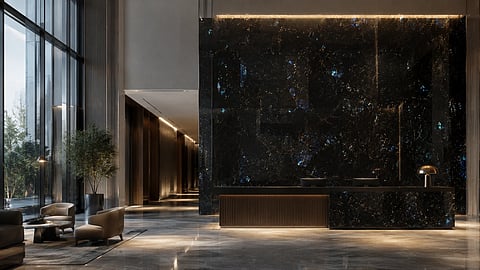
Large-format surfaces in stones such as Volga Blue granite — where labradorescent minerals are distributed across continuous slabs — show how this instability works at architectural scale. A kitchen island where the horizontal surface extends into vertical planes without interruption creates a material field that shifts as the observer moves around it. The iridescent response varies across the surface depending on angle and light. The material is not decorative in the usual sense. It is spatially active.
Surfaces with genuine optical instability contribute to spatial experience in ways that cannot be fully specified in advance. The behavior comes from the material's geological structure. It keeps unfolding across the life of the building.
These optical behaviors become meaningful at scale. A small sample in a material library gives little indication of how the stone will behave across an entire floor or wall.
At architectural scale, continuity becomes a perceptual condition of its own. A surface that reads as an uninterrupted field allows the stone's depth, variability, and light response to work across the whole plane. Grout lines, joints, and transitions interrupt this. Each interruption is a boundary the eye registers. Each registered boundary reduces how fully the surface functions as a unified optical field.
Large-format slabs minimize necessary seaming. The floor or wall is perceived not as a collection of pieces but as a single material presence. This changes how the space itself is read. A continuous surface becomes part of the spatial geometry — not a treatment applied within it.
The same applies when stone crosses planes. When a horizontal surface continues into a vertical one without transition, the eye stops registering a material and starts registering an environment. This is where stone moves from finish to architecture.
Engineered surfaces are designed for consistency. The goal is visual uniformity — predictable, stable, repeatable. This serves real purposes. It makes large projects manageable and ensures what arrives at site matches what was approved.
But consistency has a perceptual cost. A fully consistent surface is resolved at first encounter. Once the eye has processed it — which happens quickly, because nothing resists resolution — it becomes background. It functions as a neutral field against which other elements are read.
This is not a failure. It is a different perceptual condition, suited to different spatial objectives. But it means the choice between an engineered surface and a natural one is not only about appearance. It is about how the surface will participate in spatial experience over time — whether it will keep producing new visual information, or settle into a fixed background from the moment of installation.
Natural stone is perceived differently from manufactured surfaces not because it looks different, but because it behaves differently. It works as a geological optical system — shaped by mineral variation, internal depth, and an ongoing interaction with light that produces different visual results across conditions and over time.
This behavior cannot be copied by replicating appearance. It comes from the material's physical structure. It keeps unfolding across the life of a building.
For architects and designers working at scale, the implication is clear. Material decisions define not just what a space looks like at a given moment. They define how it will be experienced across its entire life — how it will read in morning light a decade from now, how it will register as conditions shift. That duration is what architecture is made of.
Inspired by what you read?
Get more stories like this—plus exclusive guides and resident recommendations—delivered to your inbox. Subscribe to our exclusive newsletter
The products and experiences featured on RESIDENT™ are independently selected by our editorial team. We may receive compensation from retailers and partners when readers engage with or make purchases through certain links.