
- Locations
- Interviews
- Luxury Home
- Luxury Lifestyle
- Luxury Travel
- Luxury News
- Events
- More
- Magazine
- Contact Us

TVs keep getting larger, but for many homeowners the harder question is not which screen to buy. It is what should go underneath it. A stand that is too small can make the TV look like it is floating awkwardly on the wall. A cabinet that is too bulky can make the living room feel crowded. In apartments, open-plan homes, and upscale interiors, the media furniture has to support the screen while also solving storage, proportion, and style.
That means a TV stand should not be chosen by appearance alone. A better process starts with the screen size, then moves to wall width, viewing distance, traffic flow, and finally materials and color. When those decisions are made in the right order, the furniture feels like part of the room instead of an equipment shelf that was added later.
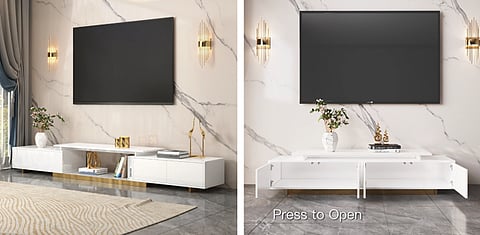
Many living rooms feel off because the stand is much narrower than the screen. As a general rule, the stand should be wider than the TV so the screen has a stable visual base. When the television is already large, a narrow cabinet can make the whole wall feel top-heavy.
A well-proportioned tv stand does more than hold a screen. It balances the visual weight of the room. For 55-inch, 65-inch, and even larger TVs, measure the actual TV width and the available wall space instead of relying only on the size range listed in a product title.
Height matters as well. The center of the screen should sit close to eye level when viewed from the sofa. If the stand is too high, watching for long periods can feel uncomfortable. If it is too low, the media wall may feel disconnected from the sofa, coffee table, and rug.
Modern living rooms have more media clutter than people expect: remotes, game consoles, speakers, routers, power strips, manuals, batteries, and charging cables. If all of those items are exposed, even an expensive room can look messy.
For most homes, closed storage works better than a fully open design. Drawers and doors can hide cables and devices, while open sections can be reserved for items that need ventilation or display space. In a refined living room, clean surfaces and strong horizontal lines are often more timeless than complicated shapes.
If the living room is larger, or if the TV wall is a major focal point, a tv console can make the whole media area feel more complete. Compared with a basic piece that simply holds a screen, a console places more emphasis on width, finish, and how the furniture integrates with the room.
For example, a walnut finish can soften the hard look of a black screen. A long cabinet can make the wall feel wider. Slim legs or a floating effect can keep the piece from feeling too heavy. In high-rise apartments and modern homes, the furniture does not need to be complicated, but it should belong in the same design language as the sofa, coffee table, rug, and lighting.
Many people forget to check outlet locations before ordering a media cabinet. Once the piece arrives, they may discover that cords are too short, outlets are blocked, devices do not ventilate well, or wires are visible from behind the cabinet. Before buying, confirm how many outlets you need for the TV, sound system, router, and gaming devices, and check whether the cabinet has cable-management openings.
Even with a wall-mounted TV, the cabinet still has a role. It can hold remotes, speakers, and decorative objects, while keeping the area below the screen from feeling empty. A mounted TV paired with a low, long cabinet is one of the most balanced approaches for many modern living rooms.
A TV stand is not just an accessory. It shapes proportion, storage, and the overall feel of the living room. Instead of asking only which style looks good, ask how large the TV is, how wide the wall is, what needs to be stored, and whether the room's traffic flow will stay comfortable.
When the size, function, and finish all fit the space, the media wall feels calmer and the living room feels more complete. A good TV stand does not demand attention. It makes the entire room look more organized.
Inspired by what you read?
Get more stories like this—plus exclusive guides and resident recommendations—delivered to your inbox. Subscribe to our exclusive newsletter
The products and experiences featured on RESIDENT™ are independently selected by our editorial team. We may receive compensation from retailers and partners when readers engage with or make purchases through certain links.