
- Locations
- Interviews
- Luxury Home
- Luxury Lifestyle
- Luxury Travel
- Luxury News
- Events
- More
- Magazine
- Contact Us

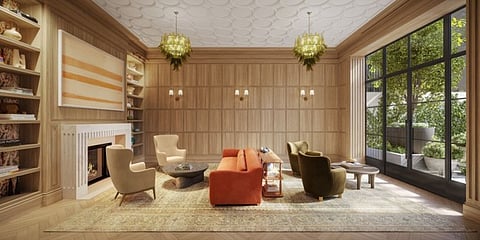
There is a quiet shift underway in how the well-designed home treats its fireplace. For years the hearth was something to modernize away, boxed into drywall, fitted with a glass front, or replaced by a flat panel of flame behind tempered glass. Now it is coming back to the center of the room, not as nostalgia, but as one of the most deliberate design decisions a homeowner makes.
Walk through any of the season's most talked-about residences, from the Clearwater cabins rising in Idaho to the lakefront homes along Chicago's North Shore, and the fireplace is rarely an afterthought. It anchors the room the way a serious piece of art does. Designers are framing it in limestone, blackened steel, and hand-troweled plaster. They are scaling it up, not down. And increasingly, they are returning to the one thing a sealed gas insert can never quite replicate: real wood, real fire, and the particular stillness that comes with it.
The luxury market tends to lead the return to authenticity, and the hearth is following the same path as natural stone, unlacquered brass, and reclaimed timber. Affluent homeowners who can afford every convenience are choosing, in growing numbers, the version that asks a little more of them. A wood fire is tactile. It has sound and scent and movement. It rewards attention.
Architects working in the high end describe clients requesting wood-burning fireplaces specifically, often as the emotional core of a great room or primary suite. The biophilic design movement, which has moved from wellness buzzword to genuine architectural principle, only reinforces it. A real fire connects a room to something elemental, and that connection is exactly what the modern luxury home, for all its glass and automation, can feel starved of.
But a wood fire done at this level is not casual. The difference between a beautiful evening and a smoky, sputtering disappointment comes down almost entirely to the wood itself, and that is where most homeowners, even sophisticated ones, get it wrong.
Here is the part that separates a designed hearth from a working one. The fuel matters as much as the firebox.
Most firewood sold at the roadside or bundled at the grocery store is what the trade calls green or air-dried, cut relatively recently and left to sit outdoors. It carries far too much moisture, often well above 20 percent. Wet wood is the reason fireplaces smoke, throw little heat, and leave a film of creosote in the flue. It hisses instead of catching. It is, in a literal sense, the wrong material for the room.
The alternative is kiln-dried firewood, hardwood brought down to a low, stable moisture content in a controlled kiln. It lights quickly, burns clean and hot, produces minimal smoke, and behaves predictably every time. For a homeowner who has invested in a custom hearth, the logic is the same as buying good wine to fill a beautiful cellar. The vessel deserves the contents.
There is a practical dimension too. Kiln drying kills the insects and mold spores that live in green wood, which matters when the wood is being stored indoors near a six-figure interior. The last thing a finished room needs is firewood quietly introducing pests to the millwork.
For homeowners in the Chicago area and the northern suburbs, sourcing at this level has gotten easier. Suppliers like Best Burn Firewood Chicago deliver kiln-dried hardwood by the rack and cord across the metro, which means the homeowner gets consistent, ready-to-burn wood without the guesswork of a roadside pile. It is a small upgrade in the scheme of a luxury home, and a disproportionate one in how the fireplace actually performs.
Once the wood is right, the rest is composition. The most successful hearths this year share a few instincts.
They treat storage as part of the design. A built-in niche of neatly stacked wood, lit well, has become a styling element in its own right, the textural counterpoint to a smooth plaster surround. Designers are building these directly into the architecture, flanking the firebox or running floor to ceiling beside it.
They scale with confidence. A fireplace that reads as a feature wall, in a single material carried from floor to ceiling, does more for a room than a modest mantel ever could. Restraint in palette, boldness in proportion.
They consider the room in every season. The best hearths are not only winter objects. Paired with the right furniture and lighting, they hold a room together year-round, the way a fireplace in a Hamptons summer house still earns its place in July.
What ties all of this together is a broader move in luxury interiors away from the frictionless and toward the felt. The considered hearth is part of the same impulse that brings handmade tile and imperfect, living materials back into rooms that could just as easily be flawless and cold.
A fire is the oldest centerpiece there is. The homeowners getting it right are the ones who treat every part of it with intention, from the stone that frames it to the wood that feeds it. Get those details correct, and the fireplace stops being a fixture and becomes what it was always meant to be: the place the whole house gathers.
Inspired by what you read?
Get more stories like this—plus exclusive guides and resident recommendations—delivered to your inbox. Subscribe to our exclusive newsletter
The products and experiences featured on RESIDENT™ are independently selected by our editorial team. We may receive compensation from retailers and partners when readers engage with or make purchases through certain links.