
- Locations
- Interviews
- Luxury Home
- Luxury Lifestyle
- Luxury Travel
- Luxury News
- Events
- More
- Magazine
- Contact Us

Ask most people about their storage situation at home and you will get one of two answers. Either they do not have enough of it, or they have plenty but it is in the wrong place, the wrong configuration, or simply not working the way they need it to.
Both answers point at the same underlying problem. Whether it is a Victorian terrace in Manchester, a compact London flat or a modern new-build with limited built-in storage, many UK homes ask more from their storage than traditional furniture was ever designed to deliver. Particularly in older British homes where alcoves, chimney breasts and uneven walls are common, flexibility becomes far more valuable than perfectly symmetrical furniture. The furniture market offers plenty of options. But the options tend to assume a level of spatial regularity that most British homes do not have and a household stability that most British lives do not maintain.
Modular cabinets have emerged as the most credible response to this. Not because they are new, but because the best versions of them have finally caught up with what domestic interiors actually require.
The practical advantages of modular storage are well established. Configurability. Adaptability over time. The ability to fit irregular spaces that fixed furniture cannot accommodate. These are the reasons people choose modular systems, and they are genuine reasons.
But the better modular cabinet systems do something beyond the practical. They treat the aesthetic quality of the configuration as seriously as its functional flexibility. They recognise that in a small UK home, storage is never invisible. It is always part of the room's character. And a storage system that looks wrong in a room makes the room feel wrong, regardless of how well it functions.
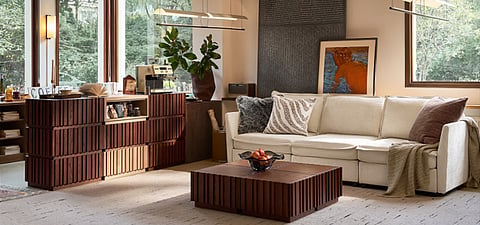
The Hulala Home modular cabinet range approaches this from both directions. The individual units are designed with proportions and finishes that read as domestic furniture rather than storage equipment. And the configuration options allow for arrangements that give a wall genuine rhythm and visual interest rather than simply filling it up.
One of the most important design decisions in any modular storage configuration is the balance between open and closed sections. Get this wrong and the storage either looks cluttered or looks sterile. Get it right and storage becomes one of the most effective ways to give a room its character.
Open sections earn their place by displaying things worth seeing. Books with their spines facing out. A plant catching the light from the window. A few objects that mean something to the people who live there. These are the things that make a room feel inhabited rather than merely furnished.
Closed sections earn their place by concealing everything else. The functional clutter of daily life. The cables and chargers and things that need to be accessible but do not need to be seen. A home where the closed storage is doing its job properly is a home where the open sections can breathe.
In a small UK home, every storage decision has consequences beyond the storage itself. A unit that is slightly too wide makes the room feel cramped. A configuration that stops short of the ceiling wastes the vertical space that small rooms can least afford to lose. A finish that does not sit comfortably with the other materials in the room creates a visual tension that is always present and always slightly wrong.
Good modular storage for small spaces is designed with all of this in mind. Units sized for rooms with non-standard dimensions. Configurations that reach the ceiling and recover the vertical space that standard furniture leaves unused. Finishes chosen for how they will read in a domestic interior, not how they will look on a showroom floor.
These are the details that separate storage that works from storage that transforms a room. And in a small UK home where the margin for error is small and the visibility of every choice is high, they are the details that matter most.
Keep visual weight low
Instead of filling every wall, leave intentional breathing space around a modular configuration.
Repeat materials, not furniture
Matching oak finishes or soft neutral tones across different pieces creates a calmer interior than matching every product.
Mix display with concealment
A room feels curated when everyday essentials disappear behind doors while meaningful objects remain visible.
The strongest modular systems are designed to make these principles easy to achieve.
Modular storage costs more upfront than its fixed-format equivalents. This is worth acknowledging honestly, because the argument for the investment only holds if the investment is genuinely understood.
The argument is this. Fixed storage depreciates every time circumstances change. The configuration that was right becomes slightly wrong, then quite wrong, then needs to be replaced. Modular storage does not depreciate in the same way, because it can be reconfigured to remain right as circumstances change. The upfront cost is higher. The lifetime cost is lower. And the lifetime value, in terms of a home that continues to feel right through successive changes, is higher still.
Good storage is rarely about owning more space. It is about using the space already available with greater intelligence. As British homes continue to evolve around changing lifestyles, modular furniture is becoming less of a trend and more of a long-term design philosophy, one where flexibility and beauty are expected to exist together.Explore Hulala Home UK's modular cabinet collection to see how adaptable storage can become part of everyday living.
Inspired by what you read?
Get more stories like this—plus exclusive guides and resident recommendations—delivered to your inbox. Subscribe to our exclusive newsletter
The products and experiences featured on RESIDENT™ are independently selected by our editorial team. We may receive compensation from retailers and partners when readers engage with or make purchases through certain links.