
- Locations
- Interviews
- Luxury Home
- Luxury Lifestyle
- Luxury Travel
- Luxury News
- Events
- More
- Magazine

Luxury used to mean more. More marble, more gold, more visible detail crammed into every surface. That version of luxury is fading. What replaced it is quieter and harder to fake. A master bathroom that feels expensive not because it shouts but because every material was chosen with intention. This thoughtful approach creates a timeless space that delivers lasting beauty, everyday functionality, and enduring value.
For homeowners planning a refined bathroom upgrade, ARIEL Bath's July 4th Sale event offers an ideal opportunity to invest in timeless materials without compromising on quality or design.
For years, a luxury bathroom meant ornate fixtures, heavy patterns, and as much visible detail as a room could hold. The thinking was that more decoration signaled more money spent. That formula has quietly fallen out of favor among people who actually live in high-end spaces.
What replaced it is restraint. Clean lines, fewer materials used more thoughtfully, and a focus on how things feel rather than how loudly they announce themselves. A bathroom built this way does not need gold trim on every edge to feel premium. It needs materials that are genuinely good, paired together with care, and given room to be the actual focus.
Once you strip away heavy decoration, something else has to carry the visual interest in a room. That something is texture. The grain of solid wood, the cool flatness of stone, the way light moves differently across a matte surface versus a polished one.
This is where modern luxury actually lives now. Not in carved details or gold accents but in the quiet contrast between materials sitting next to each other. A wood grain against smooth stone creates depth without adding a single decorative element. The eye reads it as considered, even if it cannot explain exactly why.
Solid wood and stone are an old pairing, but the way they are being used now feels different. Instead of matching tones or trying to blend everything together, the contrast itself has become the point.
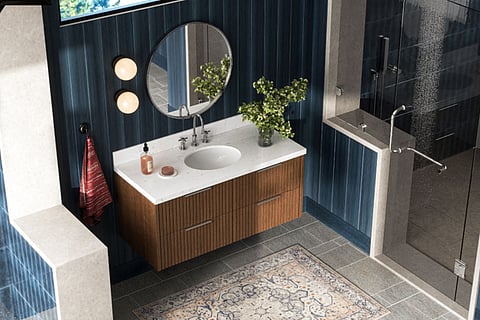
A warm wood vanity frame against a crisp white or grey stone countertop creates visual tension that neither material could create alone. The wood brings warmth. The stone brings precision and a sense of permanence. Together they read as intentional, which is exactly what separates a designed space from a furnished one.
This pairing also fits the quiet luxury philosophy in a practical way. Both materials are genuinely durable. A bathroom built around this combination is not choosing beauty over function. It gets both from materials that were always going to last regardless of styling.
There is a subtle shift in how people define luxury now, and it has less to do with how something looks on day one and more to do with how it holds up over years. A vanity that still looks flawless after a decade says more about quality than one that looked impressive for six months and then started showing wear.
This is where structural permanence comes in. Solid wood frames that do not warp. Stone surfaces that do not stain or chip. Hardware that does not corrode under daily steam exposure. None of this is visible at a glance, but it is exactly what separates furniture built for genuine longevity from furniture built to photograph well.
Metropolitan properties tend to work with less square footage than suburban homes. That constraint actually makes material choice more important, not less. In a small bathroom, every surface sits closer to the eye, so every material decision becomes more visible.
A minimal material palette done well makes a compact urban bathroom feel intentional rather than cramped. Two or three materials, chosen carefully and paired thoughtfully, create more impact than five competing finishes ever could. This is part of why quiet luxury translates so naturally to city living, where doing less but doing it properly was already a practical necessity before it became a design trend.
The traditional path to this kind of considered material pairing involved custom millwork, separately sourced stone, and a designer coordinating everything to make sure proportions and tones worked together. That process is slow and expensive, which historically kept this aesthetic out of reach for most renovations.
Pre-matched, high-spec components change that equation. When a manufacturer designs the wood finish and the stone countertop together from the start, the contrast and proportion work is already done. There is no guessing whether a wood tone will pair well with a stone, because that pairing was already tested before the product reached the market.
ARIEL Bath fits naturally into this shift toward quieter, more considered luxury. The Coastal Natural Oak collection brings genuine organic warmth into a bathroom, with wood grain and tone variation that no painted finish can replicate. Paired against the brand's stone countertop options, it creates exactly the kind of natural material contrast that defines modern luxury design.
The Midnight Blue collection takes the same philosophy in a different direction, offering a deep, confident tone that still reads as restrained rather than flashy. Both collections come as pre-matched, high-spec components, meaning the wood finish, countertop, and hardware were designed together rather than assembled from separate sources afterward. During the season, homeowners can also explore premium master bath collections on promotion, making it easier to achieve a sophisticated, design-forward space at exceptional value.
For metropolitan properties where every material choice carries more visual weight, ARIEL Bath offers a way to achieve a bespoke, custom feel without the custom process. The character is built in from the start, proving that design-forward bathrooms do not require a fully custom build to feel genuinely high-end.
Quiet luxury in the bathroom is not about doing less for the sake of minimalism. It is about choosing fewer materials and making sure each one earns its place through quality, texture, and permanence. A wood vanity against a stone counter, finished with intention rather than excess, says more about taste than any amount of ornamentation ever could. For urban spaces especially, this restrained approach is where real luxury quietly lives now.
Inspired by what you read?
Get more stories like this—plus exclusive guides and resident recommendations—delivered to your inbox. Subscribe to our exclusive newsletter
The products and experiences featured on RESIDENT™ are independently selected by our editorial team. We may receive compensation from retailers and partners when readers engage with or make purchases through certain links.