
- Locations
- Interviews
- Luxury Home
- Luxury Lifestyle
- Luxury Travel
- Luxury News
- Events
- More
- Magazine
- Contact Us

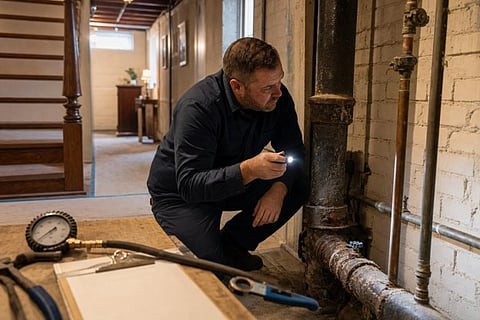
Older and historic homes are rewarding places to live, but their plumbing rarely forgives shortcuts. A pre-war townhouse or decades-old second home can hide lead service lines, brittle cast-iron drains, and pressure problems behind plaster, tile, and millwork. When something leaks, damage can spread quickly and character finishes can be expensive to restore. The goal is to find one who treats the house carefully, works from evidence, and documents the work clearly.
Before you call, keep a short checklist in front of you so conversations stay focused and comparable.
Verify license and insurance using the official state, city, or local regulator lookup, not the plumber's word alone.
Ask about older-home experience with materials such as cast iron, galvanized supply lines, lead-risk components, and mixed-era pipe transitions.
Require diagnostics before quotes, including a camera scope where appropriate, a static pressure reading, and questions about lead risk.
Confirm permits and code items such as backflow prevention or a pressure-reducing valve, where your jurisdiction requires them.
Demand a written, itemized scope that explains access points, restoration responsibilities, and warranty terms.
Licensing rules vary by city and state, so start with the authority that governs your property. In New York City, for example, alteration or relocation of piping must be supervised by a Licensed Master Plumber, who pulls permits and arranges required inspections. That credential matters because it requires written and practical exams plus experience criteria, according to the city's Department of Buildings.
Use paperwork as a screen. Texas consumer guidance, for example, advises verifying the Responsible Master Plumber's license and insurance, and notes that written estimates and invoices should display the plumber's license number and licensing agency contact information. If an estimate for major work lacks a verifiable license number, treat it as a red flag. Simple fixture swaps may not need a permit, but structural, drainage, or supply-line changes often do.
Plumbing installed before modern standards carries specific hazards. Lead pipes are more common in homes built before 1986, and brass fixtures or lead solder can be sources even without a lead service line, according to the EPA. Galvanized supply lines corrode from the inside, and original cast-iron drains can crack, rust through, or collect debris as they age.
The single most useful habit for older-home owners is refusing to accept a bid for major work sight unseen. A careful plumber will want evidence before recommending a repair.
For drain trouble, ask for a sewer-camera inspection from cleanout to main. It can show cracks, root intrusion, and bellied lines and clarify responsibility, since many owners are responsible for the lateral, or side sewer, from house to public main. Seattle Public Utilities advises side sewer inspection before purchase, sound counsel for any older property changing hands. This evidence-first approach is also a sensible way to compare reliable maintenance professionals for specialized older-home work.
Ask the plumber to measure static water pressure. Some jurisdictions require a pressure-reducing valve where pressure runs high, with one common threshold at static pressure above 80 psi. Also ask about backflow prevention if the home has a treated boiler, irrigation system, or pool, since some properties must install and periodically test these devices.
Permitted work protects you, not just the city. In New York City, alterations must be supervised by a Licensed Master Plumber and properly permitted, and certain properties must install, maintain, and annually test backflow prevention devices. Failure to keep them tested can lead to fines or service disconnection.
Older homes raise a health issue too. Under the EPA's Renovation, Repair and Painting Rule, contractors, including plumbers, must be EPA-certified to disturb painted surfaces above set thresholds in homes built before 1978. If your project opens walls with original paint, ask whether the firm holds that certification. For permits and inspections, confirm the scope with your local building authority rather than relying only on a contractor's summary.
Preservation often comes down to access. Ask how candidates will reach pipes without unnecessarily removing original plaster, tile, or millwork, and how they will patch and restore afterward. Ask how they choose materials, including copper and PEX compatibility, and handle transitions between old and new sections.
Request documentation of valve locations and shutoffs, plus a closeout package with camera videos, pressure readings, permits, inspection results, and a parts list. That record is a small ask during the job and a large advantage later.
Insist on an itemized written scope separating labor, materials, permits, inspections, and restoration. Vague lump sums make bids hard to compare and disputes harder to resolve. Quick leak fixes also matter: EPA WaterSense notes that the average household wastes about 9,400 gallons of water each year from leaks.
Ask for workmanship warranty terms in writing, and confirm that permits are signed off before final payment. Store videos, reports, and invoices with your home records. Documented and code-compliant work is easier to defend when you sell, refinance, or file an insurance claim.
When researching candidates online, look for clear license details, service area, diagnostic capabilities, permit handling, and the types of properties the firm regularly services. If you also maintain a property in Australia's ACT, local options such as plumber Woden Valley can be a starting point for finding plumbing and roof-plumbing specialists serving Woden Valley and nearby suburbs. The same scanning habit applies wherever you own: read for specifics, not slogans.
Inspired by what you read?
Get more stories like this—plus exclusive guides and resident recommendations—delivered to your inbox. Subscribe to our exclusive newsletter
The products and experiences featured on RESIDENT™ are independently selected by our editorial team. We may receive compensation from retailers and partners when readers engage with or make purchases through certain links.