
- Locations
- Interviews
- Luxury Home
- Luxury Lifestyle
- Luxury Travel
- Luxury News
- Events
- More
- Magazine

At a Glance
South Florida has no shortage of steakhouses promising prime cuts, polished surroundings and indulgent dining, but The Wagyu House in Hallandale Beach approaches the genre from a decidedly different direction. Rather than creating a restaurant and then seeking premium beef to support the concept, its expertise came first. Meat N' Bone spent years sourcing, butchering, selling and educating consumers about premium proteins before bringing that knowledge into the dining room. The result is a steakhouse experience that puts provenance, product knowledge and personal preference at the center of the plate, inviting diners not simply to eat Wagyu, but to better understand it.
"What I think is still under-told is that The Wagyu House is not simply another steakhouse that serves Wagyu," explains Gabriel Llaurado, Co-Founder and Chief Marketing Officer of Meat N' Bone. "It was created by Meat N' Bone, a company that spent years sourcing, butchering, selling and educating consumers about premium proteins before we ever opened this restaurant. That gives us a very different foundation. We can introduce guests to different grades, cuts, origins and styles of Wagyu and help them understand why they taste different. The goal is not just to serve an expensive steak; it is to create a place where guests can discover what they actually like."
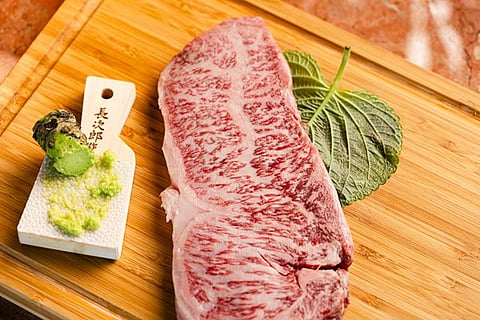
That spirit of discovery is particularly relevant in a dining landscape where "Wagyu" has become a ubiquitous menu descriptor despite encompassing dramatically different eating experiences. USDA Prime, American Wagyu and Japanese A5 can vary enormously in richness, texture, marbling and flavor, while Japanese A5 itself can change depending on region, producer, breed, cut and Beef Marbling Score. At The Wagyu House, those distinctions are treated less as insider terminology and more as an invitation to explore.
Llaurado says three elements most clearly differentiate the restaurant: "First is access and sourcing. Through Meat N' Bone, we have relationships and purchasing capabilities that give us access to exceptional Japanese and American Wagyu programs, specialty cuts and premium proteins. Second is education and variety. Wagyu is not one product. We want guests to experience the difference between USDA Prime, American Wagyu, Japanese A5, different marbling levels, cuts and Japanese regions rather than simply seeing 'Wagyu' written on a menu. Third is the connection between restaurant and the Meat N' Bone shop. Guests can have an incredible protein in the dining room and then walk into the integrated Meat N' Bone boutique and continue that experience at home."
That butcher-driven foundation also changes how a menu can evolve. "It influences almost everything," Llaurado says. "A traditional restaurant often develops a menu and then looks for products that fit it. Because of Meat N' Bone, we can sometimes work in the opposite direction: we discover an extraordinary producer, cut or protein and then ask ourselves how we can showcase it at the restaurant. We already have relationships with producers and suppliers, purchasing volume, receiving infrastructure and years of experience evaluating proteins. Our team understands grading, marbling, aging, specifications, provenance and how products perform. That means quality control does not begin when a box arrives at the restaurant. It starts with sourcing."
For diners, that expertise is particularly valuable when navigating Wagyu's often-confusing nomenclature. As Llaurado explains, "One of the biggest misconceptions is treating 'Wagyu' as if it were one product. USDA Prime is an American grading designation. American Wagyu generally involves Wagyu genetics raised in the United States and can offer an incredible balance between marbling and the traditional steak experience. Japanese A5 is something very different again, with much more intense marbling, richness and a unique texture. Even within Japanese A5, region, producer, breed, BMS score and cut can dramatically change the experience. We try to make that approachable rather than intimidating. For consumers, I think transparency matters. If a restaurant is charging a premium for Wagyu, you should be able to understand what you are eating: country of origin, grade, cut and ideally the producer or region when relevant."
The menu makes those distinctions tangible. Consider the Denver Steak Wagyu BMS7+ versus the Japanese A5 Miyazaki-Gyu Ribeye, two expressions of Wagyu that share a category but deliver decidedly different experiences. "They are both Wagyu experiences, but they are dramatically different," Llaurado says. "The Denver Steak Wagyu BMS7+ is intensely flavorful and beautifully marbled, but it still has the structure and beefiness people associate with a traditional steak. It is a great choice for someone who wants the tenderness and richness of premium Wagyu while still eating a substantial steak. The Japanese A5 Miyazaki-Gyu Ribeye is much more decadent. The marbling is extraordinary, the fat melts at a very low temperature, and the texture can almost dissolve on the palate. If someone is trying Wagyu for the first time, we ask what they normally enjoy. If they love a classic steak experience, I may guide them toward the Denver. If they want to understand what makes Japanese A5 completely different from American beef, Miyazaki is an incredible introduction. Our job is not to sell somebody the most expensive steak. It is to help them order the steak they are going to enjoy the most."
Yet beef does not entirely define the kitchen. The Charred Wagyu Tartare may put the restaurant's signature protein squarely in the spotlight, but Garlic Butter Jumbo Crab Cakes and Japanese BBQ Glazed Salmon broaden the experience. "The Charred Wagyu Tartare is very representative of our beef philosophy. The objective is to preserve the richness and texture of the Wagyu while using char and seasoning to add another layer of flavor without overwhelming the beef," Llaurado explains. "The Jumbo Crab Cakes show another side of the restaurant. We are very serious about beef, but we are equally serious about the quality of everything else we put on the plate. The Japanese BBQ Glazed Salmon reflects the same philosophy we apply to our steaks: start with an excellent ingredient and build flavors around it that complement rather than disguise it. Wagyu may be the headline, but quality is the broader identity."
The setting gives travelers another reason to look beyond the usual Miami and Fort Lauderdale dining circuits. Situated at Atlantic Village at 601 N. Federal Highway, The Wagyu House pairs its culinary concept with a garden-view dining room, marble bar and tropical patio, while its integrated Meat N' Bone boutique creates an unusual bridge between restaurant and retail. Michelin-trained Chef Chucho Rojas heads the kitchen with direct access to the company's sourcing network, allowing the experience to move from tasting to learning to recreating a discovery at home.
"Hallandale Beach was especially attractive to us because of how much the area is evolving," Llaurado says. "It sits between Miami and Fort Lauderdale, but more importantly, it is surrounded by growing communities where people are building their lives, raising families and increasingly looking for exceptional experiences closer to home. Atlantic Village is at the center of that evolution. For someone visiting The Wagyu House for the first time, the ideal evening would be to arrive early and spend some time exploring Atlantic Village before dinner. Then settle in at the bar for a cocktail before experiencing the menu and trying two very different Wagyu offerings side by side, perhaps an American Wagyu cut and Japanese A5. After dinner, guests can spend time on the patio, explore the Meat N' Bone boutique to discover something to take home or ship later, or continue exploring Atlantic Village."
That side-by-side experience may ultimately be the restaurant's most compelling proposition. A guest can arrive thinking of Wagyu as a singular pinnacle and leave understanding that personal preference may favor American Wagyu over Japanese A5, one cut over another, or a particular degree of marbling. Rather than price serving as the organizing principle, preference does. The integrated butcher boutique makes that newfound knowledge actionable beyond the meal, while Atlantic Village's open-air mix of dining, wellness, retail and family-oriented concepts makes the destination easy to fold into a broader South Florida evening.
"I think the biggest thing I would emphasize is that The Wagyu House is not a steakhouse that discovered Wagyu," Llaurado concludes. "It was created by a company that has spent years sourcing, butchering, selling and educating consumers about some of the world's best proteins. That foundation gives us an opportunity to make premium dining more transparent and more educational. We want people to understand what they are eating, why it is special and, most importantly, what they personally enjoy. Luxury does not have to mean intimidating. It can also mean having access to an extraordinary product, understanding its story and having people around you who are excited to share that knowledge."
RESIDENT was hosted by The Wagyu House for the purposes of this review. Opinions are the writer's own.
For more information, visit The Wagyu House.
Inspired by what you read?
Get more stories like this—plus exclusive guides and resident recommendations—delivered to your inbox. Subscribe to our exclusive newsletter
The products and experiences featured on RESIDENT™ are independently selected by our editorial team. We may receive compensation from retailers and partners when readers engage with or make purchases through certain links.