
- Locations
- Interviews
- Luxury Home
- Luxury Lifestyle
- Luxury Travel
- Luxury News
- Events
- More
- Magazine

There's a version of Italy that doesn't show up on the usual shortlists. Not the Amalfi cliffs or the Venetian canals, but a quieter interior: a stretch of central Italy where Umbria, Tuscany, and Lazio converge in a landscape of olive groves, medieval hilltop towns, and stone estates that have been standing since before the Renaissance. For a growing number of high-net-worth buyers and second-home seekers, this is where the real search begins.
What draws them isn't just beauty. It's the particular kind of asset that central Italy produces: properties with historic depth, cultural weight, and an authenticity that's increasingly rare in a world where luxury has become legible and predictable. These are interiors where a Cassina piece sits as naturally against a sixteenth-century fireplace as it would in a Manhattan penthouse, which says something both about the furniture and about what central Italy does to your sense of proportion.
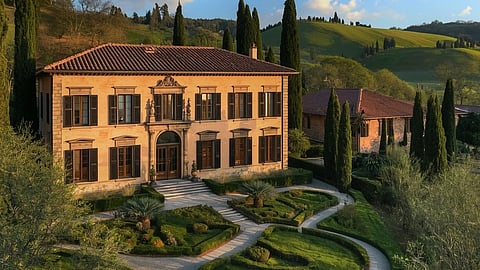
The estates that command serious attention in this part of Italy aren't the ones with the most amenities. They're the ones with the most coherent identity: places where architecture, landscape, and interior life form a single, inseparable whole.
Castello di Reschio, on the Umbria-Tuscany border, is perhaps the most architecturally ambitious example. A 3,400-acre private estate, it was acquired by Count Antonio Bolza in the 1990s and has been meticulously restored over three decades by his son, architect Count Benedikt Bolza. The result is something that functions simultaneously as a working estate, a hotel, and a collection of individually designed private villas; each restored from ruins using local stone, handcrafted mosaics, and bespoke furniture produced in Bolza's own on-site studio. There are no shortcuts here, and no generic luxury. Every room is a considered argument about what it means to inhabit a historic space without betraying it.
Further south, in the mountains above Rieti near the Umbrian border, the village of Labro represents a different kind of proposition entirely. One of the most beautifully preserved medieval borghi in central Italy, Labro has been inhabited continuously for over a millennium, and at its center stands the Castello Nobili Vitelleschi, a fortified noble residence still occupied by the same family that has lived there since the tenth century. The rooms are furnished with objects, paintings, and furniture passed down through generations. The family archive, intact from around the year 1000, documents the property's history in unbroken continuity. This is not a property that can be acquired. It can only be approached as a reference point, a benchmark for what centuries of accumulated domestic culture actually looks like when it hasn't been curated for consumption.
In Tuscany, Villa Lena offers a third model. Set on 500 hectares of woodland and rolling fields near Pisa, the nineteenth-century estate was purchased in a state of disrepair in 2007 and has since been transformed into something harder to categorize than a hotel or a rental property: a living estate that changes with the seasons and the people who pass through it. Artists come for residencies. Chefs work with the farm's produce. The interiors mix original Tuscan architectural features with contemporary art and bespoke pieces. The logic is less about preservation and more about regeneration: treating the estate as a platform for cultural production rather than a static monument to the past.
What these three properties have in common, beyond their geographic proximity and historical depth, is that none of them fits neatly into the conventional luxury travel or real estate category. They resist easy description. And that resistance, increasingly, is exactly what buyers at this level are looking for.
The conversation around second homes and investment properties in central Italy has shifted meaningfully over the past decade. The Chianti formula (restored farmhouse, vineyard, infinity pool, predictable aesthetic) has run its course among buyers who've already done that. What's emerged in its place is a more sophisticated appetite: for properties with genuine narrative, for landscapes that haven't been polished into postcards, for a version of Italian life that still has friction and texture.
There's a reason Italians don't need to explain la vita lenta in this part of the country. The concept of "the slow life" didn't originate as a lifestyle trend here. It's simply what happens when a region has never been in a hurry. The pace isn't chosen. It's imposed by the landscape, by the distance from everything, by winters that actually feel like winters.
Umbria, in particular, has absorbed much of this demand. Less visited than Tuscany, less documented, less expensive per hectare, but equally rich in history, equally beautiful, and considerably more private. The area around Todi, the Valnerina, the border territories between Narni and Spoleto: these are landscapes where serious buyers are quietly acquiring and restoring estates that will take decades to fully realize.
The interiors of these properties present their own set of decisions. When the walls are eight hundred years old, the furniture cannot be an afterthought. The pieces that tend to survive stylistically in these environments are the ones with their own historical grounding: designs that don't perform novelty but carry weight. It's the same instinct that drives collectors to invest in enduring design rather than seasonal trends.
Central Italy, approached this way, is less a destination than a philosophy. The slow life here isn't a marketing concept. It's structural: built into the pace of the landscape, the scale of the estates, the rhythm of truffle season, and olive harvest. For buyers willing to think in decades rather than weekends, it remains one of the most compelling places in the world to put down roots.
Inspired by what you read?
Get more stories like this—plus exclusive guides and resident recommendations—delivered to your inbox. Subscribe to our exclusive newsletter
The products and experiences featured on RESIDENT™ are independently selected by our editorial team. We may receive compensation from retailers and partners when readers engage with or make purchases through certain links.