
- Locations
- Interviews
- Luxury Home
- Luxury Lifestyle
- Luxury Travel
- Luxury News
- Events
- More
- Magazine

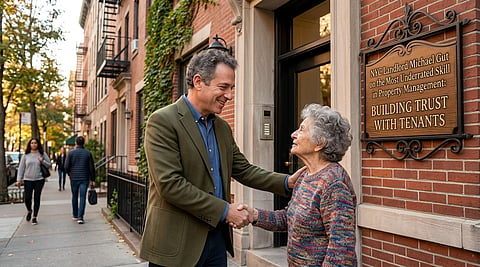
In New York City’s competitive rental market, people tend to evaluate landlords on the easiest metrics: their occupancy rates, how they collect rent, and when they respond to maintenance requests. But experienced property owners know that beneath all of those numbers lies a foundation that either holds or gives way over time: the trust they build with tenants.
As a landlord based in Greenpoint, Brooklyn, Michael Gut has centered his approach on building trust with his tenants, which has led to a long and stable career in property management.
If you ask most New Yorkers what they think makes a landlord successful, their answers typically cluster around the practical: a well-maintained building, fair pricing, and prompt repairs. But while these things matter, they’re truly just table stakes.
The difference between landlords who consistently retain good tenants and those who cycle through turnover after turnover is less tangible and harder to fake. Tenants stay where they feel they’re heard, treated fairly, and respected as people rather than a simple revenue line.
In NYC, Michael Gut has demonstrated this principle across his decades-long career in residential property management. When he enters a rental agreement, he doesn’t maximize short-term value extraction. Instead, he focuses on the longer view. Gut knows that a tenant who trusts their landlord is one who communicates their problems early, takes care of their unit, and, eventually, renews their lease.
There’s economic value in that stability. And it all starts with the way a landlord shows up for their tenants in the ordinary moments, not just the stressful ones.
A common misconception around renting is that landlord-tenant trust should only be a worry if something goes wrong, as if it’s just a feeling to be repaired. The reality is that establishing trust long before any conflict arises leads to better outcomes. Landlords should respond to all questions promptly, follow through on their commitments, and be honest about what is and is not possible.
Tenants are perceptive. They notice when a landlord says one thing and does another, or when communication goes quiet the moment a lease is signed.
If a landlord manages residential properties in a borough as densely populated and relationship-driven as Brooklyn, they should know the informal side of property management, which carries outsized weight. This is because neighbors talk, buildings develop reputations, and a landlord who’s known for being accessible and fair attracts better tenants and retains them over time.
Michael Gut’s commitment to the Greenpoint community reflects this reality. Stability in property management is rarely accidental.
A landlord should prioritize acknowledging when things don’t go right and be ready to fix those issues without being chased. Tenant protections in New York City are among the strongest in the country, which means disputes can escalate quickly. Here, operating with integrity and accountability has a meaningful and relational advantage for landlords.
It’s never about avoiding problems or pushing them off to someone else. A property owner builds their reputation cumulatively, over a long period of time.
A landlord who handles issues directly, honestly, and without defensiveness creates an environment in which tenants are more likely to raise concerns before they become formal complaints and to work through disagreements rather than escalate them. Michael Gut’s practices as a landlord reflect an understanding that the best way to manage conflict is to reduce the conditions that produce it in the first place.
Property management is a people business. While the physical asset matters, the relationship between the owner and the tenant matters just as much, if not more. If landlords find themselves managing a constant churn of new faces and recurring move-out costs, they should reflect on their interactions with tenants.
Michael Gut understands that the human side of property management requires patience and interpersonal awareness that no spreadsheet can capture, especially in NY. A long-term tenant is far from just a stabilized cash flow, because they’re also a person who knows the building, looks out for the property, and can become an informal steward of the community within it. That kind of tenant is cultivated through consistent, respectful treatment over time.
This matters particularly in New York City, where the rental landscape is intensely competitive and tenants have access to significant legal protections. It’s not just about leaving value on the table. Landlords who fail to build trust are exposing themselves to a higher risk of disputes, regulatory scrutiny, and reputational damage in a market where word of mouth still moves faster than any marketing budget.
No classroom can offer the kind of education that a career spanning decades in New York City property management can give a landlord. The city has gone through economic cycles, regulatory overhauls, shifting neighborhood demographics, and the extraordinary disruptions of a global pandemic.
Landlords who survived and maintained stable portfolios through those periods share a common trait: they treated their tenant relationships as assets worth protecting, not liabilities to be minimized.
Union environments are similar because they demand their participants to operate within agreed-upon frameworks, communicate directly, and resolve disputes through process rather than power. Those habits translate directly to property management. Combined with 25 years working within the 32BJ union environment, Michael Gut's tenure in real estate shows a career built on structured accountability and a clear-eyed understanding of how sustained professional relationships function.
For landlords looking to develop stronger tenant relationships, the fundamentals aren’t complicated. They should communicate clearly and consistently, especially when delivering unwelcome news, and be prepared to follow through on maintenance commitments within the timeframes promised. Landlords should also remain available during normal business hours and have a reliable after-hours process for genuine emergencies.
None of these things requires large capital expenditures. What they require is true consistency, follow-through, and respect for the people who live in their buildings. Over time, that consistency compounds into the kind of reputation that attracts quality tenants and discourages the adversarial dynamics that make property management unnecessarily difficult.
It’s time for New York City to have landlords that take the trust dimension of property management seriously. In a city where housing is chronically undersupplied and tenant stress runs high, the quality of the landlord-tenant relationship has consequences for the communities that depend on stable, well-managed housing. A landlord who operates with integrity contributes something beyond a functional unit. They contribute to the social fabric of the neighborhood.
Michael Gut's career in Brooklyn reflects a commitment to that kind of contribution. It is a reminder that the most underrated skill in property management is also the most foundational one. Trust, built steadily over time, is what makes everything else work.
Inspired by what you read?
Get more stories like this—plus exclusive guides and resident recommendations—delivered to your inbox. Subscribe to our exclusive newsletter
The products and experiences featured on RESIDENT™ are independently selected by our editorial team. We may receive compensation from retailers and partners when readers engage with or make purchases through certain links.