
- Locations
- Interviews
- Luxury Home
- Luxury Lifestyle
- Luxury Travel
- Luxury News
- Events
- More
- Magazine

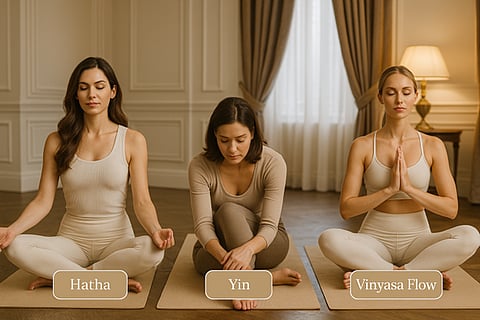
Walk into any yoga class today and you will see mats lined in perfect rows, each person following the same sequence, the same cues, the same flow. It is a beautiful image, but it hides a simple truth: not everybody responds to yoga in the same way. Some people leave class feeling clear and grounded. Others walk out overstimulated, overheated or more depleted than when they arrived.
It turns out this is not a new problem. Thousands of years ago, Ayurveda understood that people move, breathe and recover differently based on their natural body tendencies. While the modern wellness world is just beginning to embrace personalization, Ayurveda treated it as a foundation rather than an afterthought.
This older framework offers a quiet challenge to the one-size-fits-all yoga culture: your practice should match your body, not the latest trend.
Ayurveda, often called the science of living, is one of the earliest systems to look at health as a dynamic, individualized process. It groups people into three broad body types based on observable patterns. Light and quick. Warm and focused. Grounded and steady. These patterns influence not only mood and digestion, but also flexibility, strength, stamina and breath rhythm.
Today we call this personalization. In ancient times it was simply common sense.
The more you explore it, the more obvious the idea becomes. The person who bends in half without trying usually lacks stability. The person who powers through hot yoga with fierce determination often overheats easily. The calm, steady individual may need more activation to feel awake. It is not good or bad. It is simply how their bodies work.
When every student is pushed into the same pace, same temperature and same intensity, someone will inevitably be mismatched. This is the real reason many people quietly drift away from yoga. They think they are not flexible enough or strong enough. In reality, they were simply doing a style that did not match their needs.
Consider what often happens:
The flexible person gets pushed deeper into poses that strain their joints.
The fiery personality gravitates to heated power yoga and leaves feeling drained rather than energized.
The grounded type attends a very slow class and becomes even heavier and unmotivated.
Ayurveda predicted these outcomes long before modern biomechanics or stress research confirmed them.
Ayurveda outlines three main pattern types. Each one thrives with a different style of practice.
These individuals are naturally flexible and creative, but they tire easily and become overstimulated fast. They benefit from slow flows, steady holds, gentle warmth and fewer transitions. Anything too fast or too cold makes them feel ungrounded.
They are strong, sharp and competitive by nature. Their biggest challenge is overheating, both mentally and physically. A better fit for them is moderate pacing, alignment-based flows, cooling twists and a focus on breath over performance.
These individuals often have natural strength and stamina but can feel sluggish without stimulation. They thrive with energizing flows, sun salutations and a warmer room. Slow, restorative classes are comfortable but do not give them the lift they actually need.
Each type gets a different version of yoga, yet all three benefit when the practice is tailored.
One of the most intuitive aspects of Ayurveda is that it allows room for change. Your constitution is not rigid. Stress, seasons, age and lifestyle all shift your needs.
A usually energetic person in winter may need more heat and activation. A fiery personality going through burnout may need grounding instead of intensity. A grounded person in summer may need cooling practices more than stimulation.
Ayurveda is dynamic. Yoga, under this lens, becomes a responsive daily ritual rather than a fixed routine.
The current wellness world is obsessed with personalization. DNA-based diets, wearables, metabolic tracking and nervous system coaching reflect a desire to understand our bodies more precisely. Ayurveda offers a simpler version of the same idea. It does not require a device. You can observe your own tendencies by paying attention.
This is part of the reason many yoga teachers are beginning to revisit Ayurvedic principles. There is a growing recognition that pushing the same sequence on every student misses the point. People feel better, stay consistent and avoid injury when the yoga aligns with their natural patterns.
You do not need to overhaul your life to try this approach. A few simple shifts can make a dramatic difference.
If you feel anxious, choose grounding poses and slower breath.
If you feel overheated or irritable, choose cooling postures and steadier pacing.
If you feel heavy or unmotivated, choose sun salutations and dynamic movement.
Your body already gives you clues. Ayurveda simply helps you understand them.
Yoga becomes deeper, safer and more transformative when you tailor it to your body type instead of expecting one style to work for everyone. Dedicated yogis even incorporate Ayurveda and Sattvic diet as part of their wellness routine. Modern wellness is just catching up to what the ancients already knew: the best practice is the one that matches who you are.
Inspired by what you read?
Get more stories like this—plus exclusive guides and resident recommendations—delivered to your inbox. Subscribe to our exclusive newsletter
The products and experiences featured on RESIDENT™ are independently selected by our editorial team. We may receive compensation from retailers and partners when readers engage with or make purchases through certain links.