
- Locations
- Interviews
- Luxury Home
- Luxury Lifestyle
- Luxury Travel
- Luxury News
- Events
- More
- Magazine

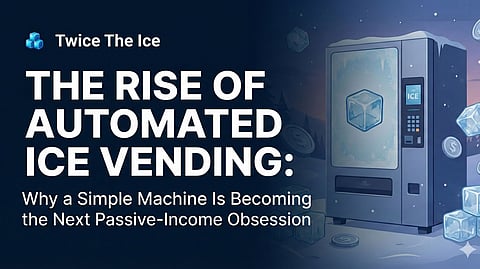
In an era where entrepreneurship often means building something digital, it is surprising to see one of the fastest-growing passive-income models rooted in something far more tangible: ice. Yet across the United States, a new wave of small investors is turning to self-operating ice and water vending machines as a way to generate cash flow without staff, storefronts, or daily management.
The concept, driven by companies like Twice The Ice (twicetheice.org), is simple enough to sound improbable. You choose a location with steady foot or vehicle traffic, install an automated vending unit that produces and bags ice on site, and collect revenue around the clock. No employees, no retail hours, no perishables, no stocking runs, and virtually no customer interaction. It is the vending-machine model reimagined for a generation that values automation more than manual effort.
Despite its simplicity, the numbers behind the business explain why interest is growing so quickly.
Unlike trend-based consumer products that spike and fade, ice is one of the most stable commodities in the American market. From construction sites and fishing docks to sports facilities and neighborhood convenience stops, demand is steady and largely immune to economic swings. Many operators report that summer months can nearly double monthly revenue, providing a seasonal lift that traditional retail businesses envy.
Twice The Ice publishes real-time snapshots of partner performance across the country, offering unusual transparency for an industry that has historically run quietly in the background. It is not uncommon to see machines in Tennessee, Colorado, Arizona, or Washington generate four to six thousand dollars in monthly revenue, with net profits often ranging between fifteen hundred and forty-five hundred dollars per machine depending on location.
For many owners, the appeal is not just the margin structure but the lack of complexity. Water and electricity represent a fraction of the retail price per bag, and with no staff or storefront overhead, the model functions more like an asset than a traditional small business.
For most operators, the process begins with a strategy call focused on assessing territories, traffic patterns, and utility access. The company handles location scouting, lease negotiations, permitting, installation, and machine configuration. Once installed, owners monitor their units through a mobile dashboard that shows live revenue, machine health, payout history, and maintenance alerts.
The equipment itself is engineered to be self-sustaining. It produces purified ice internally, eliminating the need for refills or deliveries, and it operates cashlessly to reduce security risks and simplify accounting. When issues arise, usually software or sensor calibrations, they are often resolved remotely. More serious mechanical needs are managed through a nationwide technician network.
Much like short-term rentals in their early days, the model attracts individuals looking to diversify income without signing up for another full-time job. But unlike real estate, it avoids vacancies, cleaning cycles, and seasonality risks that depend heavily on tourism.
Part of the appeal lies in what automated ice vending is replacing. The typical side hustle now involves stocking online storefronts, managing supplier delays, fighting for traffic on Amazon, or dealing with the unpredictability of Airbnb regulations. By comparison, a self-operating ice machine producing revenue while the owner sleeps feels refreshingly straightforward.
The equipment is not inexpensive. Packages range from roughly twenty-eight thousand dollars for a basic turnkey installation to more than one hundred thousand for multi-unit city-dominance plans, but owners retain full control of the physical asset and its cash flow. Many later resell their machines for three to four times annual profit, similar to income-producing real estate.
The business also carries an unexpected tax advantage. Because the units qualify as capital equipment, many operators are able to use Section 179 deductions to write off a substantial portion of their investment in the first year, significantly reducing the effective cost of entry.
As counterintuitive as it sounds, automated ice vending fits comfortably into the world of remote work and digital convenience. Owners often operate their machines from their phone, approving maintenance requests and tracking revenue in the same way they might check an investment portfolio. The actual product, ice, remains physical, but the management is almost entirely virtual.
The low competition in many regions and the recession-resistant nature of the category have also fueled interest. Unlike saturated online marketplaces, the availability of viable locations limits supply, and companies like Twice The Ice cap the number of new builds each month based on territory availability.
For some, the model becomes a form of decentralized franchising without the royalties or brand restrictions. For others, especially first-time investors, it represents a way to build recurring income without navigating the volatility of e-commerce or the complexity of brick-and-mortar retail.
The resurgence of interest in automated vending is not uniquely about ice. It reflects a broader shift toward businesses that blend physical reliability with digital oversight, offering the stability of offline assets with the convenience of online management. Ice happens to be the category where demand is constant, margins are unusually high, and operations are straightforward enough to scale.
Whether this becomes a lasting trend or a stepping stone to a broader wave of automated local businesses remains to be seen. But for now, in an increasingly digital world, one of the most compelling passive-income stories is rooted in something surprisingly familiar: a machine on a street corner producing ice, day and night, without anyone standing behind it.
Inspired by what you read?
Get more stories like this—plus exclusive guides and resident recommendations—delivered to your inbox. Subscribe to our exclusive newsletter
The products and experiences featured on RESIDENT™ are independently selected by our editorial team. We may receive compensation from retailers and partners when readers engage with or make purchases through certain links.