
- Locations
- Interviews
- Luxury Home
- Luxury Lifestyle
- Luxury Travel
- Luxury News
- Events
- More
- Magazine
- Contact Us

Interior construction accuracy is no longer just a “nice to have” it’s a competitive advantage. In an era where tight timelines, prefabrication, and digital construction workflows dominate the industry, architectural millwork design plays a critical role in determining whether an interior project is delivered seamlessly or plagued by costly rework.
From custom cabinetry and wall paneling to reception desks and integrated storage systems, millwork defines how interior spaces actually come together on site. When millwork design is precise, interiors align perfectly. When it isn’t, even the best architectural concepts can fall apart during execution.
This article explores how architectural millwork design directly impacts interior construction accuracy, the latest CAD-driven trends, and the challenges and opportunities shaping the industry across the USA, UK, and global markets.
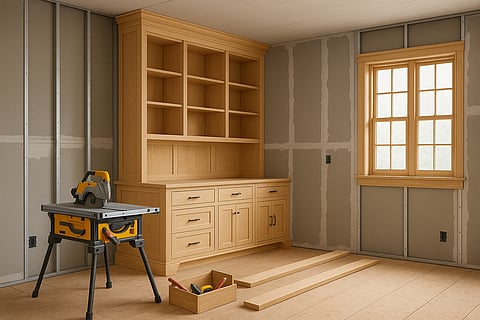
Architectural millwork design sits at the intersection of design intent and build reality.
While architects and interior designers focus on aesthetics and space planning, millwork designers translate those ideas into buildable, measurable, and manufacturable components.
Accurate millwork design ensures:
Components fit exactly as intended
Trades coordinate without clashes
Materials are optimized with minimal waste
Installation happens faster and cleaner
According to data published by Autodesk Construction Cloud, poor design coordination is responsible for up to 30% of construction rework costs, a figure that directly affects interior fit-outs where millwork tolerance is extremely tight.
Rework is one of the biggest profit killers in interior construction projects.
When architectural millwork and design lack precision, common issues arise:
Cabinets don’t align with walls or ceilings
Panels clash with MEP services
Site modifications delay schedules
Custom pieces must be remanufactured
Research from McKinsey & Company shows that rework can account for 5–15% of total construction costs, especially in commercial interiors where customization is high.
Accurate millwork design reduces rework by:
Using detailed shop drawings
Defining tolerances clearly
Coordinating dimensions with structural and MEP layouts
Simulating installation sequences digitally
This is where advanced CAD drafting becomes indispensable.
Modern architectural woodworking and design rely heavily on CAD tools to bridge the gap between design and fabrication.
Today’s millwork CAD workflows enable:
Precise 2D shop drawings
Highly detailed 3D models
Parametric components for design changes
Clash detection with other trades
According to National Institute of Building Sciences (NIBS) data, projects using coordinated digital drawings experience up to 40% fewer design-related errors during construction.
CAD-based millwork design ensures that:
Every panel, joint, and edge is documented
Fabricators receive clear manufacturing instructions
Installers understand sequencing before arriving on site
In premium residential, hospitality, and corporate interiors, expectations are unforgiving.
Clients investing in luxury interiors demand:
Seamless joints
Perfect symmetry
Flush finishes
Consistent material grain alignment
High-quality interior design services depend heavily on millwork accuracy to achieve these outcomes.
Poorly detailed millwork can ruin:
Hotel lobbies
Corporate boardrooms
Retail flagship stores
Luxury residences
According to Statista, the global interior design market is projected to reach over USD 177 billion by 2029, with custom millwork being one of the fastest-growing segments due to demand for personalization.
Accurate millwork design enables designers to push creative boundaries without compromising constructability.
Interior construction involves multiple stakeholders:
Architects
Interior designers
Millwork fabricators
MEP engineers
General contractors
Without accurate millwork drawings, coordination breaks down.
Well-developed architectural millwork design improves coordination by:
Aligning millwork with electrical outlets and lighting
Preventing clashes with HVAC diffusers and sprinklers
Integrating AV systems and smart technology
Supporting prefabrication workflows
A report by Dodge Construction Network highlights that coordinated digital drawings improve collaboration efficiency by over 25%, particularly in interior construction projects with complex detailing.
Millwork design is evolving rapidly, especially in the USA and UK markets.
3D models help teams visualize installation and detect issues before fabrication begins.
Accurate millwork design supports factory-controlled environments, reducing on-site variability.
Material optimization through CAD reduces waste and supports green building certifications.
Millwork is increasingly coordinated within BIM environments for better accuracy.
According to BuildingSMART International, BIM-enabled coordination can reduce design conflicts by up to 60%, significantly impacting millwork-heavy interiors.
Despite technological advancements, challenges remain.
Incomplete architectural drawings
Late-stage design changes
Lack of standardized millwork documentation
Poor communication between designers and fabricators
In fast-track projects, these issues often lead to rushed detailing, which directly affects construction accuracy.
This is why experienced CAD professionals and detailed millwork drafting are more critical than ever.
Time is money in interior construction.
Accurate architectural millwork and design help accelerate timelines by:
Reducing RFIs during construction
Allowing parallel fabrication and site preparation
Minimizing installation errors
Supporting just-in-time delivery
According to Construction Industry Institute (CII) studies, projects with detailed preconstruction planning including millwork detailing finish up to 20% faster than those without.
Many US and UK firms are outsourcing millwork CAD drafting to specialized teams.
The reasons include:
Access to skilled CAD professionals
Faster turnaround times
Cost efficiency without quality compromise
Scalability for large projects
Outsourced teams often focus exclusively on architectural woodworking and design, bringing deeper expertise than general drafting teams.
As interiors integrate more technology, smart storage, concealed wiring, modular systems, millwork accuracy becomes even more critical.
Future-ready interiors require:
Precise tolerances
Flexible components
Adaptable layouts
Architectural millwork design enables this adaptability without sacrificing accuracy or aesthetics.
Interior construction accuracy doesn’t happen by chance. It is the result of meticulous architectural millwork design, detailed CAD drafting, and coordinated workflows.
As projects become more complex and client expectations continue to rise, millwork design will remain a cornerstone of successful interior delivery.
For architects, contractors, and developers in the USA, UK, and beyond, investing in accurate millwork design is not just about reducing errors, it's about delivering interiors that perform, impress, and endure.
Many firms today collaborate with experienced CAD design partners, including leading UK-based CAD design companies, to ensure millwork precision aligns with modern construction demands without compromising creativity or efficiency.
Inspired by what you read?
Get more stories like this—plus exclusive guides and resident recommendations—delivered to your inbox. Subscribe to our exclusive newsletter
The products and experiences featured on RESIDENT™ are independently selected by our editorial team. We may receive compensation from retailers and partners when readers engage with or make purchases through certain links.