
- Locations
- Interviews
- Luxury Home
- Luxury Lifestyle
- Luxury Travel
- Luxury News
- Events
- More
- Magazine
- Contact Us

If you're rolling in a classic muscle car or an older truck equipped with a 2bbl carburetor, you know the drill: It’s dependable, gets decent gas mileage, and starts right up. But when you put your foot down and demand real power, especially once that needle swings past 4000 RPM, the engine feels like it's running out of breath.
That feeling is the bottleneck. Your 2bbl carburetor is fundamentally limited in flow (CFM). While great for street cruising, it simply cannot feed a hungry V8 engine the massive volume of air and fuel it needs to unleash its true potential at high RPMs.
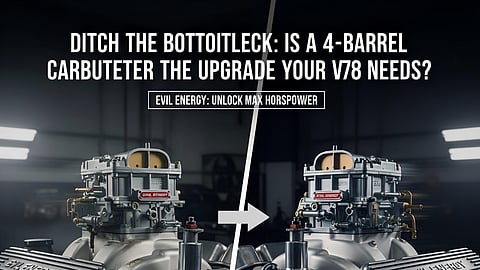
The goal of any great performance upgrade is to match the flow. Moving to a 4-barrel carburetor is the fastest way to add significant horsepower and improve that coveted high-end pull. It's the moment your V8 engine gets to truly stretch its legs.
In the V8 engine community, choosing a 4-barrel carburetor often leads to intense debate. Here’s our straightforward take on the questions mechanics and enthusiasts discuss most:
The Debate: Modern EFI (Electronic Fuel Injection) offers superior efficiency and cold starts. Why choose an EVIL ENERGY 4-barrel carburetor?
Our Take: For classic muscle car platforms, the carburetor offers simplicity, vintage aesthetics, and raw power unmatched by costly EFI conversions. The 4-barrel carburetor provides accessible, hands-on tuning and a lower initial investment, keeping the project authentic and manageable for the average enthusiast.
The mechanism that opens the second set of barrels is crucial:
Vacuum Secondaries (Street/All-Purpose): The secondaries open based on engine load/vacuum. This is the best choice for heavier vehicles (trucks) or street cars, preventing bogging and smoothing out the transition. It's the most forgiving setup.
Mechanical Secondaries (Track/Drag): The secondaries open directly with the throttle linkage. This provides instant, aggressive power delivery—great for drag racing where you need maximum fuel delivery right off the line.
The Mistake: Many users simply guess or oversize their 4-barrel carburetor.
The Rule: The optimal CFM is calculated based on your engine's displacement (CID) and its maximum operating RPM. While our EVIL ENERGY 750 CFM unit is the industry sweet spot for most performance 350-450 CID V8 engines, always use the formula to confirm:
$$CFM = \frac{CID \times Max \ RPM}{3456} \times Volumetric \ Efficiency$$
If your build targets extremely high RPM (7000+), you might need a higher CFM unit, but 750 CFM covers most street/strip V8 engine builds.
Our EVIL ENERGY 750 CFM 4-barrel carburetor is engineered for performance enthusiasts. It operates with a clever dual-stage system:
Primaries (Street): The two smaller primary barrels handle daily driving, idling, and light cruising. They ensure smooth response and respect your fuel economy, much like a well-mannered 2bbl carburetor.
Secondaries (Strip): When you mash the throttle, the two large secondary barrels kick open instantly, delivering an explosive rush of air/fuel mixture. This is where the EVIL ENERGY power is unleashed.
We offer two reliable, high-value carburetors to fit your specific needs:
To earn your trust, we need to talk about the reality of the swap. Upgrading your 2bbl carburetor is a system overhaul, not just a simple bolt-on:
The Big Question: "I want to put a 4-barrel carburetor on my Mustang, do I need to swap the manifold?"
The Truth: Yes, absolutely. The mounting flange for a 2bbl carburetor is completely different from a 4-barrel carburetor (often referred to as a "square bore"). While adapters exist, they restrict airflow and choke your new 750 CFM carb. To maximize the performance of your EVIL ENERGY 4-barrel carburetor, a dedicated performance intake manifold is essential.
Budgeting: Be realistic. The swap involves the new 4-barrel carburetor, the intake manifold, and potentially fuel line upgrades to handle the higher flow.
Tuning (Dialing In): A 4-barrel carburetor requires more expertise for precise tuning than a basic 2bbl carburetor. Getting the air/fuel mixture perfect (the "sweet spot") for both street cruising and wide-open throttle takes time, jetting changes, and patience.
If your V8 engine is mostly stock, you never visit the strip, and your priority is easy maintenance and gas mileage, then the reliable EVIL ENERGY 350 CFM 2bbl carburetor is your best bet. Don't pay for horsepower you won't use.
Your V8 engine is capable of more than you think. The shift from a limiting 2bbl carburetor to a free-flowing carburetor 4 barrel is the moment you transform your classic ride into a true muscle car performer.
The EVIL ENERGY lineup offers the right solution for any goal—from the proven dependability of our 2bbl carburetor to the raw power of our 750 CFM 4-barrel carburetor.
Inspired by what you read?
Get more stories like this—plus exclusive guides and resident recommendations—delivered to your inbox. Subscribe to our exclusive newsletter
The products and experiences featured on RESIDENT™ are independently selected by our editorial team. We may receive compensation from retailers and partners when readers engage with or make purchases through certain links.