
- Locations
- Interviews
- Luxury Home
- Luxury Lifestyle
- Luxury Travel
- Luxury News
- Events
- More
- Magazine
- Contact Us

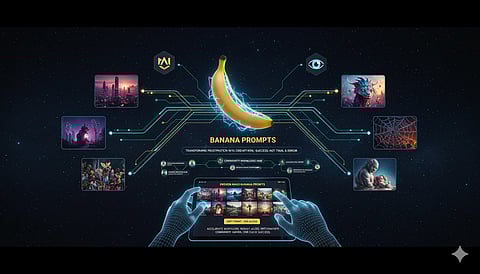
AI-based image creation is more complicated than simply entering text into a prompt box. The distinction between the disappointing results and the visuals of the professional grade is often based on the organization of instructions by the creators. This comprehensive guide explores banana prompts—optimized text commands that unlock the full potential of AI image generators.
Generators of AI images do not process text in the same way as people do. These systems decode prompts of particular visual elements, style, or compositional elements. By knowing this process of interpretation, the creators develop control over outputs instead of relying on chance.
Image banana prompts represent a refined approach to AI communication. These are brief, tactically written instructions that maximize the creative output and minimize the time wasted on non-productive variations. The methodology aims at accuracy, transparency, and established standards that consistently provide quality of various AI platforms.
Prompts are blueprints as opposed to casual descriptions. Each word adds to the result of the visual, i.e., careful building yields far superior results compared to throwing money at a wall.
Successful banana prompts reveal consistent structural patterns that creators can replicate across projects.
The unexpected prompts start with the crystal clear identification of the subject. As opposed to generic words, excellent prompts use particular qualities that reduce the range of interpretations of the AI. A topic that is said to be weathered fisherman gives better guidelines than just a man, whereas an iridescent hummingbird hovering near crimson hibiscus is better than a bird and a flower.
Artificial intelligence recognizes thousands of artistic styles, including classical styles and modern digital ones. Style indicators such as Studio Ghibli animation aesthetics, Dutch Golden Age painting, and modern-day fashion photography already determine the visual system.
Several style sources generate distinct hybrid styles. The blending of art nouveau and futuristic architecture, vintage travel posters, and isometric game design all give unique effects that cannot be attained by one-style prompts.
Image creation by professionals uses camera and illumination terminologies that are largely ignored by the majority of creators. The words used to refer to focal length, aperture effects, lighting setups, and perspective cause a dramatic effect on the quality of output.
Technical targets such as shots on an 85mm lens, shallow depth of field, golden hour lighting, or wide-angle 24mm, dramatic shadows, and high contrast provide an AI model with the technical goals needed to enhance realism and professionalism.
Prompts are interpreted differently by different platforms of AI. What works outstandingly in a certain system may not work well in a different system.
Midjourney is good at artistic and stylistic requests. It reacts to art movement allusions and aesthetic characterizations. The creators who are using this platform have the advantage of focusing on mood, atmosphere, and the artistic lineage.
Stable Diffusion is flexible and fine-tuned, especially when users exploit model-specific training. This platform can have more technical prompts. They include names of the particular artists, exact values of colors, and instructions for compositions.
Flux and more video-oriented tools, such as Runway, Sora 2, Veo 2, and Veo 3, need temporal aspects outside of moving image generation. Prompts need to take into consideration movement, transitions, and storyline flow across frames.
The users of Nano Banana Pro enjoy the knowledge of the balance between speed and quality of this platform. It enables rapid iteration without compromising the output quality.
Even experienced authors make mistakes that undermine their conclusions.
An unknown language results in an interpretation that is not predictable. Such words as "good-looking," "interesting," and "cool" do not have any visual representation to the AI systems. Objective visual terms are superior substitutes for abstract adjectives.
Prompt overloading is a situation in which creators include too many conflicting ideas into a single instruction. AI models have issues with such contradictions as photorealistic cartoons or minimalist baroque. It is best to have one direction per generation.
Negative prompts are ignored, and thereby unwanted elements are bypassed. On the majority of platforms, negative instructions are possible, which explicitly exclude such issues as distorted anatomy, blurriness, pixelation, and watermarks. Such filters bring in significant consistency.
Neglected aspect ratio and resolution place technical specifications in default settings, which may not be in accordance with project needs. A specification has to be done concerning the intended use.
Copying without making changes implies that the prompts of other contexts are used without making changes to the needs. A product photography prompt is not necessarily a prompt that is useful in character illustration.
Different professional contexts demand tailored approaches to image banana prompts.
Marketing departments must have brand-congruent imagery that matches pre-existing visual identities. Their prompts are highlighted on color schemes, compositional balance, and emotional appeal to target audiences.
Game developers need asset creation and stylistic consistency for hundreds of objects. Their cues are regular lighting, a similar point of view, and compatible styles of art.
The creators of social media images are more focused on attentional compositions, trendy looks, and fast-moving content to experiment with various ideas in a short period of time.
Freelance designers who deal with various customers require versatile, quick solutions. These are flexible to different brand requirements, industry conventions, and project specifications.
Banana prompts transform AI image generation from frustrating experimentation into reliable creative production. Leveraging the knowledge of AI and comprehending the manner in which it interprets instructions, the implementation of established structural patterns, and learning through the insights of the community can lead to success instead of trial and error.
For creators ready to accelerate their workflow without hours spent on testing variations, Bananaprompts offers immediate access to proven nano banana prompts across all major AI platforms. Live examples of creators with experience to use, effective prompts that can be copied immediately, and AI art creations of high quality are now available. The community-based and free platform offers the solution to improved outcomes at the reach of a single click.
Inspired by what you read?
Get more stories like this—plus exclusive guides and resident recommendations—delivered to your inbox. Subscribe to our exclusive newsletter
The products and experiences featured on RESIDENT™ are independently selected by our editorial team. We may receive compensation from retailers and partners when readers engage with or make purchases through certain links.