
- Locations
- Interviews
- Luxury Home
- Luxury Lifestyle
- Luxury Travel
- Luxury News
- Events
- More
- Magazine

True luxury is often felt before it is seen. We spend months selecting the perfect marble for the kitchen island, the exact thread count for the linens, and the most evocative art for the walls, yet the most powerful design element in any home remains entirely invisible. Scent-scaping, the art of olfactory interior design, is the final layer of a curated lifestyle. It is what transforms a cold, beautiful room into a living sanctuary with a distinct soul. Much like a bespoke suit or a signature perfume, the way your home breathes tells a story to every guest who crosses the threshold. To master the atmosphere of your space is to master the art of the 'invisible decor,' creating an environment where luxury isn't just a look, but a lingering feeling.
In a thoughtfully designed home, every room serves a different purpose. Just as you wouldn’t place a velvet sofa in a kitchen or a desk in the center of a bathroom, your fragrance choices should reflect the function and "energy" of the space. This is known as scent-zoning.
The foyer is your home’s first impression. To create an atmosphere that feels both expansive and welcoming, opt for "clear" and airy scents. The vibe should be sophisticated, crisp, and bright.
Key Notes: Silver fir, bergamot, white tea, or a light neroli.
Luxury Tip: Use a large-format reed diffuser here. It provides a constant, effortless "waft" that greets you the moment you open the door without the need to light a flame.
This is where luxury meets comfort. The living room requires a scent with "texture", something that feels as rich as the upholstery. The vibe should be warm, conversational, and layered.
Key Notes: Sandalwood, cedar, amber, or soft leather.
Luxury Tip: This is the perfect place for a statement candle. The flickering light adds a visual layer of "hygge" (cosiness) that complements the depth of the fragrance.
The biggest mistake in home scenting is trying to mask kitchen odors with heavy florals or "bakery" scents. Instead, look for fragrances that cleanse the air. Think botanical, fresh, and restorative.
Key Notes: Crushed mint, tomato leaf, basil, or Meyer lemon.
Luxury Tip: Avoid gourmand scents like vanilla here; they often clash with actual cooking. A high-end kitchen soap and lotion set in a citrus scent can act as a functional decor piece.
Your bedroom is a transition space from the public self to the private self. The scent here should be intimate and conducive to "unwinding" to create a serene, velvet-soft, and quiet vibe.
Key Notes: Palo Santo, French lavender (not the medicinal kind, but the honeyed version), iris, or cashmere musk.
Luxury Tip: Mist your linens with a bespoke pillow spray thirty minutes before bed. It creates a sensory ritual that signals to your brain that the day is officially over.
Now that we’ve mapped out the scent for each room, we must consider the delivery system. In a luxury lifestyle context, the object providing the scent is just as important as the fragrance itself, it serves as a piece of functional art.
Luxury scenting is not a "one size fits all" endeavor. To achieve a professional, hotel-level atmosphere, you must choose the right medium for the volume of the room and the desired intensity.
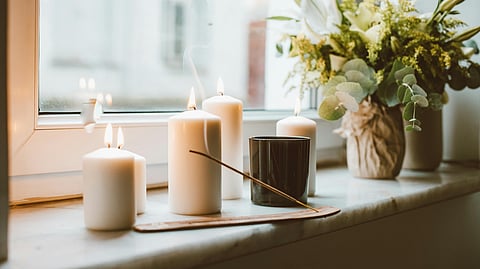
The candle is the "couture" of home fragrance. It is less about constant scenting and more about the ritual of the moment. These are the best for living rooms, dining tables, and bath-side relaxation.
The Luxury Detail: Look for hand-poured waxes (beeswax or soy) and high-quality mineral wicks. A Trudon or Diptyque vessel is designed to be repurposed as a decorative object (for brushes or florals) long after the wax is gone.
Pro Tip: Never blow out a luxury candle; use a wick snuffer to prevent smoke from tainting the fragrance you’ve just spent hours building.
If a candle is a performance, a reed diffuser is the background music. It provides a constant, low-level scent that ensures a room never feels "stale." These are ideal for entryways, hallways, and guest bathrooms.
The Luxury Detail: Quality matters here. Cheaper diffusers often smell of alcohol and "clog" the reeds. Luxury versions use high oil concentrations that can last six months or more.
Maintenance: Flip the reeds once a week to "refresh" the scent throw.
This is the secret behind the scent in five-star hotel lobbies (like the Edition or Ritz-Carlton). Unlike traditional diffusers that use water or heat, these machines use high pressure to atomize pure essential oils into a dry mist. They perfect for large, open-concept spaces or homes with high ceilings.
The Luxury Detail: Many of these units can be programmed via smartphone to scent your home only during the hours you are awake, preserving your precious oils.
The Benefit: It covers the largest square footage without the "dampness" of a regular humidifier-style diffuser.
Think of these as the "jewelry" of your home's outfit. They provide an immediate, concentrated burst of fragrance.
Best For: Refreshing upholstery before guests arrive or lightly scenting curtains so the breeze carries the fragrance throughout the room.
The Luxury Detail: Opt for "Alcohol-Free" mists to ensure they don't damage delicate silks or velvet fabrics.
To achieve an atmosphere that feels effortless rather than overwhelming, one must follow the unspoken etiquette of home fragrance. Luxury is defined by restraint; it is the art of the "lingering presence" rather than a sensory assault.
A luxury home should never smell like a perfume counter. The goal is the "waft": a subtle hint of fragrance that appears and disappears as you move through a room. If a guest can identify the scent immediately upon entering, it is likely too strong. If you are using a nebulizer, set it to 20% capacity. If you are lighting multiple candles, ensure they share a common base note (like sandalwood or musk) to avoid olfactory chaos.
Nothing breaks the spell of a gourmet meal faster than the cloying scent of a heavy floral lily or a synthetic vanilla candle. All scented media in the dining room should be extinguished at least 30 minutes before a meal is served. If you must have a scent during dinner, stick to unscented tapered candles for ambiance, or a very light "herbal" diffuser tucked far away from the table.
Just as you wouldn't wear a heavy shearling coat in July, your home shouldn't be cloaked in heavy "Fireside" scents during the spring. Transition your home’s "wardrobe" quarterly.
Spring/Summer: Focus on mineral, aquatic, and green botanical notes.
Autumn/Winter: Lean into resins, spices, smoked woods, and "velvet" textures which you often find in Arabian fragrances.
In the luxury market, we prioritize the purity of ingredients. Cheaper candles often use paraffin wax, which releases soot and can give guests headaches. Look for "clean-burning" labels and natural essential oil blends. A high-quality scent will have a "three-dimensional" quality, top, heart, and base notes, just like a fine personal perfume.
In interior design, "white space" allows the eye to rest. In scenting, "silence" allows the nose to reset. Do not scent every single square inch of your home. Leave transitions (like a stairwell or a specific hallway) scent-neutral. This prevents "nose blindness" and ensures that when you step into a scented zone, the impact is renewed.
Connoisseur's Tip: Always trim your candle wicks to 1/4 inch before every lighting. This prevents the glass from charring and ensures the flame stays small and sophisticated, rather than tall and flickering.
Ultimately, scent-scaping is the most intimate form of hospitality you can offer, both to your guests and to yourself. It is the invisible thread that sews together the disparate elements of a room, turning a collection of beautiful objects into a living, breathing narrative. When you curate the scent of your home with the same intention as the art on your walls, you create a space that doesn't just look like a luxury; it feels like an escape.
In a world that is increasingly loud and fast, there is a quiet, profound power in returning to a home that smells of your own curated peace. It is the final layer of the "quiet luxury" movement: a secret shared between you and your four walls, lingering in the air long after the candles have been snuffed and the lights have dimmed. After all, the most memorable homes aren't just those we see, but those we remember with our hearts and our senses.
Inspired by what you read?
Get more stories like this—plus exclusive guides and resident recommendations—delivered to your inbox. Subscribe to our exclusive newsletter
The products and experiences featured on RESIDENT™ are independently selected by our editorial team. We may receive compensation from retailers and partners when readers engage with or make purchases through certain links.