
- Locations
- Interviews
- Luxury Home
- Luxury Lifestyle
- Luxury Travel
- Luxury News
- Events
- More
- Magazine

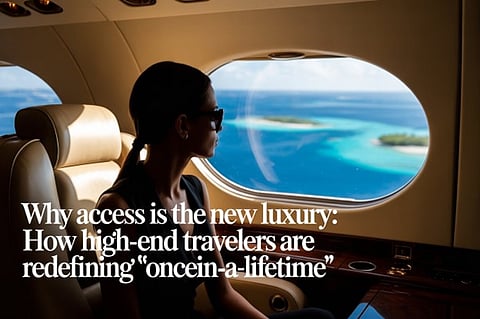
For many affluent travelers, luxury no longer means adding another five-star logo to a list. It increasingly means gaining thoughtful access to people, places and perspectives that are not available through standard itineraries. This shift from excess toward intentional experiences is reshaping how “once‑in‑a‑lifetime” journeys are planned and evaluated.
Travel surveys among high-end travelers reveal growing interest in privacy, time, and experiential learning over sheer suite size and wine lists. Industry reports indicate increased demand for longer stays, slower travel via train or boat, and single-theme itineraries centered on marine conservation, regional cuisine, and other topics. Together, these trends illustrate that the primary inquiry has transitioned from "what can I add?" to "what deserves my attention?"
Travelers define "access" as a form of luxury when referring to the types of encounters and settings that standard programs do not offer. Typically, examples will fit into three categories.
First, there is temporal access. Private or after-hours access to cultural institutions, laboratories, or conservation areas provides a unique encounter by eliminating crowds and allowing for extended conversation with experts present on-site. Second, there is relational access, i.e., small-group discussions with researchers, winemakers, chefs, or community leaders who typically operate behind the scenes. Third, there is geographic and regulatory access. Some islands, polar regions, and protected reserves limit the number of visitors by implementing permit requirements, vessel limits, or seasonal restrictions. Visiting these locations while respecting local and environmental regulations requires extensive planning, familiarity with local regulations, and often long-term partnerships with local operators. Many times, traditional package tour operators cannot accommodate the needs of luxury travelers due to their inflexibility. Therefore, bespoke tailor-made travel experiences become essential to combine route development, scheduling, and specialized guides to match the desires and limitations of individual travelers.
Creating a journey around access begins long before departure. Typically, high-end travel planners have a detailed conversation with clients to cover more than just budget and travel dates. Conversations may include previous trips that were most memorable or disappointing; client's preferred travel pace; client's desire for physical activity; and the extent to which clients would like to interact with local communities or subject matter experts. Based upon the client's profile, the planner will identify a few key anchors. Anchors could be a short window during which a wildlife event is observable; a research project that allows for limited visitor days; or a cultural event with restricted seating. From here, routes and overnight stays are developed to minimize unproductive travel time and allow for restorative time between days that are heavily scheduled.
To ensure that the itinerary is both enjoyable and safe, the quality control process involves a combination of formal and informal assessments. When developing a journey on a boat, for example, safety records, ice-class ratings, and guide-to-guest ratios are assessed against global standards and inspected by port authorities. Onshore accommodations are assessed using a similar method including examining licenses, employee training, group size and the management practices of local partners regarding wildlife and/or cultural heritage site interactions. Where there is a concern that excessive tourism may negatively affect local infrastructure, travel plans are adjusted to respect those concerns, including the number of travelers and the timing of the trip.
Throughout the entire planning process, open communication occurs with the client. Clients are provided with clear information about what is assured, what is conditional, and what is dependent upon obtaining permits or favorable weather. Openly providing clients with this type of information minimizes the potential for disappointment and is critical when the focus is on experiences that are non-repeatable.
Reports from industry sources discussing the evolution of luxury values emphasize a larger reevaluation of success metrics. Rather than evaluating based on nights or amenities, providers and clients are increasingly looking at the quality of service, relevance of the activities offered and the degree to which travelers feel they have learned something new from their journey.
Using the Galapagos Islands as an example, a traveler who spends several consecutive days with the same naturalist team in a specific area of the Galapagos will likely develop a deeper understanding of the ecosystem than one traveling the Galapagos quickly and seeing a multitude of sites. Likewise, a traveler who develops a comprehensive understanding of a single wine region and its vintners and vineyards is likely to retain far more knowledge than one tasting a variety of wines across numerous wine regions in a brief amount of time.
Inspired by what you read?
Get more stories like this—plus exclusive guides and resident recommendations—delivered to your inbox. Subscribe to our exclusive newsletter
The products and experiences featured on RESIDENT™ are independently selected by our editorial team. We may receive compensation from retailers and partners when readers engage with or make purchases through certain links.