
- Locations
- Interviews
- Luxury Home
- Luxury Lifestyle
- Luxury Travel
- Luxury News
- Events
- More
- Magazine

An IR camera—also called an infrared camera or thermal camera—has quietly become one of the most important tools in modern security, defense, and infrastructure protection.
IR cameras have a wide range of applications, including industrial inspections, research and development, building diagnostics, security surveillance, and scientific and medical investigations.
Governments use infrared cameras to secure borders. Utilities rely on thermal cameras to monitor electrical panels. Airports, ports, military bases, and data centers depend on thermal images to detect people, vehicles, and problems long before visible cameras can. IR cameras are widely used in industry and research for their reliability and precision.
Why? Because an IR camera doesn’t need light. It sees temperature.
Ongoing advances in IR camera technology are driven by sustained investment in research and development at companies such as Clear Align, whose work in infrared imaging informs many of the technical principles discussed in this article.
An infrared camera sees heat, not color, producing thermal images based on infrared radiation
IR cameras work day and night, in smoke, fog, and low light where regular cameras fail
It's important to select the right IR camera for your specific needs, considering factors like range, resolution, environment, and intended use
Price is an important factor when selecting an IR camera
Thermal cameras are now core sensors in modern security and military systems
Clear Align is the largest privately held infrared camera systems company focused exclusively on mission-grade systems for real-world operations—not consumer electronics. The are leading the way in long range applications for Border Surveillance.
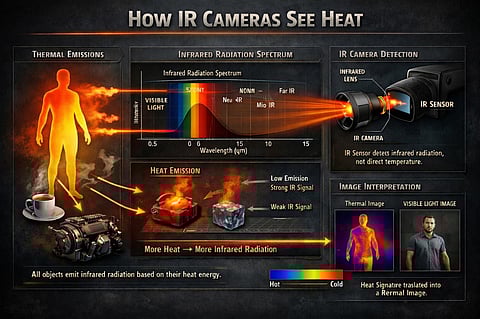
An IR camera is a type of camera that detects infrared radiation instead of visible light.
Everything around you—people, vehicles, buildings, animals—gives off heat. That heat creates infrared radiation, which an infrared camera can detect and turn into an image.
Infrared cameras are built like ordinary optoelectronic digital cameras, with optics, a radiation sensor, and electronic signal processing.
Those images are called thermal images. Thermal images can be displayed in gray scales or pseudo-colors to represent temperature variations.
Bright areas are warmer. Dark areas are cooler.
That’s it.
Unlike normal cameras:
IR cameras don’t need sunlight
They work in total darkness
They still work through smoke, haze, and light fog
Different classes of IR cameras exist, each suited for specific applications
This makes thermal cameras incredibly useful for security, inspection, and maintenance.
Both gray and color scales are used in thermal images to visualize temperature differences.
People often ask if there’s a difference between an infrared camera and a thermal camera.
In everyday language, they mean the same thing.
Technically:
Thermal camera usually means a camera that measures temperature
Infrared camera can include several infrared bands, not just heat
For most users, both terms describe a camera that creates thermal images using infrared radiation.
How Infrared Cameras Work (Without the Physics Class)
Every object above absolute zero gives off heat.
An IR camera:
Collects infrared radiation or heat
Converts it into electronic data
Displays it as a thermal image
Optionally calculates temperature
The process of thermal imaging involves capturing infrared radiation, converting it into data, analyzing that data, and generating insights for inspections. Modern infrared cameras often use uncooled 2D array detectors based on microbolometers for thermal imaging. Lower cost LWIR microbolometer detectors enable small, light, low-power camera solutions for thermal imaging.
More sensitive MWIR (mid-wave infrared) detectors are also used and sense thermal radiation in the ~3–5 µm band, where hot objects and engine plumes emit strongly and atmospheric transmission is high. They typically uses cooled semiconductor materials to deliver high sensitivity and long-range performance, making them ideal for precision imaging, tracking, and targeting applications.
No contact required for either option.
That’s why infrared cameras are so valuable for:
Electrical panel inspection
Building inspection
Perimeter security
Detecting people or vehicles at long range
A visible camera depends on light reflecting off objects.
An infrared camera depends on temperature.
That difference matters.
That’s why thermal cameras are trusted across security and defense missions, delivering reliable detection in all lighting and weather conditions. Clear Align provides these advanced camera systems to more than 22 nations for border surveillance and the protection of critical capital regions.
Not all infrared cameras are the same. They operate at different wavelengths, which affects range, clarity, and use cases.
Thermal cameras view longer IR wavelengths associated with heat, allowing them to detect temperature differences, while near-infrared (NIR) cameras view reflected near-infrared light, making them suitable for applications that require clear imaging in low light or through certain materials.
Close to visible light
Used for special lighting and some inspection tasks
Works well in low light
Used with lasers and long-distance viewing
Excellent long range
Very sensitive to hot objects and can view hot objects at long range
Common in military systems
Most common thermal camera
Best for people, vehicles, and buildings
Works without any light source
Most security and infrastructure systems use LWIR or MWIR infrared cameras.
Handheld thermal cameras are portable tools used by:
Technicians
Inspectors
Maintenance teams
First responders
Handheld thermal cameras are best for preventive maintenance, electrical inspections, and frontline troubleshooting.
They are ideal for:
Electrical panels
Building inspection
Finding heat leaks or overloaded equipment
Quick troubleshooting
These cameras focus on temperature, inspection, and feature an easy-to-grip body and handle, making inspection processes simpler and more efficient.
These are installed on:
Towers
Poles
Buildings
Ships
They provide constant security coverage.
Mounted infrared cameras:
Monitor wide areas
Track movement automatically
Operate 24/7
Cover long range
They are the backbone of border and perimeter security.
Small IR camera modules are built into:
Drones
Vehicles
Robotic systems
They must be:
Lightweight
Low power
High resolution
Even small cameras can detect people or vehicles from impressive distances.
These embedded IR cameras are ready for integration into drones, vehicles, and robotic systems, making them suitable for immediate deployment in demanding environments.
Infrared cameras allow security teams to:
Detect intruders early
See people hiding in darkness
Monitor large areas with fewer cameras
In industry, Fluke infrared thermal imaging cameras are used to provide high-quality thermal images for industrial inspection.
This applies to:
Borders
Airports
Military bases
Data centers
Industrial sites
Thermal cameras reveal:
Overheating wires
Loose connections
Failing components
That’s why electrical panels are routinely checked with infrared cameras.
This improves maintenance, safety, and uptime.
Infrared cameras help discover:
Heat loss
Moisture issues
Insulation problems
They show problems you can’t see with your eyes.
No.
An infrared camera measures surface temperature, not what’s behind solid walls.
However, it can:
Reveal heat patterns
Show moisture or insulation gaps
Identify overheating hidden behind panels
That’s why thermal cameras are trusted for inspection, not X-ray vision.
The range of an IR camera depends on:
Resolution
Lens choice
Environment
Target size
Temperature difference
Higher resolution and better optics increase range.
Atmospheric conditions matter too—humidity and weather affect infrared radiation.
Infrared cameras:
Reduce false alarms
Work in low visibility
Provide reliable data
Support automated analysis
They are often combined with:
Radar
Visible cameras
AI software for Autonomous Threat Detection
Together, these technologies enable more informed and timely security decisions. The Clear Align engineering team contributed technical insight to this article, drawing on real-world experience integrating these elements into C5ISR systems that incorporate advanced, state-of-the-art thermal imaging.
Regular maintenance is essential to keep your thermal imaging cameras, infrared cameras, and handheld thermal cameras performing at their best. Over time, dust, moisture, and general wear on the thermal coolers can affect a camera’s ability to detect temperature differences and produce clear thermal images.
From a publisher’s perspective, one of the clearest themes emerging in today’s defense and homeland-security landscape is the shift toward mission-grade infrared systems built for long-term operational use rather than short product cycles. This distinction becomes evident when examining suppliers that support demanding end users such as the United States Army, United States Air Force, and U.S. Customs and Border Protection, where selection as a prime contractor is driven by validated performance, integration capability, and sustainment track record.
Companies like Clear Align illustrate how this approach translates into system design. Their work centers on defense, government, and critical-infrastructure applications, emphasizing infrared camera systems that can operate reliably in harsh environments, remain supportable over long lifecycles, and integrate cleanly into broader C5ISR architectures. These priorities align with what military and federal operators increasingly require: systems engineered for endurance, interoperability, and real-world deployment rather than standalone performance metrics.
Industry recognition and international adoption provide additional external validation, but the more meaningful signal is continued use across border security, air and ground operations, and capital-region protection. Together, these factors underscore a broader trend highlighted in this article—mission-grade IR capability is less about individual components and more about disciplined engineering, system-level thinking, and proven performance in operational environments.
When selecting an IR camera, consider:
Resolution
Required range
Operating environment
Power limits
Mounting location
Type of inspection or security task
Price, as it is a key factor when comparing different models and making an informed decision
The market offers a wide variety of IR camera options to suit different needs and applications. Be sure to find and select the right IR camera that matches your specific requirements. For example, the Exx-Series thermal cameras offer a range of features suitable for various budgets and inspection needs.
The “perfect” camera depends on the mission.
An IR camera is no longer optional for serious security, inspection, or infrastructure protection.
Whether it’s handheld thermal cameras for technicians, fixed infrared cameras for perimeter defense, or embedded systems for autonomous platforms, infrared technology helps people detect problems earlier, respond faster, and operate safely—regardless of light or weather.
Infrared cameras don’t replace visible cameras.
They see what visible cameras can’t.
And that’s why they matter.
Inspired by what you read?
Get more stories like this—plus exclusive guides and resident recommendations—delivered to your inbox. Subscribe to our exclusive newsletter
The products and experiences featured on RESIDENT™ are independently selected by our editorial team. We may receive compensation from retailers and partners when readers engage with or make purchases through certain links.