
- Locations
- Interviews
- Luxury Home
- Luxury Lifestyle
- Luxury Travel
- Luxury News
- Events
- More
- Magazine

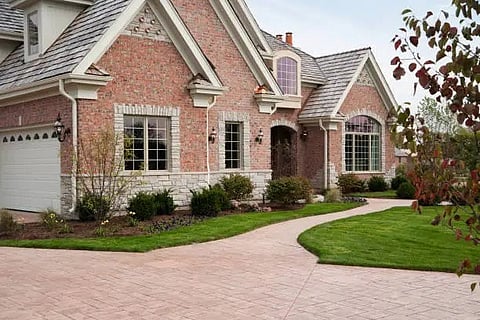
In a neighborhood where every home feels a little bit the same, the driveway is often the first surface guests actually experience—not just see. Yet for many properties, it is still poured as a plain gray slab that does nothing for the architecture or the landscape design.
For homeowners who care about texture, tone, and the quiet signals of luxury, a driveway concrete stamp is one of the most powerful ways to upgrade curb appeal without rebuilding the entire front of the house.
By pairing structural concrete with patterned stamp mats, you can turn a purely functional surface into a deliberate design element that frames the home from the street all the way to the front door.
A driveway concrete stamp is a patterned mat—usually made from high‑performance polyurethane—that is pressed into fresh concrete to create the look and feel of:
Hand‑laid stone or slate
Classic brick or cobblestone
Wide, weathered wood planks
Tumbled pavers with softened edges
Instead of installing individual stones, the concrete is placed as usual, then textured in sections. The result is a monolithic slab with the visual language of cut stone or artisan masonry.
For driveways, this balance of structure and surface is important: you get the strength and low maintenance of concrete, paired with the aesthetics of more intricate materials.
From the curb, a stamped driveway acts like a custom entry rug for the entire property. It sets expectations before guests have stepped out of the car.
Well‑selected patterns can:
Echo masonry details on the facade or entry steps
Pick up tones from the roof, shutters, or landscape stone
Guide the eye naturally toward the front door or courtyard
Done right, the driveway stops feeling like leftover negative space and becomes part of the home’s architecture.
Natural stone driveways are beautiful, but they can be:
Costly to install over large areas
Vulnerable to settling and shifting
Labor‑intensive to maintain
A stamped concrete driveway offers a different equation:
One continuous structural slab beneath the pattern
Fewer joints for weeds, shifting, or snowmelt to exploit
A surface that can be sealed against stains from vehicles and weather
For households where cars, kids, deliveries, and parties all use the same space, this mix of resilience and refinement is essential.
"Stamped concrete" does not have to mean faux stone in a single shade of tan. Modern driveway concrete stamp systems support a wide range of aesthetics:
Minimal, large‑format slate layouts for contemporary homes
Timeworn cobblestone or brick bands for historic properties
Wood‑plank patterns that soften modern farmhouses or coastal homes
Mixed borders and insets that echo interior flooring transitions
By layering integrally colored concrete, release agents, and stains, installers can create depth and variation that feels much closer to natural material than the flat, one‑note finishes of the past.
Think of the driveway not just as a parking surface, but as an extension of your outdoor living areas.
Use a tighter, more refined stamp pattern in the center drive lane and a complementary border at the edges. This visually narrows a wide drive, creates a “runway” effect, and makes the arrival feel intentional rather than purely utilitarian.
Carry the same stamp pattern—or a scaled‑down version—from the driveway through:
The front walk
The entry steps
A small porch or landing
This continuity makes the exterior feel composed, the way a well‑designed hotel uses consistent flooring to guide guests from arrival to reception.
On estates or corner lots, subtle pattern shifts can:
Distinguish guest parking from daily family parking
Highlight a motor court or fountain
Quietly signal where vehicles should stop vs. where guests should walk
All of this is done with texture and layout rather than signage.
To get a driveway that looks luxurious up close—not just from across the street—the underlying tools matter.
Look for concrete stamp mats that offer:
Deep, realistic texture. Patterns cast from real stone, brick, or wood, with enough relief to catch light and shadow.
Non‑repetitive layouts. Coordinated sets of mats with varied grout lines, so your driveway does not telegraph an obvious repeat.
Driveway‑appropriate patterns. Ashlar slate, cobblestone, flagstone, and larger modular layouts all work beautifully on vehicle surfaces.
Equally important is a complete system: compatible release agents, stains, and sealers that are designed to work together and stand up to UV, de‑icing salts, and tires.
For homeowners considering an upgrade, the workflow is surprisingly streamlined:
Base and reinforcement. Your contractor prepares a proper base, forms the driveway, and adds reinforcement as specified.
Place and finish concrete. Concrete is poured, leveled, and brought to the right stage—firm, but still plastic enough to accept imprint.
Apply release and stamp. A colored or clear release agent is applied; then the crew presses stamp mats into the surface in a planned sequence.
Detailing and cuts. Joints are cut, and any touch‑ups are made where patterns meet edges or structures.
Wash, color enhancement, and seal. After initial cure, the surface is cleaned, optional stains or tints are applied, and the driveway is sealed for protection and depth.
The end result is one coherent surface that feels like it belongs to the architecture—not an afterthought poured at the end of construction.
Because a stamped concrete driveway sits at the intersection of structure, craft, and design, it pays to work with both:
A contractor experienced in decorative concrete for driveways
A manufacturer focused on high‑quality stamp mats and compatible materials
A strong product line offers multiple driveway concrete stamp patterns—from stone and brick to wood plank layouts—so you can align the driveway treatment with your home’s architecture rather than forcing a one‑size‑fits‑all look.
For homeowners and design professionals exploring stamped driveways as a way to elevate curb appeal, dedicated decorative concrete suppliers like GlobMarble provide curated collections of concrete stamp mats, release agents, and coloring systems designed specifically for driveways, walks, and outdoor living spaces.
When those technical tools are paired with a clear design vision, a stamped concrete driveway stops being just a place to park—and becomes the first, quietly luxurious chapter in the story your home tells every day.
Inspired by what you read?
Get more stories like this—plus exclusive guides and resident recommendations—delivered to your inbox. Subscribe to our exclusive newsletter
The products and experiences featured on RESIDENT™ are independently selected by our editorial team. We may receive compensation from retailers and partners when readers engage with or make purchases through certain links.