
- Locations
- Interviews
- Luxury Home
- Luxury Lifestyle
- Luxury Travel
- Luxury News
- Events
- More
- Magazine
- Contact Us

In the world of fine craftsmanship and antique restoration, cleaning is never a purely technical act. Every surface carries a narrative—marks left by time, the specific stroke of a craftsman’s tool, and the "patina" of use that defines an object’s authenticity and cultural value.
For conservators, private collectors, and museum curators, the challenge is profound: how do we reveal the beauty of the past without erasing the evidence of its history?
As the art world becomes increasingly sensitive to the risks of "over-restoration," a quiet revolution is taking place in conservation studios. Advanced tools, such as the Xlaserlab Q1 laser cleaner, are increasingly being adopted by conservators who need absolute control—tools that allow them to remove corrosion without ever touching the surface itself.
Metal artifacts—from the intricate gears of a 17th-century horological masterpiece to the bronze contours of a garden sculpture—are in a constant battle with their environment. Oxidation and corrosion are natural processes, yet they threaten the structural integrity of the piece.
However, the traditional methods used to arrest this decay often come at a steep price. Mechanical polishing or abrasive blasting can strip away corrosion, but they often take the artist’s "hand" with them—smoothing over fine engravings, maker’s marks, and the subtle surface textures that distinguish a genuine artifact from a replica. This is a risk many conservators quietly acknowledge—one mistake during cleaning can permanently alter an object that has survived for centuries.
Furthermore, chemical stripping can be invasive. On porous, aged metals, residues can linger in crevices, causing "bronze disease" or recurring corrosion years later. In the high-end market, an object that looks "too new" loses value. Collectors seek objects that show their age gracefully, not those that have been scrubbed of their identity.
In conservation, the goal is not transformation, but fidelity. This is where the Xlaserlab Q1 distinguishes itself. It is not an industrial blaster, but a precision instrument capable of removing the unwanted (corrosion) while leaving the essential (the base metal and patina) untouched.
This is why elite restoration workshops are adopting the Q1: it offers a non-contact method to stabilize artifacts that are too fragile for physical touch.
MOPA Technology: The Art of Control The Q1 utilizes MOPA (Master Oscillator Power Amplifier) technology, which allows conservators to control the laser’s pulse duration with nanosecond precision. This enables a process of "selective ablation". The laser energy is tuned to be absorbed only by the corrosion layer. Upon impact, the rust vaporizes instantly, but the energy reflects off the healthy metal beneath. For a restorer, this means they can lift distinct layers of decay from a delicate silver inlay or a gilded frame without generating heat that could warp the metal or damage surrounding materials like enamel or wood.
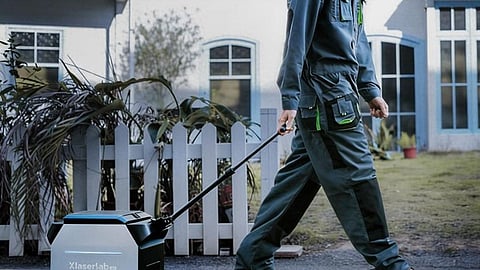
Bringing the Lab to the Artifact Many of the world's most valuable treasures—architectural ironwork, large sculptures, or installed fixtures—cannot be moved. The Q1’s compact, suitcase-style design allows it to function as a fully portable handheld laser cleaning machine. Conservators can bring this studio-grade capability directly to a gallery floor or a private estate, treating the object in situ. This eliminates the risks and insurance costs associated with transporting fragile antiques.
The application of this technology is expanding the possibilities of what can be saved:
Horology and Fine Mechanism For antique clocks and automatons, functionality depends on precision. The Q1 cleans microscopic gear teeth and pinions without the need for abrasive scrubbing, restoring movement while preserving the original plating and engravings.
Sculptural Conservation Outdoor bronze and iron sculptures often suffer from heavy weathering. Laser cleaning allows conservators to remove aggressive corrosion crusts while preserving the stable, aesthetic patina that gives the sculpture its visual depth and character.
Numismatics and Jewelry For coins and heirloom jewelry, value is inextricably linked to surface detail. The Q1 provides a way to remove tarnish from relief areas without flattening the high points of the design, maintaining the object's numismatic grade.
By adopting laser cleaning, the restoration community is moving from a mindset of "repair" to one of "preservation."
Protecting Financial Value: By avoiding micro-abrasion, the provenance and physical integrity of the object are maintained, securing its appraisal value.
Reversibility and Control: Unlike chemical baths, the laser process stops the moment the operator releases the trigger, offering total control over the level of cleaning.
Future-Proofing: By stabilizing the surface without introducing reactive chemicals, the object is better prepared for long-term storage or display.
True restoration honors the passage of time. It acknowledges that an object’s flaws and history are part of its beauty.
The Xlaserlab Q1 represents the intersection of future technology and historical respect. By integrating the Xlaserlab Q1 into their practice, conservators are not simply cleaning objects—they are making a conscious choice to protect history itself, ensuring that what survives is not only visually restored, but authentically preserved.
Inspired by what you read?
Get more stories like this—plus exclusive guides and resident recommendations—delivered to your inbox. Subscribe to our exclusive newsletter
The products and experiences featured on RESIDENT™ are independently selected by our editorial team. We may receive compensation from retailers and partners when readers engage with or make purchases through certain links.