
- Locations
- Interviews
- Luxury Home
- Luxury Lifestyle
- Luxury Travel
- Luxury News
- Events
- More
- Magazine

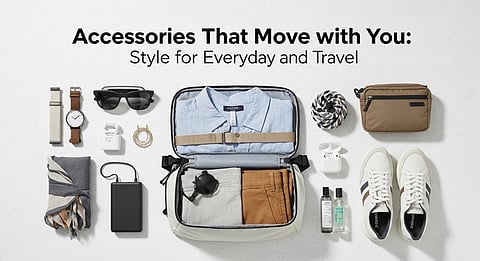
Modern life rarely stays in one place. A single day might involve commuting, working, walking, waiting, traveling, and social plans, often without time to change outfits in between. That reality has changed how people think about accessories.
Today, accessories are expected to perform. They need to be comfortable, adaptable, and durable enough to keep up with movement, while still adding polish to an outfit. Style still matters, but practicality now plays an equal role.
Choosing the right accessories have gone beyond being just for decoration. It’s about making smart decisions that support how you actually live.
Practical accessories share a few non-negotiable traits that are functional standards.
A truly practical accessory should:
Feel comfortable for extended wear
Transition easily between casual and polished settings
Hold up to frequent use and movement
Require minimal adjustment or care
If an item only works in controlled situations, it’s not practical. The best accessories earn their place by being dependable in real life, not just attractive in theory.
Accessories that stay on your body for hours need to meet a higher standard than occasional pieces.
When evaluating an accessory, ask:
Does it cause pressure or irritation after a few hours?
Does it stay in place while walking or moving?
Does it feel balanced, not heavy or awkward?
Can it be worn indoors and outdoors without issue?
Comfort is not a luxury. It directly affects posture, mood, and confidence. Accessories that fail this test quickly become distractions rather than assets.
Sunglasses complete an outfit, yes, but they do more than that. They protect your eyes, reduce strain, and influence how comfortable you feel outdoors.
For everyday and travel use, sunglasses should:
Fit securely without pinching
Sit comfortably for long periods
Offer consistent visibility in different lighting
Match multiple outfits without looking out of place
This is why many people choose a single, reliable pair rather than rotating styles. Well-designed options like Prada sunglasses are often favored because they combine structure with comfort. They feel appropriate in urban settings, while still being practical for travel, walking, or long days outside.
A practical accessory should not force outfit changes. The most adaptable accessories tend to have:
Neutral or classic color palettes
Clean, uncluttered shapes
Materials that don’t feel overly formal or casual
These qualities allow one item to move easily from:
Work environments
Errands and commuting
Travel and transit
Social or evening settings
This adaptability reduces the need to pack or carry extra pieces, which is especially valuable when traveling.
Travel exposes weaknesses quickly. Accessories are packed tightly, worn longer, and handled more frequently. Travel-friendly accessories usually:
Retain their shape in bags
Resist scratches and surface wear
Function well without special storage
Look presentable after extended use
Accessories that require constant protection or careful handling tend to become stressful. Practical travel pieces are resilient and forgiving.
Decision fatigue is real, especially when traveling or managing busy schedules. Accessories that work reliably reduce mental load by:
Eliminating outfit second-guessing
Simplifying packing decisions
Creating visual consistency across days
This is why many people rely on the same core accessories repeatedly. Familiarity builds confidence and frees attention for more important decisions.
Minimalism in accessories is not about restriction. It’s about efficiency.
Choosing fewer, higher-quality pieces:
Reduces clutter
Makes packing easier
Encourages consistent use
Improves long-term value
Accessories that work well across situations tend to replace several less practical options. Over time, this simplifies both daily routines and travel preparation.
Style doesn’t require excess. It requires intention.
Accessories express personal style through:
Proportion and silhouette
Texture and finish
Subtle design details
When these elements align with comfort and function, accessories feel authentic rather than forced. They become part of how you move, not something you adjust or manage.
A practical filter helps avoid impulse purchases. Before committing to an accessory, ask:
Will I wear this for long periods?
Does it work with most of my wardrobe?
Can I travel with it easily?
Does it feel good after several hours?
If the answer is no to more than one, the accessory likely won’t last in your rotation.
Confidence often comes from not thinking about what you’re wearing.
When accessories fit well, function properly, and align with your routine, they disappear from your awareness. That absence of friction allows you to move more freely and stay present.
This is especially important when traveling, where unfamiliar environments already demand attention. Reliable accessories create a sense of stability and ease.
Accessories that move with you are defined by usefulness, comfort, and adaptability. They support long days, varied environments, and constant movement without becoming a burden.
The strongest accessories:
Earn repeated use
Travel easily
Work across settings
Reflect personal style without effort
When accessories meet these standards, they stop being optional. They become tools you rely on, wherever the day takes you.
Inspired by what you read?
Get more stories like this—plus exclusive guides and resident recommendations—delivered to your inbox. Subscribe to our exclusive newsletter
The products and experiences featured on RESIDENT™ are independently selected by our editorial team. We may receive compensation from retailers and partners when readers engage with or make purchases through certain links.