
- Locations
- Interviews
- Luxury Home
- Luxury Lifestyle
- Luxury Travel
- Luxury News
- Events
- More
- Magazine
- Contact Us

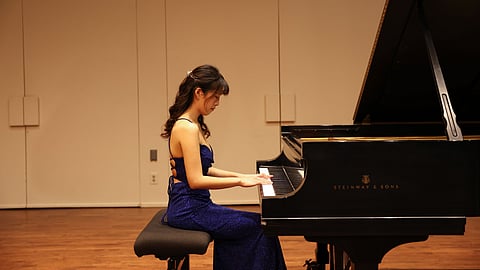
Taiwanese pianist Tina Wang will perform a solo recital on Sunday, February 22, 2026, at 2:30 p.m. in the Sanctuary at 233 West Harrison Avenue in Claremont. The program is conceived not as a collection of separate pieces but as a single, continuous journey through four contrasting worlds of piano music, moving from classical clarity to late-Romantic introspection, narrative drama, and early-twentieth-century brilliance.
Wang’s recital opens with Beethoven’s Piano Sonata in D major, Op. 28, a work dating from 1801 and often associated with the nickname “Pastoral.” Its luminous steadiness sets the tone for an afternoon of attentive listening. The sonata’s idyllic reputation is well earned: its calm is not passive but purposeful, radiating the energy of a composer whose inner life and outward craft were both deepening.
The mood shifts with Brahms’s Three Intermezzi, Op. 117, composed in 1892. Brahms famously described these late miniatures as “three lullabies of my grief,” and in performance their power lies in what they withhold. They do not rush to console and they do not dramatize sorrow; instead, they remain quietly, insistently human, inviting the listener into a space of tenderness and weight.
Chopin’s First Ballade, completed around 1835, then arrives as a narrative force. The music moves through shifting textures and turns of tension that feel almost literary, as though the piano were learning to speak in paragraphs rather than sentences. It is not merely a virtuoso showpiece; it is a work that seems to invent its own emotional weather as it unfolds.
The program closes with Ravel’s Sonatine, composed between 1903 and 1905. Here the piano becomes less a voice than a prism: every detail has edge and sheen, every gesture is balanced yet never stiff. The final movement’s animation brings the afternoon to a close not by growing louder but by growing lighter, as if the music were dissolving into clarity.
Ching-Ting (Tina) Wang is a Taiwanese pianist whose work spans solo performance, chamber music, and collaborative piano. She holds a Master of Music in Piano Performance from California State University, Northridge, where she presented both a Master’s Solo Recital and a Master’s Concerto Recital in 2024. Her training across multiple disciplines has produced a musician equally comfortable leading, listening, and shaping time with precision.
Wang’s competition record reflects sustained excellence across stages and continents. She has earned multiple First Prize awards at competitions in Taiwan, a Gold Medal at an international competition in Thailand in 2021, a Second Prize at an international competition in 2024, and a Bronze Prize at a competition in Korea in 2018. In 2019 she was invited to perform at an elite concert associated with one of these competitions. Her development has also been shaped by masterclass and festival experiences in the United States and abroad.
Institutionally, Wang received consecutive CSUN Academic Year Scholarships from 2022 to 2025, a form of recognition awarded through faculty committee review that reflects continued artistic and academic achievement over multiple seasons.
The Sanctuary at 233 West Harrison Avenue is itself a cultural artifact. Designed in 1955 by architect Theodore Criley, the building blends Romanesque references with a distinctly Claremont material sensibility, incorporating local rocks into its structure. Many consider it among Criley’s finest works, and it has been described as a modern masterpiece in local architectural reporting.
The Los Angeles Conservancy has documented the nave’s structural drama, noting its tapered arches, a continuous wall of colored light formed by large stained-glass windows, and custom liturgical furnishings. The collaborative artistic ecosystem around the church includes work by multiple artists and craftspeople whose contributions are integrated into the space rather than added as decoration.
The venue’s musical prestige is anchored by its Glatter-Götz/Rosales pipe organ, a 4,041-pipe instrument completed in 1998. The organ shares a builder lineage with the instrument later installed at Walt Disney Concert Hall. For decades, the Sanctuary has served as a place where architecture, visual art, and serious music-making converge, and it continues to attract performers and audiences who value craft, attention, and lasting intention.
Inspired by what you read?
Get more stories like this—plus exclusive guides and resident recommendations—delivered to your inbox. Subscribe to our exclusive newsletter
The products and experiences featured on RESIDENT™ are independently selected by our editorial team. We may receive compensation from retailers and partners when readers engage with or make purchases through certain links.