
- Locations
- Interviews
- Luxury Home
- Luxury Lifestyle
- Luxury Travel
- Luxury News
- Events
- More
- Magazine
- Contact Us

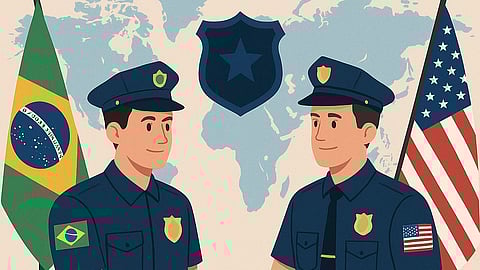
Brazil and the United States expanded their public security partnership in April 2025 to combat transnational crime through new memoranda of understanding, joint operations, and intelligence-sharing initiatives involving Brazil’s Federal Police (PF), Homeland Security Investigations (HSI), the FBI, and Interpol channels, according to official statements from both governments.
The strengthened collaboration, announced in Washington and detailed by the U.S. Embassy in Brazil, aims to accelerate investigations into human trafficking, arms smuggling, and money laundering through mechanisms such as Mutual Legal Assistance Treaties (MLATs), extradition agreements, and integrated investigative teams. Security specialist Fernando Pereira Carvalho — a former Paraná Military Police officer, U.S.-based instructor, and former Brazilian Senate advisor — emphasizes that diplomacy applied to training and protocol standardization “shortens the time between intelligence gathering and arrest,” drawing from his participation in official cooperation and training missions in Washington.
The 2025 diplomatic step did not emerge in a vacuum. In 1997, Brazil and the United States signed a Mutual Legal Assistance Treaty in criminal matters, which entered into force in 2001, enabling the formal exchange of evidence, data, and investigative requests between authorities.
The bilateral extradition treaty dates back to 1961, establishing legal guidelines for the transfer of fugitives under each country’s laws. Together, these agreements form the backbone of international cooperation: without legal frameworks, the swift sharing of evidence and enforcement of cross-border judicial orders would not be possible.
On April 22, 2025, HSI/ICE formally expanded its partnership with Brazil’s Federal Police to pursue high-impact investigations targeting transnational organized crime. A week later, the U.S. Embassy in Brasília reaffirmed that the collaboration spans more than two decades, focusing on joint investigations and technical training.
The partnership includes the deployment of liaison officers, training programs, and shared investigative methodologies — particularly strategies for tracing financial flows linked to criminal networks.
The effectiveness of this alignment is evident in recent cases. On March 26, 2025, a coordinated operation by authorities in both countries dismantled migrant-smuggling networks operating between Brazil and the United States, with support from the U.S. Department of Justice, DHS, the FBI, and international partners.
Earlier cooperation also includes a 2022 joint operation between the Federal Police and HSI that dismantled an international child exploitation ring, demonstrating institutional continuity regardless of political changes.
Interpol remains a critical channel for international policing. In Brazil, the Federal Police’s National Central Bureau (NCB) serves as the gateway for international cooperation, connecting state police agencies to global databases and notices.
In the United States, the U.S. National Central Bureau (USNCB) performs a similar function, coordinating requests and alerts among federal, state, and local authorities. This network reduces bureaucratic barriers and speeds up fugitive apprehensions and asset seizures.
Beyond urban crime, bilateral cooperation increasingly targets criminal supply chains in the Amazon region. In June and July 2024, coordinated initiatives — from Brazil’s Amazon Security Plan (AMAS) to the U.S. Treasury Department’s strategy to disrupt environmental crime financing — highlighted joint efforts between financial and law enforcement agencies.
These initiatives include “follow-the-money” training programs and the possibility of sanctions against illicit networks. Plans to establish regional police cooperation centers, such as one proposed for Manaus, aim to integrate land, river, and air enforcement operations.
Within this broader context, Fernando Pereira Carvalho stands out as a bridge between operational policing and international diplomacy. As an instructor and coordinator of defensive tactics training for Brazilian forces and SWAT teams in the United States, he has been involved since 2006 in programs such as SUPER SWAT and has taught at conferences organized by the Texas Tactical Police Officers Association (TTPOA).
Institutionally, he served as a parliamentary advisor to Brazil’s Senate committees on Foreign Relations, National Defense, and Public Security from 2019 to 2023. During that period, he participated in diplomatic missions in Washington, including meetings at the U.S. Capitol, the Pentagon, and the State Department focused on police cooperation and training.
“One of the central topics was police cooperation and training between the United States and Brazil,” his professional record notes.
Beyond credentials, Carvalho’s field experience helps explain why international cooperation is effective. Standardized procedures, a shared operational language, and mutually recognized chain-of-custody protocols increase the admissibility of evidence and reduce legal loopholes exploited by transnational criminal networks.
His experience working with elite units such as BOPE, Brazil’s Federal Police, the Armed Forces, municipal guards, and U.S. law enforcement agencies demonstrates that joint training and simulation exercises serve as powerful force multipliers. This perspective aligns with the FBI’s stated objectives for its international programs: strengthening investigative capabilities and the rule of law through legal attachés and training initiatives with foreign partners.
Despite progress, cooperation faces diplomatic challenges. Sensitive issues — such as deportation flights and the treatment of repatriated Brazilian nationals — have occasionally sparked tensions, prompting official communications and negotiations aimed at establishing direct communication channels and human-rights protocols.
However, these challenges have not halted operational coordination. On the contrary, they have led to enhanced monitoring mechanisms and joint working groups, while investigations and operations continue through technical channels grounded in treaties and formal agreements.
Inspired by what you read?
Get more stories like this—plus exclusive guides and resident recommendations—delivered to your inbox. Subscribe to our exclusive newsletter
The products and experiences featured on RESIDENT™ are independently selected by our editorial team. We may receive compensation from retailers and partners when readers engage with or make purchases through certain links.