
- Locations
- Interviews
- Luxury Home
- Luxury Lifestyle
- Luxury Travel
- Luxury News
- Events
- More
- Magazine

Ecommerce Checkout Best Practices represent make-or-break moments for enterprise digital platforms. A VP of Engineering leading a $2B ecommerce operation confronts the same reality: checkout abandonment destroys revenue at scale. Abandonment rates between 70–75% mean organizations lose millions in annual transaction value.
Engineering teams inherit checkout systems layered with years of accumulated logic. Product teams navigate conflicting priorities—security clashes with speed, personalization competes with form simplicity, cross-sell opportunities create decision paralysis. Finance requests fields for credit assessment, marketing demands data for targeting, compliance mandates regulatory documentation.
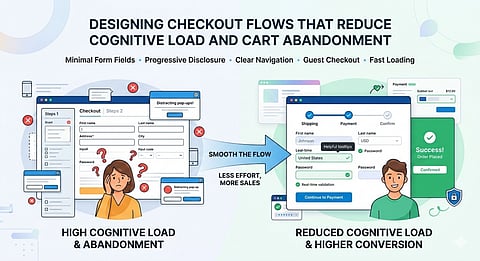
Cognitive load refers to mental effort required to complete tasks. In checkout contexts, high cognitive load manifests as decision paralysis and cart abandonment. The Baymard Institute identifies unexpected costs, complicated processes, and excessive form fields as primary abandonment drivers.
A company processing $500M annually in gross merchandise value realizes $10M in incremental revenue from a 2% abandonment improvement. Organizations processing $2B see $40M recovery from identical improvements.
Customer acquisition costs rose 15–20% over three years. When qualified traffic abandons at checkout, the entire acquisition investment vanishes. Reducing abandonment improves customer acquisition ROI directly.
Users navigate 8–12 decision points between cart entry and payment confirmation. Guest checkout authentication, payment method selection, address verification, loyalty program enrollment, promo code entry, and shipping method comparison each create abandonment risk.
Teams reducing this journey to 3–4 critical decisions see measurable improvement. Removing features creates more value than adding them in checkout design.
Extraneous cognitive load measures effort a poorly designed interface requires. Forms requesting 15 data points burden users more than forms requesting 5 essential fields.
Enterprise platforms accumulate fields across years without removal. Finance requested fields for credit risk assessment, marketing requested fields for personalization, and compliance requested fields for regulatory documentation.
Intrinsic cognitive load measures inherent task difficulty. Shipping to an address a user entered for the first time carries a higher burden than selecting from saved addresses.
Comparing multiple payment methods carries a higher burden than defaulting to a recently used method. Design choices reduce decision alternatives based on user history and behavior patterns.
Germane cognitive load theory in UX design measures resources directed toward meaningful task completion. Users mentally engage with selections that matter—payment confirmation, shipping speed, delivery dates.
They should not mentally engage with interface confusion, unclear field labels, unexpected form behaviors, or ambiguous error messages. Teams measure across all three dimensions to identify friction points.
Progressive disclosure presents only essential information at each step. Rather than displaying all shipping methods, payment options, and promotional offers simultaneously, systems show defaults with expansion capability.
Users see one recommended shipping speed with access to alternatives. This reduces cognitive burden while maintaining business optionality.
Smart defaults pre-select options based on user history. If a user selected two-day shipping across previous orders, the system defaults to two-day shipping.
If they have five saved addresses but ship most frequently to one location, that address appears pre-selected. These patterns leverage historical data to reduce decision burden.
Transparent trust signals address purchase anxiety. Security badges, return policies, customer reviews, and verified payment protection appear contextually rather than cluttered.
A simple security badge visible at payment confirmation reduces anxiety about transaction safety. Users complete transactions when they trust the platform.
Contingent field display removes irrelevant fields for specific user contexts. If a user selects a payment method without installment plan support, that field disappears.
If they purchase from a local warehouse requiring no customs documentation, that field remains hidden. Interface complexity adapts to actual user needs.
They should not mentally engage with interface confusion, unclear field labels, unexpected form behaviors, or ambiguous error messages. Teams measure across all three dimensions to identify friction points.
Progressive disclosure presents only essential information at each step. Rather than displaying all shipping methods, payment options, and promotional offers simultaneously, systems show defaults with expansion capability.
Users see one recommended shipping speed with access to alternatives. This reduces cognitive burden while maintaining business optionality.
Smart defaults pre-select options based on user history. If a user selected two-day shipping across previous orders, the system defaults to two-day shipping.
If they have five saved addresses but ship most frequently to one location, that address appears pre-selected. These patterns leverage historical data to reduce decision burden.
Transparent trust signals address purchase anxiety. Security badges, return policies, customer reviews, and verified payment protection appear contextually rather than cluttered.
A simple security badge visible at payment confirmation reduces anxiety about transaction safety. Users complete transactions when they trust the platform.
Contingent field display removes irrelevant fields for specific user contexts. If a user selects a payment method without installment plan support, that field disappears.
If they purchase from a local warehouse requiring no customs documentation, that field remains hidden. Interface complexity adapts to actual user needs.
Immediate validation feedback removes error anxiety. Systems validate fields in real-time rather than bulk error messages after form submission.
Users correct mistakes before submission. This shifts cognitive load from end-stage problem-solving to immediate correction.
Implementing these patterns requires cross-functional alignment. Finance, compliance, marketing, and customer service stakeholders bring legitimate business requirements.
The discipline lies in prioritization—distinguishing between requirements that drive measurable customer value versus those serving internal operational convenience. Teams without this discipline accumulate features without corresponding value creation.
Engineering teams execute checkout optimization through a structured approach. They instrument existing flows to establish baseline abandonment patterns and identify specific friction points driving abandonment.
Teams test design interventions with statistical rigor and implement winning patterns at scale. This methodology requires both technical capability and organizational discipline.
Platform modernization initiatives offer optimal timing for checkout redesign. Teams rebuilding platforms from architectural foundations embed cognitive load reduction into foundational design decisions.
Engineering organizations managing multi-year platform transformations should address checkout as a strategic project rather than a tactical feature.
Measuring checkout performance requires clarity on key metrics. Teams track abandonment rate at each checkpoint, time spent at specific form fields, error rate frequency, and conversion lift from design changes.
Organizations looking to address checkout friction within platform modernization initiatives benefit from working with technology partners specializing in conversion optimization. These partners conduct diagnostic assessments that identify friction patterns relative to industry benchmarks.
Partners translate findings into implementation roadmaps aligned with platform modernization timelines. Reaching out to discuss your checkout optimization challenges connects your team with practitioners who have solved these problems across enterprise scale operations.
Clutch Rating: 4.9/5 (111+ verified reviews)
GeekyAnts delivers digital transformation, product design, and custom software solutions for global enterprises processing high-transaction volumes. Teams focus on engineering-led UX improvements across web and mobile platforms, including checkout flow optimization and conversion rate enhancement. The firm structures collaboration between product and engineering to embed cognitive load reduction into platform modernization initiatives.
Address: 315 Montgomery Street, 9th & 10th floors, San Francisco, CA 94104, USA, Phone: +1 845 534 6825 | Email: info@geekyants.com | Website: www.geekyants.com/en-us
Clutch Rating: 5.0/5 (46 verified reviews)
Dreamten operates from Raleigh, North Carolina, specializing in UX and UI design for web and app platforms. Clients praise Dreamten for understanding business goals and translating them into purposeful experiences that cut user hesitation. Their structured project management and clear communication help teams reduce friction across conversion funnels.
Address: 1 Glenwood Ave, 3rd Floor, Raleigh, NC, United States, 27603, Phone: 7039638411
Clutch Rating: 4.9/5 (24 verified reviews)
Singlemind integrates UX design with engineering delivery to support product modernization initiatives. The firm works with enterprise teams to refine digital experiences that influence conversion and retention metrics. Teams collaborate across product and engineering to embed design improvements into platform architectures.
Address: 1001 SE Water Ave. STE 440, Portland, OR, United States, 97214, Phone: 5033428270
Clutch Rating: 4.9/5 (18 verified reviews)
Think Company specializes in UX research, enterprise design systems, and usability testing for complex digital ecosystems. The firm conducts structured audits that identify friction points in conversion-critical flows and translates findings into implementation roadmaps. Teams support product modernization where clarity and task efficiency drive measurable business outcomes.
Address: 201 Fayette Street, Conshohocken, PA, United States, 19428, Phone: 8002969190
Clutch Rating: 5.0/5 (6 verified reviews)
Daito Design focuses on user research and interface clarity for product teams modernizing digital platforms. The firm conducts comprehensive usability audits and user research to identify abandonment drivers and validate design interventions. Teams reduce friction in conversion-critical flows through structured assessment and iterative testing.
Address: 901 W Nineth St, Austin, TX, United States, 78703, Phone: 5125434800
Checkout performance reflects platform maturity and revenue discipline. Engineering leaders who combine UX clarity, system reliability, and analytics visibility improve completion rates and protect revenue.
Large enterprises cannot depend on surface redesigns. Teams need structured audits, precise instrumentation, and continuous iteration. Alignment across engineering, product, and customer experience ensures measurable gains.
A focused checkout review often exposes friction embedded in existing systems. Structured working sessions with experienced product and engineering partners help quantify impact, prioritize fixes, and define the next execution phase without launching large transformation programs.
Inspired by what you read?
Get more stories like this—plus exclusive guides and resident recommendations—delivered to your inbox. Subscribe to our exclusive newsletter
The products and experiences featured on RESIDENT™ are independently selected by our editorial team. We may receive compensation from retailers and partners when readers engage with or make purchases through certain links.