
- Locations
- Interviews
- Luxury Home
- Luxury Lifestyle
- Luxury Travel
- Luxury News
- Events
- More
- Magazine

Walk through any city with your eyes open and you will spot it.
Not the label. Not the logo. Something harder to name. A coat that sits slightly wrong on the shoulders but looks completely intentional. A graphic tee tucked into trousers that have no business working together but somehow do. A kid outside a coffee shop wearing something that looks like it came from three different decades and zero trend cycles.
None of those people may have ever heard of Rei Kawakubo. That is exactly the point.
Most fashion influence works through direct copying. A silhouette appears on a runway, buyers photograph it, factories reproduce it at lower price points, and six months later it is everywhere until it is nowhere. What Comme des Garcons spread through fashion did not work that way. You cannot point to a specific shape and say that shape is now in every streetwear collection because Kawakubo made it. The influence went deeper than shape.
It changed how designers thought about the relationship between clothing and the body. It changed what counted as finished. It changed the question designers were allowed to ask when they sat down to make something. That kind of influence does not wash out in a season. It gets absorbed into how people make things, and then it spreads without anyone tracking it back to the source.
Streetwear in its early form was about ownership. Taking symbols from sport, from work, from uniform, from corporate culture, and wearing them in ways that shifted who those symbols belonged to. A basketball jersey. A workwear jacket. A military surplus coat. The meaning changed based on who wore it and how. Comme des Garcons had been doing a version of this same move since the early 1980s, operating on different raw material. Not sportswear or military surplus, but the rules of tailoring and the conventions of women's dress. Taking those symbols and wearing them wrong, on purpose, until the wrongness became the meaning.
The formal logic was the same even when the clothes looked nothing alike. This is why the connection between the label and streetwear's later evolution feels genuine rather than forced. They were working the same problem from different angles. Here is why this produced actual influence rather than just parallel thinking. When streetwear designers began moving toward fashion proper in the 2000s and 2010s, they needed a framework for taking clothes seriously as objects of thought rather than just objects of signaling. Comme des Garcon had built that framework and left it sitting there for anyone willing to look.
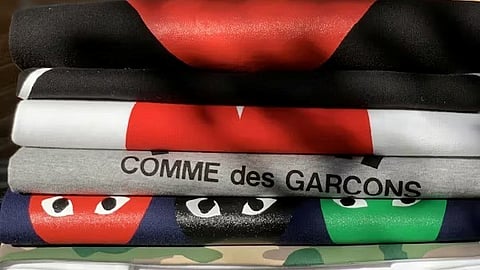
The Comme des Garcons Play line launched in 2002 with a simple heart logo designed by Polish artist Filip Pagowski. A lopsided cartoon heart with eyes, printed on basic t-shirts and polos in clean colorways. By any measure of the main line's values, this should not have worked. It was graphic. It was immediately legible. It carried none of the formal ambiguity that defined the runway work.
It became one of the most recognized clothing logos on the planet.
Let's break it down. The Play heart reached people who had no entry point into the main line's difficulty. Young people who responded to the slightly off-kilter drawing without knowing anything about asymmetrical tailoring or deconstructed knitwear. Streetwear wearers who liked that the logo was recognizable but not corporate in the usual way. Those people did not stay in the Play line forever. Some of them got curious. Some of them started looking further into what Comme des Garcons actually was. The heart logo acted as a door that opened onto something much larger and stranger, and a meaningful number of people walked through it.
Fashion collaborations are usually about two brands trading audiences. Your customers meet my customers. Everybody sells more product. The clothes are usually fine and occasionally forgettable.
Comme des Garcons collaborations have worked differently often enough to be worth examining.
When the label has worked with other brands, the results tend to feel like Kawakubo's team absorbed the partner's visual language and then put it through their own process. The partner's original codes come out the other side changed. Familiar enough to be recognizable, strange enough to make you look twice.
This matters for the streetwear conversation specifically because the brands Comme des Garcons has worked with include names that sit squarely in that world. The collaborations moved the Comme des Garcons way of thinking into spaces where it had not previously lived, and it left a mark each time. Designers who grew up wearing those collaborative pieces absorbed something about how formal tension works in clothing. How a familiar object can be made strange without being made unwearable. That lesson showed up later in their own work, often without direct acknowledgment of where it came from.
The luxury end of fashion has a particular relationship with Comme des Garcons that does not always get named directly. Through the 1990s and into the 2000s, a wave of designers arrived at major European houses with ideas that would have been considered uncommercial or formally excessive by the standards of their predecessors. Raw edges on couture pieces. Intentional asymmetry in categories that had prized symmetry for generations. Garment construction treated as visible subject matter rather than hidden infrastructure.
These designers had done their homework. The homework included Kawakubo.
None of them were copying her clothes. They were using the expanded definition of what fashion could do that her work had made available. The runway became a place where a designer could ask difficult formal questions and expect at least part of the audience to engage with those questions seriously. Next steps for understanding this lineage: look at the work coming out of major Parisian and Belgian fashion schools from the late 1980s onward. The students who graduated from those programs and went on to reshape luxury fashion were studying the same reference points. Comme des Garcons was always near the top of the list.
Every decade or so, a new wave of young people discovers Comme des Garcons and has the same reaction. How did I not know about this sooner. This keeps happening because the work does not age in the way trend-based fashion ages. A collection built around a genuine formal question retains that question regardless of what year you encounter it. The 1981 pieces are still asking what they were asking in 1981. The 1997 padded dresses are still doing what they were doing in 1997.
Young designers and young wearers find the work and take from it what they need at that specific moment. The streetwear kid finds the permission to mix references without apology. The design student finds a model for treating making as thinking. The person who just wants to dress in a way that feels true finds clothes that were never trying to make them into someone else.
This is possibly the strangest and most durable aspect of how Comme des Garcons changed fashion. Most influential labels need to be acknowledged to stay influential. Their cultural weight depends on people continuing to reference them by name, to cite them, to position themselves in relation to them.
Comme des Garcons influence has largely escaped that dependency. The thinking spread far enough and deep enough that it now lives inside how fashion works, not just inside conversations about fashion history. Designers who have never consciously studied the label are making decisions shaped by it. Wearers who have never seen a runway show are putting clothes together in ways made possible by it.
That is not influence anymore. That is something closer to a changed set of shared assumptions about what clothes can do and what they are allowed to mean. Kawakubo did not set out to change those assumptions in a way that would eventually become invisible. She set out to make the clothes she needed to make.
The invisibility is just what happens when the work goes deep enough.
Inspired by what you read?
Get more stories like this—plus exclusive guides and resident recommendations—delivered to your inbox. Subscribe to our exclusive newsletter
The products and experiences featured on RESIDENT™ are independently selected by our editorial team. We may receive compensation from retailers and partners when readers engage with or make purchases through certain links.