
- Locations
- Interviews
- Luxury Home
- Luxury Lifestyle
- Luxury Travel
- Luxury News
- Events
- More
- Magazine

For years, building a website meant choosing a theme, installing a few plugins, and publishing content. That approach worked when websites primarily served as marketing brochures. In 2026, that assumption no longer holds.
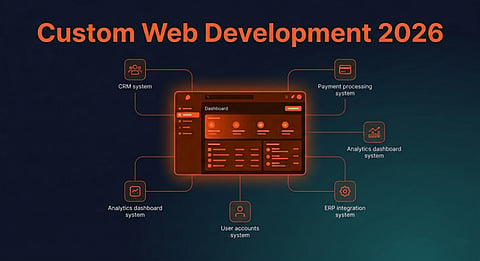
Today, a website is often the center of digital operations. It captures leads, processes payments, connects to CRM and ERP systems, manages user accounts, delivers dashboards, and feeds analytics pipelines. When those responsibilities grow, the limitations of templates and rigid platforms become visible.
This shift is the main reason businesses are investing in custom web development services. The goal is not simply a unique design. The goal is building a platform that supports business workflows, integrates with critical systems, and scales without breaking as complexity increases.
Templates and website builders still serve a purpose. They allow startups and small organizations to launch quickly. For informational websites or simple landing pages, they can be sufficient.
The problem appears when digital infrastructure expands.
Many companies begin with a template-based site and gradually add functionality. A CRM integration here, an analytics layer there, then marketing automation, customer portals, and reporting dashboards. Each addition introduces another dependency.
Eventually, the site becomes fragile.
Updates break features. Plugins conflict. Performance slows. Security risks increase. Development changes take longer than expected because everything is tightly coupled.
At that stage, the question is no longer whether the site looks good. The real question becomes whether the platform can support how the business actually operates.
That is the moment when organizations begin evaluating custom web development services.
Custom web development services refer to building a website or web application around specific business requirements rather than adapting those requirements to a prebuilt system.
A typical custom development project includes several layers.
First is architecture. Developers analyze how data moves between systems such as CRM platforms, payment gateways, internal tools, or analytics pipelines. Instead of relying on plugins, integrations are designed deliberately.
Second is user experience and interface design. A web design and web development company does not simply focus on aesthetics. The goal is to create workflows that help users complete tasks efficiently, whether those tasks involve onboarding, booking services, or managing accounts.
Third is engineering. Modern custom builds often use frameworks such as React, Angular, or Vue for the front end and Node.js, .NET, or Java for the backend. The architecture is designed to handle performance demands, scale traffic, and secure data processing.
Finally comes deployment and support. A professional web development firm introduces structured release processes, testing environments, and monitoring tools that help teams maintain stability after launch.
This approach requires more planning at the start, but it prevents structural problems later.
Search visibility depends on more than keywords. Page speed, technical structure, and user experience play a significant role in ranking outcomes.
Generic themes often carry unnecessary code, scripts, and assets that slow down performance. They may also limit control over URL structure, internal linking, or schema implementation.
Custom web development gives organizations direct control over these elements.
Developers can optimize asset loading, implement clean semantic markup, and design internal linking strategies that support search indexing. Technical SEO becomes part of the engineering process rather than an afterthought.
This does not mean search engines automatically favor custom websites. What matters is performance and usability. Custom development simply makes those outcomes easier to achieve.
Not every project requires a custom build. Many businesses function well with existing platforms.
However, several indicators suggest that a custom solution may be justified.
One signal is integration complexity. If your website must connect to multiple internal systems and those integrations are fragile or slow, a custom architecture can stabilize the environment.
Another signal is operational dependency. If your website processes revenue, manages customer accounts, or drives core workflows, downtime or performance issues directly affect the business.
A third signal is scalability. Organizations expecting rapid growth need systems that can evolve without constant reengineering.
In these cases, a web development services company typically recommends building a flexible architecture that supports expansion rather than repeatedly patching an existing system.
When companies move to custom web development, the benefits are not limited to technology.
Operational efficiency improves because workflows can be automated instead of managed manually. Data accuracy increases because systems communicate directly instead of relying on disconnected tools.
Security also improves. Custom builds allow teams to implement role-based permissions, encrypted data flows, and controlled access points that match internal policies.
Over time, the website stops being a static asset and becomes a business platform.
Organizations that want to explore this approach often begin by reviewing the capabilities of experienced development partners such as Aionys, whose engineering teams specialize in building scalable digital systems rather than template-based websites.
Selecting a development partner requires more than reviewing design portfolios.
A credible web dev company should be able to explain how projects are structured from discovery to deployment. This includes how requirements are gathered, how risks are evaluated, and how release processes are managed.
Look for evidence of real outcomes rather than lists of technologies. Strong development teams show how their work improved performance, reduced operational costs, or supported measurable growth.
They also explain trade-offs. Every architecture decision involves compromises between cost, speed, and flexibility. A reliable partner is transparent about those trade-offs before development begins.
Businesses evaluating providers often start by reviewing specialized offerings such as custom web development services that focus on scalable architecture and long-term maintainability.
One reason companies hesitate to adopt custom web development is cost. Custom builds generally require higher upfront investment than template-based websites.
However, the long-term economics often tell a different story.
Templates accumulate hidden costs through plugin licenses, performance limitations, and repeated redesign cycles. Each time the platform reaches its limits, another rebuild becomes necessary.
Custom architecture avoids many of these problems. Because the system is built around business workflows from the beginning, new features can be added incrementally instead of requiring structural changes.
For organizations planning multi-year growth, the predictability of this model often outweighs the initial expense.
As digital systems become more interconnected, the distinction between “website” and “software platform” continues to blur.
Customer portals, data dashboards, and SaaS-style experiences are increasingly common. Businesses expect real-time insights, seamless integrations, and consistent performance across devices.
Under these conditions, rigid templates struggle to keep pace.
Custom web development services allow organizations to design systems that evolve alongside their operations. Instead of forcing workflows into generic platforms, the platform adapts to the business.
Companies that treat their websites as infrastructure rather than marketing collateral will be better positioned to scale, innovate, and compete in the years ahead.
For organizations ready to move beyond template limitations, exploring custom web development services can be the first step toward building a digital platform designed for long-term growth.
Inspired by what you read?
Get more stories like this—plus exclusive guides and resident recommendations—delivered to your inbox. Subscribe to our exclusive newsletter
The products and experiences featured on RESIDENT™ are independently selected by our editorial team. We may receive compensation from retailers and partners when readers engage with or make purchases through certain links.