
- Locations
- Interviews
- Luxury Home
- Luxury Lifestyle
- Luxury Travel
- Luxury News
- Events
- More
- Magazine

Mallorca’s coastline stretches for 550 kilometres, featuring hundreds of coves that cannot be reached by car. The rocky coves of the south-east, the wild beaches beneath the Tramuntana cliffs, and the underwater grottoes of Porto Cristo – all these can only be explored from the water. That is why chartering a boat in Mallorca has long been a staple of an island holiday. The marinas of Palma, Alcudia and Port de Soller offer dozens of vessels of various types — from small motorboats for half a day to cruise catamarans for two weeks. But which vessel should you choose? Whether to book a crewed charter in Mallorca or skipper it yourself, whether to go under motor, sail or on two hulls — it all depends on the route, the number of days and the group. Let’s break down each option with specific prices and details.
Motorboats form the backbone of the island’s charter fleet: around 60% of the boats in the marinas at Palma, Portals and Santa Ponsa are motorised. There is a wide choice – ranging from open motorboats of 6–8 metres for day trips to yachts over 20 metres with cabins and climate control. The most popular are 8–10-metre motorboats: they can accommodate a group of up to eight people and do not require a crew. The main advantage of a motorboat is speed: it is realistic to travel from Palma to Cape Formentor and back in a single day. The wind in Mallorca rarely hinders motorboats — during the summer months, the swell off the coast usually does not exceed one metre. A motorboat is the ideal choice in several typical situations:
A short holiday. Two or three days is too short for a sailing trip. A motorboat allows you to see as much of the coastline as possible in the shortest time.
Day trips. Setting off from the marina in the morning, lunch at anchor in Sa Calobra Bay, and returning in time for dinner – a standard day’s itinerary.
Inexperienced group. Operating a motorboat is easier than sailing, and if you have a licence, you don’t need a skipper.
Water sports. Wakeboarding, tubing and water skiing require power that a sailing boat simply cannot provide.
The downside is the fuel. A 10–12-metre motorboat consumes 150–200 litres of diesel a day; at around €1.50 per litre, this adds up to €225–300 on top of the hire cost. Over a week, the cost of diesel can exceed the price of the boat itself. Renting a medium-sized motorboat starts from €400–500 a day in the low season.
Sailing is the choice of those who set sail for the sea’s sake, not just to tick a box on a list. On a sailing yacht, there’s no engine vibration or smell of diesel – just the wind, the lapping of the waves and the creak of the rigging. Mallorca’s thermal breezes are consistent from May to October: the morning calm gives way to a south-westerly wind of 10–15 knots by midday, before dying down in the evening. These conditions are ideal for day trips and offer no stormy surprises.
Good to know. A sailing yacht’s cruising speed is 5–7 knots. In a week, you can cover 150–200 nautical miles, sail around the entire island and visit coves that larger boats cannot reach due to their draught.
Popular week-long itineraries include a coastal cruise from Palma along the southern coast to Porto Colom, and a trip around Cape Formentor to Soller. Both can easily be completed in seven days, leaving plenty of time for swimming in the coves and enjoying dinner on the seafront.
You can book a private sailing yacht charter in Mallorca from Palma, Port de Soller or Alcudia. A 35–40-foot sailing yacht costs from €1,500 per week in May up to €4,500–5,000 in the height of summer. This is cheaper than a motor yacht of a comparable size, and fuel costs are minimal — the engine is only needed for mooring and short stretches of calm seas.
There is just one restriction, but it’s a significant one: you need the right qualifications. Without an ICC international certificate, you’ll have to hire a skipper for €150–200 a day, which will increase your budget.
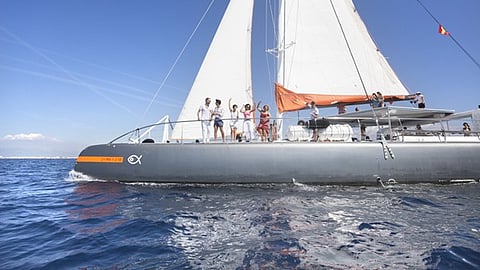
Catamarans appeared in Mallorca’s charter fleets later than monohull yachts, but quickly found an audience. Two hulls offer a combination of qualities found in neither motorboats nor classic sailing yachts: stability in waves, ample living space and minimal draught. Catamarans are often cited as the best option for family sailing — and with good reason. This type of vessel is worth considering if the following are important to you:
minimal roll even in rough seas;
a spacious cockpit and saloon for relaxing with children;
a draught of less than a metre – allowing you to get right up to the beach;
a net between the hulls for sunbathing and swimming from the boat.
Renting a 38–42-foot catamaran starts at €2,500 per week in the low season and rises to €6,000–7,000 in July and August. It is more expensive than a monohull, but for a group of six to eight people, the price per person works out to be comparable. The cabins are more spacious, the deck is wider, and there is significantly less seasickness on a catamaran — for a trip with young children, this is often a decisive factor. One practical drawback is the size: a catamaran is wider than a monohull, not every marina will allocate a berth, and mooring is usually more expensive.
The type of boat is only part of the decision. Before hiring a boat in Mallorca, it is important to clarify a few practical details that will affect both your comfort and the final cost. Here are some things people often overlook when making their first booking:
Licence. A licence is required to operate a vessel with an engine exceeding 15 hp in Spain. Without one, you may only go out to sea with a hired skipper.
Season. May, June and September are the best times for a charter. The water is warm, the wind is steady, and prices are 30–40% lower than at peak times.
Port of departure. Palma is convenient for the south coast, Alcudia for the north and Menorca, and Port de Soller for the western coves.
Deposit. The deposit for a 35–40-foot yacht is €1,500–2,500. This can be covered by insurance for €150–300 when booking.
It is advisable to clarify the terms and conditions before signing the contract – the operator will send a checklist and answer any questions regarding the specific vessel.
Now that we’ve decided on the organisation, let’s get back to choosing the type of boat. There’s no one-size-fits-all option: each type is best suited to its own purpose. The simplest approach is to start with a single priority:
Motorboat — speed, short breaks, water sports.
Sailing yacht — peace and quiet, week-long cruises, fuel economy.
Catamaran — comfort, family holidays, large groups.
In practice, the type of boat sets the tone for the whole holiday, so it’s worth choosing carefully. The great thing about Majorca is that there’s a boat to suit every need — from a compact day boat to a sailing catamaran for a two-week cruise around the Balearic Islands. And if you’re unsure, try different options on different trips: many people do just that until they find the right fit.
Inspired by what you read?
Get more stories like this—plus exclusive guides and resident recommendations—delivered to your inbox. Subscribe to our exclusive newsletter
The products and experiences featured on RESIDENT™ are independently selected by our editorial team. We may receive compensation from retailers and partners when readers engage with or make purchases through certain links.