
- Locations
- Interviews
- Luxury Home
- Luxury Lifestyle
- Luxury Travel
- Luxury News
- Events
- More
- Magazine
- Contact Us

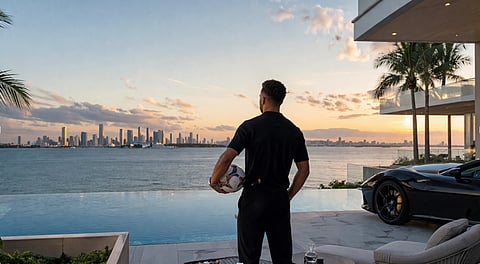
The luxury around elite football in April 2026 looks less like a postcard and more like a logistics sheet with perfect lighting. The 2026 World Cup opens on 11 June and runs through 19 July across Canada, Mexico, and the United States, and several of the biggest names are already moving inside that countdown with qualified teams behind them: Lionel Messi with Argentina, Cristiano Ronaldo with Portugal, Achraf Hakimi with Morocco, Kylian Mbappé with France, and Jude Bellingham with England.
Messi’s version of luxury is no longer built around Barcelona memory or Paris formality. Inter Miami extended its contract through the end of the 2028 MLS season in October 2025, and the club’s move into Miami Freedom Park in 2026 brings it into a 131-acre district planned around hospitality, retail, and entertainment rather than just a seat map and a parking lot. The club also unveiled a Leo Messi Stand at Nu Stadium on 27 March, a rare gesture for an active player, and that says plenty about how his status now works in South Florida.
Real Madrid still makes fame look formal, and Mbappé and Bellingham fit that city in different ways. Mbappé, in his second season at the club, was sitting on 39 goals in 37 matches on the club’s official numbers when checked this week, while Bellingham’s 2025-26 line stood at 31 matches, 6 goals, and 1 assist after a season interrupted by shoulder surgery and recovery. The visual side matters too, though it is rarely loud: Louis Vuitton’s own 2026 menswear pages continue to present Bellingham as a Friend of the House, while Mbappé’s public image has shifted toward the cleaner, sharper end of luxury fashion since arriving in the Spanish capital in 2024. Their football keeps the same balance. Mbappé still starts left and attacks the space behind the full-back, Bellingham still appears late around the box after drifting out of the camera’s first frame, and England and France are both already qualified for the World Cup.
Ronaldo’s luxury life has become too large to separate from business. Reuters reported last June that he extended with Al Nassr until 2027 and estimated his total earnings at around $275 million, numbers that belong to sovereign-wealth football rather than old European wage structures. Portugal has already qualified for the 2026 World Cup, and its place in the story remains easy to spot because the image never really changes: the tunnel shot, the flawless training clip, the late finish, the sponsor wall. Nothing is casual. Even in the football itself, there is still the same movement inside the box, the same quick attack on the near-post channel, the same demand that defenders carry him for 90 minutes.
Luxury around football no longer ends with watches, drivers, and private dining after the match. FIFA’s reopened ticket sale this month pushed the top 2026 World Cup final seat to $10,990, and that figure says enough about the premium layer gathering around the tournament before a ball is kicked in New Jersey on 19 July. Inside that same digital context, a betting site (Arabic: موقع مراهنات) now sits beside chauffeur bookings, seating maps, and hospitality messages on the same phone. The habit is familiar in high-end watch parties and sponsor dinners: one screen carries the live feed, another tracks the price shift after a goal, and nobody in that room treats the split attention as strange.
Hakimi gives the Paris version of this story a different tone. PSG confirmed in November 2025 that its vice-captain had won the 2025 CAF African Player of the Year award, becoming the first player from the club to take that prize and the first Moroccan winner since Mustapha Hadji in 1998, while Morocco had already sealed qualification for the World Cup back in September 2025. Paris gives that kind of success a softer frame than Madrid or Riyadh, but the luxury is there in the tailoring, the photographers, the sponsor obligations, and the rhythm of a city that treats fashion and football as neighboring industries. On the pitch, Hakimi still plays with the same timing that made him so valuable in Qatar in 2022: hold the width, wait half a second, then arrive from the blind side when the winger has already fixed the full-back in place.
The modern luxury layer around football is built for movement. Players move between airports, training grounds, and hotels; agents move between calls; entourages move between credential desks and private entrances; and the whole ecosystem now expects premium access to travel in the pocket rather than in a briefcase. That same mobile rhythm explains why people around the game download Melbet (Arabic: تحميل ميل بيت) between flights and evening kickoffs when they are checking the next qualifier, the next Champions League market, or the late line after a team sheet drops. The pattern is simple enough to notice in any airport lounge during an international break: earbuds in, two chats open, one eye on the boarding gate, and the other on football.
Ahead of this World Cup, the richest thing in football is not the car or the penthouse. It is control over time, image, access, and attention. Messi has a stand and a district growing around him in Miami, Ronaldo sits inside a contract that changed the scale of player earnings again, Mbappé and Bellingham carry luxury houses alongside a giant club, and Hakimi moves through Paris as both elite full-back and public figure. Every arrival is staged. The World Cup will still cut through all of that in June, but for now the luxury life of football’s biggest names looks exactly as the sport does at the top: measured, expensive, and never fully off the clock.
Inspired by what you read?
Get more stories like this—plus exclusive guides and resident recommendations—delivered to your inbox. Subscribe to our exclusive newsletter
The products and experiences featured on RESIDENT™ are independently selected by our editorial team. We may receive compensation from retailers and partners when readers engage with or make purchases through certain links.