
- Locations
- Interviews
- Luxury Home
- Luxury Lifestyle
- Luxury Travel
- Luxury News
- Events
- More
- Magazine

Walk into almost any garage on a Saturday morning and you can sort the contents into two piles without thinking about it.
One pile carries. The other does.
For most of the last twenty years, the outdoor industry sold us the first pile. The premium got poured into things that made bringing stuff outside more comfortable and more photogenic.
The cooler that holds ice for five days. The chair that folds to the size of a water bottle. The roof box, the insulated bottle, the weatherproof duffel, the compact grill. All genuinely good. All genuinely useful. And none of them, on their own, a reason to leave the house. Carrying gear is the supporting cast of a weekend. It improves the trip you were already going to take.
Then there's the other pile, and it has been quietly getting more interesting. A paddleboard doesn't support a lake day — it turns the lake into the day. A mountain bike isn't packed for the weekend; it's the reason the trail got chosen. A portable power station doesn't just top up phones — it makes a three-day off-grid stay feel plausible instead of punishing. This is doing gear. It generates the activity rather than carrying it.
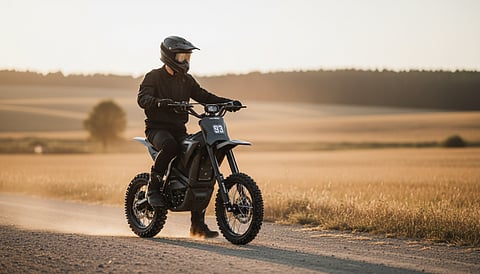
The electric dirt bike is the newest arrival in that second pile. And it's the one most likely to surprise the adults and families who haven't been paying attention to it, because for the first time it's crossing out of enthusiast powersports and into ordinary weekend life.
Here is the lens this whole piece runs on, and it's a simple one. Call it the Saturday Test.
The Saturday Test
A piece of weekend gear passes if it gives you a reason to open the garage — not just something useful to grab once you've already decided to go out. Carrying gear fails this test gracefully; it's never supposed to pass it. Doing gear lives or dies by it. Every claim below — about specs, about families, about where you ride — comes back to this single question: does it earn the garage?
The shift toward doing gear isn't a marketing accident. It tracks two changes in how adults actually live.
Long vacations have thinned out for a lot of people. The week is full — desks, commutes, the logistics of a household — and the escape hatch has shrunk down to forty-eight hours. When the available window is that small, the bar for it goes up. A weekend has to feel worth the effort, which means passive comfort isn't enough anymore. People want the window to contain something they did, not just somewhere they sat.
Then there's the quieter family math. A six-year-old is delighted by a stick and a puddle. A fifteen-year-old is not. Somewhere around the early teens, the family activity menu collapses, because the things that satisfy a younger child bore an older one, and the things that excite a teenager often exclude everyone else. Families end up negotiating instead of doing. Doing gear that an adult and a sixteen-year-old can both find genuinely fun is rare — and valuable precisely because it's rare.
To understand the appeal you have to see what it isn't, because it keeps getting mistaken for two adjacent things it only half-resembles.
A commuter e-bike is a brilliant piece of carrying-adjacent gear — it carries you, efficiently, on roads and paths. Even a fat-tire model is really a road bike that tolerates dirt. The electric dirt bike inverts that. It's built for the dirt first and tolerates nothing else by default: aggressive geometry, real suspension travel, knobby tires, torque tuned for loose ground rather than a bike lane. An e-bike rider who keeps drifting off the path toward the gravel is, without quite realizing it, shopping for this category.
From the other direction, it gets mistaken for a gas dirt bike with the noise turned down. It isn't that either. Strip out the engine and you strip out an entire ownership culture — the fuel can in the garage corner, the oil changes, the spark plugs, the clutch you learn by stalling. Some riders love that ritual and should buy a gas bike. The electric version is for the rider who wants the riding without inheriting the maintenance hobby that traditionally came bolted to it.
So it lands in a gap: more off-road than an e-bike, less mechanical than a gas bike, more agile and skill-driven than an ATV. That middle ground sounds like a compromise until you realize it's exactly the slot a weekend adult wants — real excitement, low friction, no second job. A cooler supports a weekend. This defines one. By the Saturday Test, that's the whole ballgame.
Here's where most coverage gets it wrong. It treats “family electric dirt bike” as one purchase, and that framing is both unsafe and uninspiring.
The family appeal was never that everyone rides the same machine — they shouldn't. An adult-performance bike is the wrong tool for a nervous first-time teen, in power, in seat height, in weight. The thing a family actually shares isn't the bike. It's the activity. Riding, learning, watching, improving, spending a Saturday on the same patch of land with the same goal. That's the unit of fun, and it scales across very different riders on very different bikes. Read that way, the dirt bike stops being a toy and becomes supervised outdoor skill equipment — which is exactly how it should be treated.
Doing gear only earns the garage if it gets used twice. A one-time novelty fails the Saturday Test on the second Saturday. For families, repeatability comes from structure set before the first ride, not improvised after the first near-miss. A short household rulebook does more for the activity's longevity than any spec:
Where the bike can be ridden — named, specific places, not “around.”
Who is allowed to ride, and who must be supervised.
Gear on, every time — the simplest version is “no gear, no ride.”
Which speed mode or riding setting is allowed for which rider.
Whether passengers are ever permitted (usually: no).
What actually happens when a rule gets broken.
Clear rules don't dampen the fun. They're the reason there's a second weekend, and a tenth.
Once the lifestyle case is clear, the buying decision gets sharper — and it's almost never about the number the marketing leads with.
For a rider chasing genuine off-road confidence rather than a spec-sheet bragging right, an adult electric dirt bike deserves to be judged on how it behaves on dirt, not on its top-speed headline. Four things matter more than that headline does.
On grass, gravel, and loose climbs, you feel torque constantly and top speed almost never. Torque is what pulls you off a standstill on a slope, what carries you through a soft patch without bogging, what answers when you need power right now. A bike that posts an impressive MPH but delivers its power harshly or late will feel worse on real ground than a “slower” bike with smooth, early torque.
Top speed is measured on a surface you'll rarely ride: flat, hard, straight, and long enough to reach it. Most weekend riding is none of those things. The number sells the bike and then sits unused. Judge the bike by the eighty percent of riding you'll actually do, not the two percent the spec sheet was written for.
These are the two components that quietly decide whether a powerful bike feels thrilling or frightening. Suspension isn't about plushness — it's about keeping the tires planted over ruts and bumps so the bike does what you ask. Brakes have to be sized to the motor: the faster a bike accelerates, the more stopping power becomes non-negotiable, especially for a heavier adult on rough ground. A strong motor with weak brakes isn't a fast bike. It's an unfinished one.
Range is the spec most distorted by optimism.
Advertised range assumes a light rider, flat ground, mild weather, and a modest speed mode. Add an adult, hills, cold, full power, and aggressive throttle, and the real figure drops — sometimes by a lot. The practical question isn't “what's the biggest number?” It's “what does a typical session here actually look like?” Short bursts on a small property need very little. Long lines across open acreage need more. Match the battery to the routine, not to the brochure.
A bike that looks commanding online still has to fit a body in person. Too tall and stops feel precarious; too heavy and uneven ground turns into a wrestling match; too small and an adult never relaxes into it. Fit isn't a comfort footnote — it runs a loop: a bike that fits builds confidence, confidence makes you ride more, riding more is the entire point. A bike that doesn't fit fails the Saturday Test by simply staying parked.
Here's the part the spec-obsessed reviews skip: the single most important variable in this purchase isn't on the bike at all. It's the ground you have permission to ride.
Anyone weighing different electric off-road bikes should settle the land question first, because terrain and access quietly decide which bike is even the right kind — and whether the purchase makes sense at all.
This is the category's home turf. Private property gives you boundaries, supervision, and the thing that matters most for the Saturday Test — you can ride on a whim, repeatedly, without planning an expedition. Farms and ranches add open dirt, natural lines, and a setting where a quieter electric model is genuinely less disruptive to animals and neighbors than a gas bike would be. Repeatable, controlled, low-friction: this is where doing gear thrives.
For a cabin or rural second home, the bike does something subtler than provide thrills. It answers the “what do we do now?” that often follows arrival.
A familiar property stops being just a place you go and becomes a place you do something. The drive out has a payoff waiting. The same hundred acres you've seen a hundred times feels new from the saddle. That conversion — from destination to activity — is the most underrated thing doing gear offers, and it's exactly why the bike keeps getting pulled out instead of gathering dust.
The honest flip side: the wrong location turns the best bike into a bad purchase. Sidewalks, crowded parks, shared walking paths, public roads where it isn't legal, anywhere motorized vehicles are barred, and technical terrain beyond a rider's skill — all off the table. “Electric” does not quietly mean “street legal.” Many of these machines are off-road only, and street legality depends on local law, classification, and equipment. The riding spot is part of the equipment. Without a safe, legal one, even a perfect bike is the wrong buy.
A lifestyle feature that only sells isn't worth reading, so here's the case against. An electric dirt bike is the wrong call for an adult who needs city transport, wants something light for bike paths, or simply has no legal place to ride — no thesis survives the absence of land. Maintenance is lighter than a gas bike's, not absent: brakes, tires, chain or drivetrain, suspension, battery, and bolts all still want attention. And it asks for things carrying gear never does — charging access, somewhere to store it, often a way to transport it. It earns the garage only when the rider's real life has room for it. Bought for the way it looks in a photo, it fails the Saturday Test by the second weekend.
Skip the generic spec checklist. Run the purchase through the Saturday Test in order, and the answer tends to reveal itself — sometimes by stopping you early.
Start with the land. Where, exactly, will this be ridden — and is it allowed there? No legal ground, no purchase. Stop here if the answer is shaky.
Name the riders. One adult? An adult and a teen? That decides whether you're buying one bike or matching different bikes to different people.
Match power to the least experienced rider who'll use each bike — not to the most ambitious one.
Judge torque and power delivery before top speed. Then weigh brakes and suspension as a pair, sized to the motor.
Translate the range claim into your real session, with your weight, your hills, your weather.
Check fit physically — seat height, weight, balance — because fit drives the confidence loop that decides how often it's ridden.
Budget the safety gear and the household rules into the purchase, not after it.
Confirm charging, storage, and transport before you buy, not when the bike arrives.
If a bike clears all eight, it isn't just a good bike. It's doing gear that will actually get used — which is the only kind worth buying.
Weekend gear split into two species, and the second one — the gear that does rather than carries — has been steadily annexing more of how adults and families spend their best forty-eight hours. The electric dirt bike is simply the most striking recent entry: exciting enough for an adult, approachable enough for a supervised teen, and low-friction enough that it actually gets ridden rather than admired.
For the right household — with land, with a safety mindset, with a realistic sense of how they'll use it — a purpose-built off-road machine can turn familiar acreage into something that pulls people outside on a Saturday they might otherwise have spent indoors. For the wrong household, it's an expensive ornament. The deciding factor was never the bike's top speed. It was whether the rest of your life has a place to put it.
Which is the whole point of doing gear, and the whole point of the Saturday Test. The best weekend equipment doesn't come along for the ride. It's the reason you take the ride at all.
Inspired by what you read?
Get more stories like this—plus exclusive guides and resident recommendations—delivered to your inbox. Subscribe to our exclusive newsletter
The products and experiences featured on RESIDENT™ are independently selected by our editorial team. We may receive compensation from retailers and partners when readers engage with or make purchases through certain links.