
- Locations
- Interviews
- Luxury Home
- Luxury Lifestyle
- Luxury Travel
- Luxury News
- Events
- More
- Magazine
- Contact Us

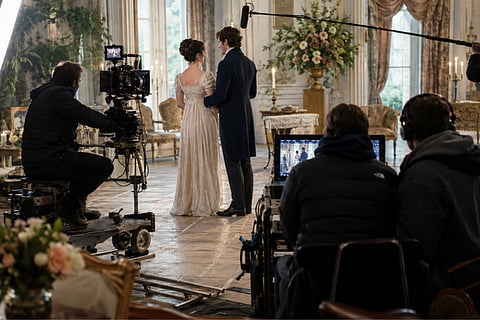
Netflix is producing a six-episode Pride and Prejudice limited series with Emma Corrin as Elizabeth Bennet and Jack Lowden as Mr. Darcy, roughly twenty years after Joe Wright's Keira Knightley film. A new Sense and Sensibility led by Daisy Edgar-Jones arrives in theaters this fall. The Other Bennet Sister, which moves the overlooked middle sister Mary to the center, is already streaming on BritBox.
Three centuries after publication, Austen is the most reliably adapted author in romance. The reason isn't nostalgia. She built her novels around character architecture so durable that every generation can rewrite the surface and leave the foundation intact.
Screenwriter Bennett Graebner, who earned his MFA from USC's School of Cinematic Arts and spent 17 years as showrunner of The Bachelor, builds stories the same way. His argument is simple: writers chasing originality should study the most-adapted author in history first.
Austen's plots are simple on paper. A woman with sharp judgment misreads a proud man. Sisters with opposite temperaments fight over love and money. What carries the books across 200 years isn't the plot but the precision of the people inside it. Get the people right, and the rest takes care of itself.
Elizabeth Bennet works because her wit and her pride are specific and self-defeating in equal measure. Each plot turn falls out of who she is, not from a mechanism imposed on her. Swap the bonnets for smartphones, and the character still drives every scene.
Sense and Sensibility runs on the same engine. Elinor's restraint and Marianne's abandon are opposite settings of one dial, and the plot is just those two temperaments colliding with money and marriage. Cast new faces, move the release to this fall, and the friction still holds.
Adapters have dropped Austen into 1990s Beverly Hills and present-day London, and the stories survive the move. Clueless kept Emma intact under a teen-comedy makeover. That durability comes from a simple sequence. Build the emotional engine first, then bolt on the setting.
2026 alone offers three simultaneous Austen projects across three formats, which is itself a sign of how dependable the source material has become. Each takes a different angle on the same shelf of novels:
Netflix's Pride and Prejudice, a six-episode limited series written by Dolly Alderton, with Emma Corrin and Jack Lowden and a supporting cast that includes Olivia Colman and Rufus Sewell
A feature Sense and Sensibility led by Daisy Edgar-Jones and Esmé Creed-Miles as the Dashwood sisters, due in theaters this fall
The Other Bennet Sister, a series that recenters the plain, book-loving middle child Mary, now streaming for U.S. viewers
A recent Marie Claire romance preview put it plainly, calling Austen's romances and stories of class timeless and noting that few writers compare to the power of her pen. Studios green-light Austen because the material has already survived every test a story can face.
Austen is also the rare IP that costs a studio almost nothing to license. Its novels are public domain, the audience is pre-sold, and the brand recognition runs three centuries deep. A green-light committee weighing a risky original against another Austen will take the sure thing almost every time. That's less a verdict on creativity than on how studios price risk in 2026, and it explains why three of these projects landed in the same twelve-month window.
Hollywood treats originality as a hunt for a premise no one has seen. Graebner's career points the other way, toward character built from the ground up. His Bachelor work and his screenwriting run on the same rule, which he describes as starting with character.
"I'm just doing the same thing I was doing in screenwriting," Graebner has said of that throughline. "Telling stories with beginnings and middles and ends, planting and payoff, and starting with character." Austen is the proof of concept at scale, an author whose people are so fully built that the plots regenerate on their own.
Recent history keeps proving the point. Bridget Jones built a four-film franchise on Pride and Prejudice's bones. It kept Austen's people and changed only the wallpaper. Those bones did the work. Studios aren't adapting Austen for the plots, which audiences know by heart. They're adapting her because the characters survive any era you drop them into.
Failure usually comes from the opposite mistake. Adapt the surface and lose the interiority, and you get a handsome costume drama nobody remembers. Plenty of Austen adaptations have died exactly that way, faithful to the bonnets and deaf to the irony. What survives is the voice inside the character's head, the gap between what she says and what she actually wants.
A character built to Austen's depth generates conflict without a writer forcing it. Put Elizabeth and Darcy in a room and the scene writes itself, because their flaws collide on contact. Originality, in that model, is a byproduct of specificity, not the goal.
Graebner learned the same economy on television, where a fully drawn contestant could carry a season of story without a writers' room inventing it. Build the person well enough, and the plot arrives on its own.
For a working writer, the copyable part isn't the marriage plot. It's the method. Give a character one real want and a blind spot about it, then let the story fall out of the collision. Austen did it with irony and money. A modern writer can do it with a group chat and a layoff.
Writers who want longevity have a free syllabus in Austen's six finished novels. Her lesson isn't the marriage plot or the period setting. A story outlives its era only when the people inside it are specific enough to be rebuilt by the next generation. Trends reward the writer who lands one clever premise. Austen rewards the writer who builds a person worth reinventing.
Bennett Graebner returned to the scripted side this year, including a mid-budget romcom, after stepping back from The Bachelor. He's betting on the same foundation Austen laid. Build a character who lasts, and they'll outlive whatever's trending the year the script finally gets made.
Inspired by what you read?
Get more stories like this—plus exclusive guides and resident recommendations—delivered to your inbox. Subscribe to our exclusive newsletter
The products and experiences featured on RESIDENT™ are independently selected by our editorial team. We may receive compensation from retailers and partners when readers engage with or make purchases through certain links.