
- Locations
- Interviews
- Luxury Home
- Luxury Lifestyle
- Luxury Travel
- Luxury News
- Events
- More
- Magazine

Mesotherapy sits in that increasingly popular middle ground between “just a facial” and more invasive aesthetic procedures. It’s minimally disruptive, customisable, and often used to target concerns that topical skincare can’t fully reach—like early laxity, dullness, dehydration, or stubborn localised fat. But because it’s a broad umbrella term (and not a single, standardised formula), the results you get depend heavily on what’s injected, where it’s placed, and who’s doing it.
If you’re considering mesotherapy, the most useful thing you can do is understand what it actually is, what it can—and can’t—do, and how to evaluate a treatment plan before you book.
At its core, mesotherapy involves delivering small amounts of active ingredients into the superficial layers of skin (typically the mesoderm/upper dermis) using multiple microinjections. The aim isn’t to “fill” in the same way dermal fillers do; it’s usually to improve skin quality by supporting hydration, texture, radiance, and, in some protocols, collagen stimulation.
Mesotherapy is most often used for:
Skin revitalisation (dehydration, dullness, crepey texture)
Fine lines that are more “surface” than structural
Enlarged pores and uneven tone (as part of a broader plan)
Scalp support for hair thinning (depending on the cocktail used)
Localised fat reduction (body-focused mesotherapy protocols vary by region and regulation)
That said, it’s not a one-stop replacement for other injectables. If your main issue is significant volume loss in the mid-face, deep nasolabial folds, or structural sagging, mesotherapy alone is unlikely to deliver the lift or contour you’re picturing.
One reason people get confused is that “mesotherapy” can refer to many different formulations: hyaluronic acid for hydration, vitamins and amino acids for skin conditioning, antioxidants, peptides, or other skin-supportive compounds. Some providers also combine mesotherapy-like techniques with polynucleotides or biostimulatory approaches, but those aren’t interchangeable—each has distinct evidence, mechanism, and expectations.
A good consultation often starts with a simple question: are you trying to improve skin quality or face structure?
Mesotherapy is a strong option if you want to:
Boost hydration and glow without changing facial shape
Improve “tired” looking skin—especially under eyes, cheeks, neck, or hands
Maintain results between other treatments (like lasers, microneedling, or light peels)
If your concern is more about “deflation”—think flatter cheeks, temples hollowing, or a more drawn look—your clinician may discuss volumising options. For an overview that clarifies where mesotherapy ends and volume correction begins, you can view volume-restoring injections as part of your research, then bring questions from that reading into your consultation. The goal is to match technique to anatomy, rather than chasing a trend.
Most appointments follow a similar rhythm: assessment, prep, injections, and aftercare guidance. The details vary depending on the area treated and the solution used.
A reputable practitioner should cover:
Medical history (including allergies, autoimmune conditions, bleeding risk, pregnancy/breastfeeding status)
Current skincare and actives (e.g., retinoids, acids)
Previous injectables and any complications
Your primary goal and what “success” looks like to you
Expect your clinician to look at skin thickness, laxity, hydration, and facial movement—not just the one line you want gone.
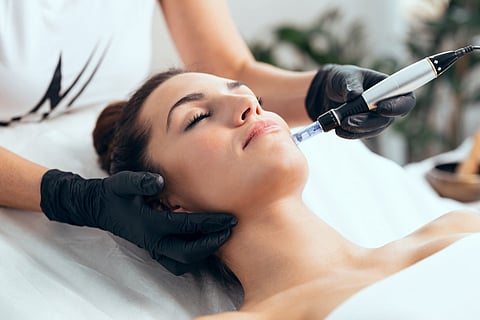
Mesotherapy is typically delivered via very fine needles in a series of quick, shallow injections. Sensation ranges from mild scratching to a sharper sting, depending on the area (the forehead and around the mouth tend to be more sensitive). Many clinics use topical numbing cream, though it’s not always essential.
You may see small raised bumps (papules) immediately after—this is normal and usually settles within hours to a day.
Mesotherapy isn’t usually a “walk out looking totally different” treatment. It’s more incremental, which is part of its appeal for people who want subtlety.
Some people notice improved hydration or glow within a week, especially if hyaluronic acid is part of the formula. Texture and fine-line improvements can take longer, often building across a course.
A common plan is 3 sessions spaced 2–4 weeks apart, then maintenance every few months. That isn’t a hard rule—your plan should reflect your skin condition, age, lifestyle (sun exposure, smoking, stress), and whether other procedures are being done alongside.
It’s best to be clear on limitations:
It won’t replace a facelift or correct significant skin laxity
It won’t lift tissue that has descended due to structural ageing
It won’t mimic the projection you get from dermal fillers in cheeks or chin
If a provider promises dramatic reshaping from mesotherapy alone, treat that as a caution flag.
Mesotherapy is generally considered low downtime, but “low” doesn’t mean “none.”
Typical short-term effects include mild swelling, redness, pinpoint bruising, tenderness, and occasional itching. Under-eye treatments can swell more noticeably because the tissue is delicate and holds fluid easily.
To keep it simple, you want clarity on three things:
Who is injecting (their qualifications and experience with the specific area)
What is being injected (brand/product, ingredients, and rationale)
What the plan is if you bruise, swell, or dislike the result
Also ask about hygiene standards, single-use consumables, and whether they document batch numbers for traceability. In aesthetics, process is safety.
Aftercare tends to be straightforward, but it matters. Most clinicians recommend avoiding intense exercise, alcohol, saunas, and very hot showers for 24–48 hours (heat and increased circulation can worsen swelling and bruising). Skip active skincare—retinoids, strong acids—until any irritation settles.
If you’re prone to bruising, discuss this ahead of time. Sometimes timing your appointment away from major events is the smartest “aftercare” you can do.
Mesotherapy outcomes are highly operator-dependent. Technique, depth, and product choice all affect results and risk. Choose someone who:
Gives you a balanced view (benefits and limitations)
Can explain why a specific cocktail suits your skin
Has experience treating your concern in your age group and skin type
Doesn’t rush you into a package before assessing you properly
Mesotherapy can be an excellent tool when used thoughtfully—especially for skin quality, luminosity, and maintenance. Go in with clear expectations, ask the right questions, and treat the consultation as a two-way evaluation. Done well, it’s not about changing your face; it’s about helping your skin look like it’s been well looked after.
Inspired by what you read?
Get more stories like this—plus exclusive guides and resident recommendations—delivered to your inbox. Subscribe to our exclusive newsletter
The products and experiences featured on RESIDENT™ are independently selected by our editorial team. We may receive compensation from retailers and partners when readers engage with or make purchases through certain links.