
- Locations
- Interviews
- Luxury Home
- Luxury Lifestyle
- Luxury Travel
- Luxury News
- Events
- More
- Magazine

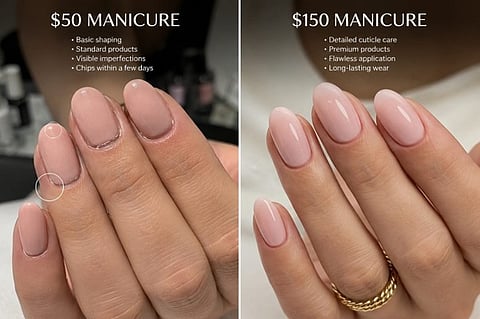
At first glance, the difference may seem obvious.
The $50 manicure is simple. The $150 one has better nail art, a fashionable salon, or a recognizable name behind it.
Sometimes, yes.
But two manicures can look almost identical in a photo and involve completely different processes. One may take 45 minutes. The other may require two hours of preparation, shaping, correction, and careful application.
Training, including a professional russian manicure course, can also change how a technician approaches each step. The real value of a manicure is not limited to what you see on the first day.
A technician completing a basic service in 45 minutes can see more clients each day. Someone offering detailed preparation and structured gel may book two hours for the same appointment.
Experience matters too. A technician who has spent years improving her shaping, product control, and problem-solving will usually charge more than someone who recently started working.
Salon expenses also influence pricing. Rent, insurance, ventilation, professional tools, booking software, continuing education, and sanitation supplies all become part of the service cost.
Some services use a simple base, color, and top coat. Others require several products selected for the condition and flexibility of the client’s natural nails. That does not automatically make one manicure better, but it changes the time and materials involved.
Location matters as well. A $100 service in one city may be considered mid-range and premium somewhere else.
Some skilled technicians charge less because they work from home, live in a lower-cost area, or are still building a client list. A simple manicure can also be exactly what a client needs.
Nail preparation may be shorter. The technician might perform basic cuticle-area cleanup, quickly shape the nails, and move directly into color application.
There may be less time to correct uneven natural nails or check every angle. Small differences in length and shape might remain because the appointment is designed to stay within a limited time.
The service may not include detailed structure, repairs, or reshaping. If a client has strong, short, even nails, this may be completely fine. If her nails bend, grow unevenly, or regularly experience lifting, the basic process may not address those issues.
They suit clients who want fresh color without a long appointment or extensive correction. The problem begins when someone expects a highly detailed result from a service priced and scheduled for speed.
Preparation is usually more detailed. The technician examines the nails, cleans the surrounding area carefully, and creates a smooth surface for application without aggressively thinning the natural nail.
Instead of filing each nail quickly from above, the technician checks the sidewalls, length, symmetry, and how the shape looks from the client’s view. Uneven growth may be corrected so the finished set looks balanced.
Product can be placed strategically to support the nail rather than simply cover it. Thin or flexible areas may need reinforcement. Nails that naturally grow downward or sideways may require visual correction.
There is usually more checking along the way. A technician may refine the surface, adjust thickness, and correct small flaws before applying color.
Hygiene should be expected at every price, not treated as a luxury upgrade. The CDC recommends cleaning grooming tools before use and properly sterilizing shared salon tools. A higher price may support more time and resources for professional sanitation, but safe practices should never be optional.
A better test comes two or three weeks later.
Has the product lifted near the cuticle? Are the nails cracking at the sides? Does the shape still look balanced as the natural nail grows?
Correct preparation helps the product adhere. Balanced structure supports the nail during everyday activities. Careful application reduces bulky edges and uneven growth.
Product safety matters too. The FDA’s nail care guidance advises following product instructions and warnings. Even a premium product can cause problems when it is applied carelessly, cured incorrectly, or repeatedly placed on the skin.
One good manicure can happen by chance. Professional technique means producing reliable results across different nail types and appointments. The client should not receive perfect nails in March and a rushed, uneven set in April.
That predictability has value.
She may be paying for a technician who knows how to work with thin or damaged nails. She is paying for honest recommendations about length and shape. She is paying for an appointment that begins on time and does not feel rushed.
If one nail breaks, the technician knows how to repair it. If a product is not suitable, she chooses another. If the client’s nails show signs of irritation or unusual changes, she does not simply cover the problem.
The American Academy of Dermatology notes that aggressive filing and certain artificial nail practices can weaken natural nails. Its guidance on reducing artificial nail damage is a useful reminder that durability should not come at the cost of nail health.
A premium service should reduce unnecessary damage, lifting, and repeated repairs.
It should also feel predictable from booking to checkout.
The difference between a $50 and $150 manicure is not always visible on day one.
It may be hidden in the preparation, structure, correction, sanitation, and time spent refining the result. It can also appear later in how evenly the manicure grows and how well it handles everyday wear.
Of course, price alone guarantees nothing.
An expensive manicure can disappoint. An affordable one can be excellent.
The better question is not simply, “Why does this cost more?”
Ask what the service includes, how much time is reserved, and what kind of result you can realistically expect.
You are not only paying for prettier nails.
You are paying for the process behind them.
Inspired by what you read?
Get more stories like this—plus exclusive guides and resident recommendations—delivered to your inbox. Subscribe to our exclusive newsletter
The products and experiences featured on RESIDENT™ are independently selected by our editorial team. We may receive compensation from retailers and partners when readers engage with or make purchases through certain links.