
- Locations
- Interviews
- Luxury Home
- Luxury Lifestyle
- Luxury Travel
- Luxury News
- Events
- More
- Magazine

Contemporary jewelry has spent the past decade steadily escaping the narrow idea of ornament. At international gatherings such as Schmuck in Munich, and in curatorial projects that describe jewelry as a living language rather than a decorative afterthought, the field has increasingly asked what small objects can do once they enter the space of the body. Can jewelry hold memory? Can it speak about identity without becoming illustration? Can it make private states visible without reducing them to confession?
Zhuwei Lu's solo exhibition Reconcile, presented at Sycamore Place Gallery in Decatur, Georgia, on February 21 and 22, 2026, belongs to this conversation. Invited by the Taiwanese Junior Chamber of Commerce Georgia, Lu was given a focused setting in which to present a recent body of work in depth. The invitation emphasized the organization's interest in her combination of electroforming and personal experience, as well as its commitment to meaningful artistic voices and cultural exchange. In that context, Reconcile became more than a jewelry exhibition. It became a compact study of how materials, bodies, and unresolved histories can meet.
The title is important. Reconcile is not a soft word here. Lu's works do not suggest easy peace or decorative harmony. They are full of pressure, contact, and contradiction. Copper growths spread across pale forms. Metallic textures crust against smooth surfaces. Transparent and amber fragments hang beside heavier structural elements. Some pieces seem to have been excavated; others seem to be in the middle of becoming. Nothing feels entirely finished in the sense of being closed. Instead, the works feel alive because they continue to negotiate with their own materials.
This is especially clear in Lu's use of electroforming. In conventional jewelry language, the value of a piece is often attached to stone, polish, symmetry, or preciousness. Lu shifts the emphasis toward process. Electroforming allows metal to accumulate slowly, building uneven skins and protrusions that resemble mineral deposits, coral, scar tissue, or botanical growth. The process produces a surface that is both controlled and unpredictable. Lu's achievement lies in allowing that unpredictability to remain visible while still composing the work with authority.
One necklace in Reconcile makes this approach unmistakable. Worn over a black turtleneck, it begins with a structured metal collar and then releases a cascade of curled, translucent, copper, and violet-toned forms. The piece recalls armor, ceremonial dress, dried plant matter, and anatomical fragments all at once. It is dramatic, but not theatrical in an empty sense. Its drama comes from the way it transforms the upper body into a field of attachment. The wearer does not simply display the piece; the wearer becomes part of its architecture.
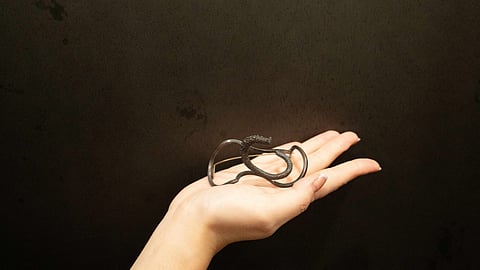
Another work, photographed close against a dark textile surface, arranges circular and ring-like forms with coppery encrustations across a chain-like structure. The contrast between the soft black ground and the granular metal surface gives the piece a feeling of time compressed into matter. It could be read as corrosion, growth, wound, relic, or ornament. That ambiguity is the point. Lu's work refuses to tell the viewer exactly what has happened. It offers evidence instead: a residue of contact, transformation, and survival.
This is why Reconcile feels connected to the broader direction of contemporary jewelry after the spring season. Schmuck Munich 2026, one of the field's most important international platforms, emphasized the quality of the individual work across national, material, and stylistic categories. Cluster's 2026 jewelry program similarly frames contemporary jewelry as something more than ornament: a medium for memory, identity, and possible futures. Lu's exhibition in Decatur did not imitate those large platforms, but it shared their central question. What happens when jewelry becomes a way of thinking with the body?
Lu's answer is physical. Her pieces do not float in the abstract. They need shoulders, fabric, chest, collarbone, and movement. The body gives them scale and risk. It also gives them vulnerability. A sculptural object on a pedestal may appear self-contained, but jewelry must negotiate closeness. It touches. It rests. It pulls. It asks to be carried. In Reconcile, that closeness becomes part of the meaning. The works seem to ask what it means to carry evidence of growth and damage at the same time.
This concern gives the exhibition its emotional depth. Lu's surfaces often look wounded and regenerative at once. Copper does not appear as a luxury finish; it appears as a living trace. Translucent forms do not read as pure decoration; they interrupt the density of metal with moments of exposure and light. Circular structures suggest continuity, but their rough edges resist closure. The result is jewelry that does not describe reconciliation as a final state. It describes reconciliation as an ongoing labor.
There is also a cultural dimension to the work's presentation. Reconcile was supported by a community-based organization committed to cultural exchange, and that setting matters because Lu's work itself exists between traditions and geographies. Her practice draws on advanced contemporary jewelry techniques while carrying the sensitivity of an artist formed by multiple cultural contexts. The pieces do not announce identity through obvious symbols. Instead, they translate displacement, adaptation, and self-definition into material behavior. Growth becomes a metaphor for becoming; encrustation becomes a metaphor for memory; wearability becomes a metaphor for living with what has changed.
The strongest contemporary jewelry often operates at this scale: intimate, but not small in meaning. It can be held in the hand, worn on the body, and still address questions usually reserved for sculpture, performance, or installation. Lu's Reconcile understands that power. The exhibition did not ask jewelry to become larger in order to become serious. It asked viewers to look more closely at the scale jewelry already owns.
Several months after the show, Reconcile remains worth revisiting because its questions have only become more relevant. In a cultural moment that often prizes immediate visibility and smooth surfaces, Lu offers work that is slow, irregular, and insistently tactile. Her jewelry does not decorate the body from the outside. It asks the body to become a site where material memory, emotional repair, and artistic transformation can meet.
That is the quiet force of Reconcile. It shows that contemporary jewelry can be beautiful without being obedient, sculptural without abandoning the body, and personal without becoming private. In Zhuwei Lu's hands, adornment becomes a language of friction and repair - one that continues to speak long after the gallery closes.
Website: www.zhuweilujewelry.com
Inspired by what you read?
Get more stories like this—plus exclusive guides and resident recommendations—delivered to your inbox. Subscribe to our exclusive newsletter
The products and experiences featured on RESIDENT™ are independently selected by our editorial team. We may receive compensation from retailers and partners when readers engage with or make purchases through certain links.