
- Locations
- Interviews
- Luxury Home
- Luxury Lifestyle
- Luxury Travel
- Luxury News
- Events
- More
- Magazine

Step into any contemporary bathroom, and you'll find more than just serums and moisturizers on the counter. The modern beauty routine has become undeniably more technological. In the last few years, a wave of stylish, ergonomic devices has emerged claiming to tighten, lift, and resurface skin from the comfort of home, and there's no doubt they're appealing to beauty-conscious consumers. But as this technology advances, the same question keeps coming up: are these devices an effective substitute for med spas?
As an informed skincare journalist, my honest answer is: not always, but that's not really the point.
The debate between at-home skincare devices and professional clinical procedures often gets framed as a binary choice, but that framing is false. Professional treatments and at-home devices serve different needs, operate at entirely different energy levels, and complement each other within a well-rounded skincare routine. Deciding whether at-home lasers and RF devices are worth the investment starts with understanding how each one actually functions.
Before getting into the science of how clinical lasers and radiofrequency work, it's useful to look at why home-based aesthetic treatments have grown into a billion-dollar industry. Part of the appeal is simple: convenience and privacy. Not everyone has a lifestyle that allows for multiple days off following an invasive resurfacing laser treatment.
Yet, the real advantage of at-home technology is consistency. One way to think about it: consider your skin the way you would your body. A med spa treatment is like working out under the direction of a strength coach. It deliberately causes controlled stress to your cells to trigger regeneration, creating a significant amount of micro-injury to stimulate a strong repair response and deliver outstanding results. At-home technology, by comparison, is more like a daily yoga practice or a brisk walk.
Interested in treating skin texture, laxity, or collagen integrity? The two leading technologies for that purpose are RF and NAFL. Here's how each type of energy interacts with tissue, and why handheld devices don't work exactly like professional tools.
Radiofrequency uses targeted electromagnetic energy to create controlled heat in the deep dermis. Once tissue reaches ideal treatment temperatures, it triggers a biological chain reaction: existing collagen fibers contract immediately for an initial tightening effect, while fibroblasts are stimulated to produce new collagen and elastin over the following months.
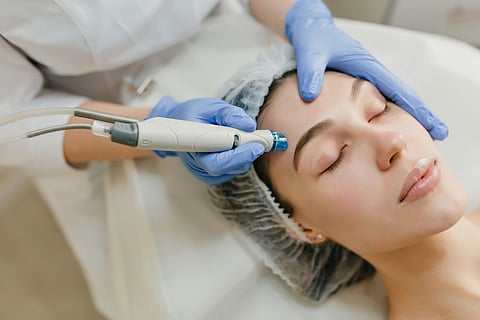
Clinical use: Professional RF treatments (often paired with microneedling) deliver intense energy deep into the skin, producing considerable structural change. These treatments usually require topical anesthesia and cause redness afterward.
Home-based: Consumer RF devices operate at lower energy settings to ensure safety for unsupervised use. While there's no harsh sensation per session, regular use several times a week helps firm and rejuvenate the skin over time.
Laser devices work by delivering concentrated beams of light energy into the dermis. "Non-ablative" refers to light that penetrates the skin without vaporizing its uppermost layer, unlike ablative lasers. "Fractional" means the treatment targets columns of skin rather than the entire surface. NAFL remains the gold standard for skin resurfacing when it comes to smoothing texture, reducing pore size, and improving hyperpigmentation and fine lines.
In the clinic: Professional NAFL devices (such as Fraxel or Clear + Brilliant) deliver powerful beams of laser light in dense concentrations. Moderate swelling, redness, and a sandpaper-like texture are expected for several days afterward.
At home: At-home fractional lasers apply energy at lower concentrations. The same micro-thermal zones are produced to renew the skin, but without social downtime. Visible improvement in texture develops with regular use.
Since the effectiveness of any at-home device depends entirely on proper use, usability, ergonomics, and safety all matter. A device that's inconvenient or hard to use will end up sitting untouched on the shelf, and if you're investing time into an at-home routine, it's worth using the right equipment.
When evaluating the market, look for products from companies that adhere to strict safety standards and incorporate clinical-grade design principles. One such example is MimiSilk's at-home beauty devices. MimiSilk's Iris and Vera are designed to bring professional aesthetic science into an easy-to-use format. Between their usability and precise energy delivery, devices like Iris and Vera make dermal firming and skin refinement simple to build into your evening routine.
How should the aesthetic consumer properly allocate their resources? It's important not to view in-home products as a compromise, or med spas as an indulgence. Each has its own place in a skincare journey.
Interventional therapy (the med spa): If your goal is to address severe skin laxity, acne scars, or deep pigmentation, the med spa should be your first stop. You'll need high-end machinery capable of remodeling tissue and addressing issues rapidly.
Maintain & preserve (at home): Once you've achieved a certain baseline, at-home RF or laser devices become an important maintenance tool. Working them into your weekly routine helps preserve treatment results, protecting your investment while continuing to support collagen production.
Prejuvenation (at home): If you're only in your late twenties or thirties and your goal is prevention, pairing quality at-home devices with effective topical actives (retinoids, peptides, stable vitamin C) can help keep skin firm and radiant for years to come.
Even though contemporary energy-based devices are designed with safety features, they still deliver active energy into the human skin. It's always wise to consult a board-certified dermatologist or aesthetician before using any energy-based device. It’s especially important for those with a history of melasma or post-inflammatory hyperpigmentation, since thermal energy, when used incorrectly, can trigger pigmentation issues.
There's no substitute for the intensive results of a clinical med spa treatment, and that was never the intended purpose of at-home devices. Instead, they offer a self-empowering form of skincare built on privacy, consistency, and progressive care. Understanding the science behind them, choosing quality devices, and setting realistic expectations makes it easy to fit a device-based routine into your daily skincare regimen.
Inspired by what you read?
Get more stories like this—plus exclusive guides and resident recommendations—delivered to your inbox. Subscribe to our exclusive newsletter
The products and experiences featured on RESIDENT™ are independently selected by our editorial team. We may receive compensation from retailers and partners when readers engage with or make purchases through certain links.