
- Locations
- Interviews
- Luxury Home
- Luxury Lifestyle
- Luxury Travel
- Luxury News
- Events
- More
- Magazine

Serious collectors now treat selling as deliberate portfolio management, not a last resort.
The number on a Rolex insurance schedule and the number a secondary-market buyer will actually pay are rarely the same figure. Confusing them is the most common way collectors misprice a sale.
Specialists who price against live secondary-market data, rather than retail or replacement cost, are best positioned to tell a collector what a given reference is really worth today.
For larger collections, consignment, which involves a defined marketing window rather than an instant sale, commonly nets several percentage points more than a same-day offer.
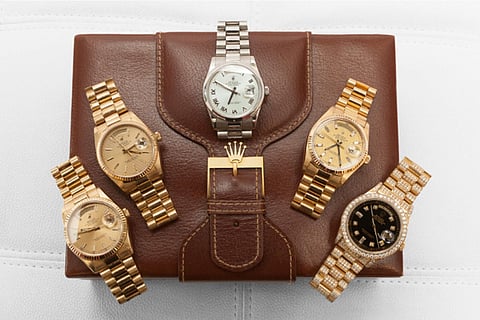
For a certain kind of collector, the watch box has quietly become a portfolio. Not in the cold, spreadsheet sense, as nobody buys a Daytona purely as an asset class, but in the sense that a serious collection, like any serious holding, benefits from periodic editing. The pieces that no longer earn their spot on the wrist get moved along, and the capital they release goes toward the next acquisition, a real estate closing, or simply back into liquidity. What's changed recently isn't the buying. It's that selling has stopped being something collectors do quietly out of necessity and started being something they do deliberately, as a matter of good stewardship.
Talk to anyone who has spent a decade building a collection and you'll hear the same admission: the watches that stay are rarely the ones bought first. They're the ones that survived several rounds of editing. That process only works, though, if the collector actually understands what each piece is worth on the day they're ready to part with it, and that's where most people get the math wrong.
Ask most Rolex owners what their watch is worth and they'll cite the number on their insurance schedule. It's an understandable habit, and it's also almost always the wrong number to use when deciding whether to sell.
An insurance appraisal is built to answer a different question than the one a seller is asking. It estimates what it would cost to replace the piece at retail, through an authorized channel, today. This is a figure insurers use to set premiums and payouts, not one that reflects what a buyer would actually pay for that exact watch in the secondary market. The two numbers can diverge sharply, in either direction. A well-kept, full-set example of a discontinued reference, which collectors point to as a favorite case study with the Submariner "Kermit," can trade well above its original MSRP once buyers realize it isn't coming back. A more common reference in a saturated size or configuration might sell for meaningfully less than its insured value, simply because supply has caught up with demand.
Collectors who sell well have usually learned to hold these two numbers apart in their heads: one for the insurance file, one for the market. Confusing them is how people either walk away from a fair offer because it doesn't match a number that was never meant to reflect resale value, or hang onto a piece they'd otherwise happily sell because they assume it's worth less than it actually is.
Getting the real number requires going to someone whose business is the secondary market itself, not the retail one. Rolex specialists who price against live secondary-market data, such as comparable sales, current demand for specific references, and condition-adjusted pricing, arrive at offers that reflect what a watch will actually bring, rather than what it once cost or what it would cost to replace. Diamond Banc is a Rolex buyer that works this way, builds offers around recent sale prices for the exact model in question rather than a generic price list, which is precisely the discipline that distinguishes a real resale figure from an insurance one. That distinction matters most for exactly the references collectors are most likely to be editing out of a collection: older, discontinued, or unusually configured pieces where retail pricing has long since stopped being relevant.
The other piece collectors underweight is authentication. A Rolex that's changed hands a few times, been serviced outside an authorized network, or lost its original papers still needs its serial number, movement, and case markings verified before anyone can price it with confidence. That verification should happen at no cost to the seller, as part of the offer process, not as a hurdle before one. It's the standard at reputable specialty buyers: Diamond Banc's in-house Rolex specialists authenticate serial number, movement, and case markings on every offer at no charge, rather than asking the seller to pay for or arrange it themselves.
For collections large enough to warrant it, there's a third option worth considering before an instant sale: consignment. Rather than accepting a same-day offer, a defined marketing period lets a piece find its true buyer rather than its fastest one. It's a structure a handful of specialty buyers now offer directly. Diamond Banc's consignment program, for instance, works within a roughly ten-business-day window and is built to net sellers five to twelve percent more than an instant purchase offer would. It's a useful lever for a collector who isn't in a rush and wants the collection edited well rather than edited quickly.
None of this is an argument for selling everything. It's an argument for treating the decision with the same rigor collectors already apply to buying, which includes knowing which number to trust, understanding what authentication actually protects against, and recognizing that a well-timed sale, handled through the right channel, isn't a retreat from collecting. It's how a collection stays interesting. The collectors with the most enviable boxes aren't the ones who never sell. They're the ones who know exactly when, and to whom.
Inspired by what you read?
Get more stories like this—plus exclusive guides and resident recommendations—delivered to your inbox. Subscribe to our exclusive newsletter
The products and experiences featured on RESIDENT™ are independently selected by our editorial team. We may receive compensation from retailers and partners when readers engage with or make purchases through certain links.