
- Locations
- Interviews
- Luxury Home
- Luxury Lifestyle
- Luxury Travel
- Luxury News
- Events
- More
- Magazine

You started pricing super clone watches, and the numbers made no sense. One listing says $250, another says $1,400, and both claim to be the same model at the same "super clone" grade. Before you assume the cheaper one is a steal or the pricier one is a ripoff, it helps to understand that the replica market runs on tiers, and the price usually tells you which tier you are actually in. We sell super clones at Watchvale, so we have skin in this game, but the pricing structure below is the same one any honest seller works within, and knowing it protects you from paying top-tier money for a bottom-tier watch.
Let us break down what the market actually charges in 2026 and what each price level tends to buy.
The replica market generally sorts into three rough bands, and the price follows what is inside the case rather than what the dial says. At the bottom are low-cost replicas, the ones you see in Instagram ads and market stalls, usually under a few hundred dollars. These focus on looking the part in a photo and little else. The middle band covers mid-grade replicas, roughly four to six hundred dollars, with better finishing and a more reliable movement than the cheap stuff but still not built to match the original closely. The top band is the super clone, and in 2026 these run roughly a thousand to fifteen hundred dollars from established sellers.
The warning sign here is obvious once you know the tiers. A "super clone Daytona" priced at $250 has quietly redefined the term, which is a polite way of saying some sellers use the label without delivering the build. If a listing calls itself a super clone but charges low-tier money, the label is doing marketing work, not describing the watch.
The jump from a few hundred dollars to over a thousand is not arbitrary. Most of it goes into the movement. A top-tier build aims to replicate how the genuine caliber behaves, including how smoothly the seconds hand sweeps and what happens when the date flips at midnight. What separates the tiers is how smoothly it sweeps and what happens at midnight.
Materials account for much of the rest. Correct case metals, a sapphire crystal with anti-reflective coating, properly applied lume, and a bracelet with solid links and a decent clasp all cost more to produce. Then there is quality control. A serious operation rejects units that drift too far off time, which means fewer bad watches ship but each good one costs more.
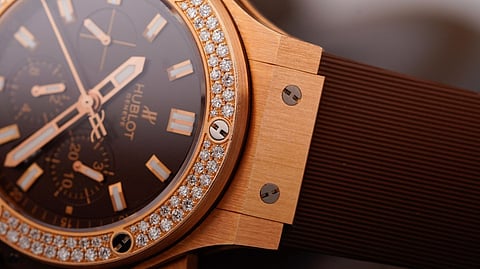
Within the super clone tier, a few things push a watch toward the top of the range. Precious-metal-look finishing, more complex movements like chronographs, and models that are simply harder to replicate accurately all add cost. A time-and-date watch is cheaper to clone well than a running chronograph with multiple working subdials, so expect to pay more for complications.
The seller's overhead matters too. A shop that offers real customer support, a return window, and a warranty builds those costs into the price. That is not padding. It is the difference between a seller who disappears after payment and one who helps when something goes wrong.
Price is a useful signal but not a guarantee. A high price can reflect a genuinely better watch, or it can reflect a seller betting you will equate cost with quality. The reliable move is to check what the price is supposed to be buying. A watch either names its movement and shows its photographs, or it does not. As Yasir Floy, the owner of Watchvale, Proposed quote for approval: "The price should match what is inside the watch. When a super clone is priced like a street fake, something is missing, and it is usually the movement."]
The judgment runs both ways. Overpaying for a mislabeled mid-grade piece is a loss, but so is assuming the cheapest "super clone" is the same watch as one that costs four times more. It is not.
Why are some super clone watches so much cheaper than others?
Because they are usually not the same tier despite the shared label. A genuine top-tier super clone in 2026 tends to run around a thousand dollars or more, so a listing at a fraction of that is likely a lower-grade replica using the term loosely.
What is the biggest cost inside a super clone?
The movement. A build that mimics the original caliber's winding, sweep, and date behavior costs far more than a basic automatic, and it is the part you cannot see but rely on daily.
Does a higher price always mean better quality?
No. Price is a signal, not proof. A high price can reflect a better watch or simply a seller counting on you to equate cost with quality, so verify the movement, materials, and seller terms before paying.
Are super clone prices going up?
The tier has grown quickly as genuine luxury prices rise, and demand at the top end stays strong. Prices move with model complexity and materials more than with hype, so complications and metal finishes cost the most.
So how much do super clone watches cost? In 2026, the real top tier generally lands between roughly a thousand and fifteen hundred dollars, with mid-grade replicas well below that and cheap fakes lower still. The number on the listing is your first clue to which tier you are actually in. A super clone priced like a street fake is almost never a bargain, it is a mislabeled lower grade. Match the price to what is inside the case, confirm the seller names the movement and stands behind the watch, and you will know whether you are paying for quality or just for a word on a product page.
Inspired by what you read?
Get more stories like this—plus exclusive guides and resident recommendations—delivered to your inbox. Subscribe to our exclusive newsletter
The products and experiences featured on RESIDENT™ are independently selected by our editorial team. We may receive compensation from retailers and partners when readers engage with or make purchases through certain links.