
- Locations
- Interviews
- Luxury Home
- Luxury Lifestyle
- Luxury Travel
- Luxury News
- Events
- More
- Magazine

Non-surgical body contouring offers several ways to address specific cosmetic concerns without incisions or surgical fat removal. But the treatments grouped under this name do not all work alike. Some target small fat deposits, while others aim to firm skin, stimulate muscles, or soften the appearance of cellulite.
The technology, treatment area, and individual response all influence what changes are possible. Understanding how the main methods work can help you compare treatment options, ask informed questions, and set expectations that reflect what each procedure can realistically achieve.
This article focuses on non-invasive body contouring: treatments that use devices applied to the skin's surface to change the appearance of a particular area without incisions or injections. Depending on the technology, the goal may be to reduce a localized fat bulge, improve skin tightness, enhance muscle definition, or temporarily smooth cellulite.
These outcomes are not interchangeable. A procedure that stimulates abdominal muscles, for example, does not necessarily tighten loose skin. Likewise, a treatment that improves skin texture may leave the underlying fat layer largely unchanged.
Non-invasive contouring is not a treatment for obesity or a substitute for weight management. The intended improvements are generally targeted and modest, and some require maintenance sessions.
Cryolipolysis uses controlled cooling to affect fat cells beneath the skin. During treatment, an applicator typically draws a small, pinchable fat bulge into a chamber and cools it.
The body gradually clears the affected fat cells, so any visible reduction develops over weeks rather than immediately, often becoming more apparent within two to three months.
Common treatment areas include the abdomen, flanks, and thighs, depending on the device's authorized indications. Redness, swelling, bruising, and temporary numbness can occur.
Less commonly, patients experience more serious complications. One important risk is paradoxical adipose hyperplasia (PAH), in which the treated fat enlarges instead of shrinking. PAH does not resolve on its own and may require surgery.
Fat freezing is unsuitable for certain cold-sensitivity disorders and does not guarantee even or lasting results.
Radiofrequency body contouring delivers electrical energy that generates controlled heat in selected tissues.
Depending on the device and its intended use, that heating may produce a tighter-looking skin surface, temporarily improve cellulite appearance, or reduce circumference in a treated area.
Some systems aim to affect collagen-rich structures; others heat tissue beneath the skin. Results therefore depend on the specific equipment and protocol, not simply the RF label.
If you are considering RF treatment, equipment selection is part of the conversation. A provider may use a body sculpting machine to address a clearly defined contouring goal, such as improving firmness in a selected area. Ask which tissue the system targets, why it suits your concern, and how changes will be assessed.
RF sessions can cause temporary redness, swelling, or discomfort. Excessive heating can also produce burns, blisters, or pigmentation changes, making provider training and appropriate settings important.
Ultrasound-based contouring applies sound-wave energy through the skin. Certain cavitation systems use acoustic effects intended to disrupt fat cells, while focused-ultrasound devices concentrate energy at a selected depth, potentially producing heating or mechanical disruption.
Both approaches may be used to target localized fat, but they differ in energy delivery, device settings, and supporting evidence.
That distinction matters when comparing procedures advertised simply as "ultrasound body sculpting." The expected effect depends on the exact device, treatment site, and authorized purpose. Some people may see a reduction in local circumference, but results are not predictable for every patient.
Improper energy delivery can cause burns or damage underlying tissues, including nerves. Providers commonly use coupling gel to maintain contact between the applicator and skin. Ultrasound body contouring should not be performed over open wounds or compromised skin, or in people with contraindicated active implants or implanted metal. The provider should check the exact device's restrictions before treatment.
Light-based contouring includes technologies with very different mechanisms.
Some non-invasive laser or infrared systems deliver heat to tissue beneath the skin. Depending on their design, they may target small fat deposits or temporarily improve the appearance of cellulite and body circumference.
Low-level light therapy works differently. It delivers low doses of light without intentionally heating fat or skin and may temporarily reduce circumference in the treated area. These approaches cannot be assumed to produce the same degree or duration of change.
Non-invasive light treatments are also distinct from laser-assisted liposuction, which involves inserting instruments through the skin and is therefore a surgical procedure.
Possible side effects vary by system and can include redness, discomfort, skin discoloration, or burns. Appropriate eye protection is important, and some treatments are unsuitable for people with photosensitivity or medications that increase light sensitivity.
Electromagnetic muscle stimulation uses pulsed magnetic fields to trigger repeated contractions in targeted muscles.
Unlike treatments designed primarily for fat reduction, its central purpose is to improve muscle tone, firmness, or definition. Devices may be used on areas such as the abdomen, buttocks, or thighs, depending on their intended indications.
A treatment session produces contractions without the patient performing a conventional workout, but it does not replace exercise or guarantee fat loss. Changes in appearance depend on factors such as the device, starting muscle condition, and treatment schedule.
Some patients notice soreness or cramping afterward. Improvements can be temporary, and follow-up sessions may be needed to maintain them. Magnetic-field treatments may be inappropriate for people with certain implanted electronic or metal devices.
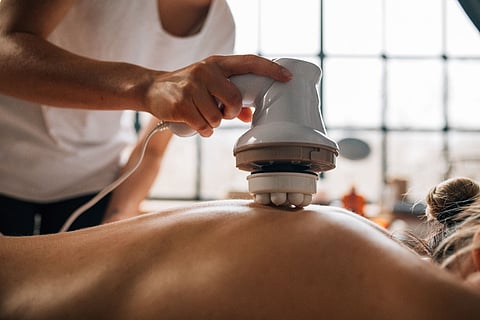
Mechanical body contouring uses physical movement or pressure rather than primarily relying on heating or cooling. Techniques can include suction, rolling handpieces, vibration, or devices that deliver pressure waves to the skin's surface.
These treatments may move fluid within superficial tissues and temporarily soften the uneven appearance of cellulite. However, a smoother appearance after a session is not evidence that fat cells have been destroyed.
Changes are often short-lived, and repeated appointments may be needed. Temporary bruising, tenderness, or discomfort can occur, particularly with stronger suction or pressure.
People with vibrational or pressure urticaria, conditions in which vibration or pressure triggers hives, should avoid these treatments and discuss alternatives with their clinician.
Start with the change you actually want. A small, pinchable fat deposit may prompt a discussion about cryolipolysis or selected ultrasound and heat-based devices.
Mild skin laxity points toward technologies intended for tightening. Muscle definition is a different goal, more closely associated with electromagnetic stimulation. For cellulite appearance, mechanical methods or certain energy-based procedures may be relevant.
A qualified clinician can assess whether your expectations fit the available options. Ask for the device's name, its intended use, evidence for your treatment area, likely number of sessions, total cost, recovery considerations, and whether maintenance is typical.
Before-and-after images can help illustrate possibilities, but they cannot predict your individual outcome. The best choice addresses a specific concern rather than promising an overall transformation.
These procedures avoid surgical incisions, but they still carry medical risks.
Short-lived redness, swelling, tenderness, or bruising can occur across several technologies. More serious complications, including burns, skin changes, nerve injury, or PAH after fat freezing, depend on the method used.
Safety also depends on medical history. Pacemakers or other active implants may rule out certain RF, ultrasound, or magnetic-field procedures. Cold-related conditions may make cryolipolysis unsuitable, while photosensitivity can affect eligibility for light treatments.
Tell your provider about medications, implanted metal, pregnancy, skin conditions, and previous procedures. Choose a trained clinician who can verify the exact device's regulatory status and authorized uses, rather than relying on broad claims about a technology.
The most useful starting point is a specific goal: less localized fullness, firmer-looking skin, better muscle definition, or a temporary improvement in cellulite.
From there, compare the technology, expected timeline, limitations, and risks. An informed consultation can help determine whether non-surgical body contouring fits your needs and what a reasonable result might look like.
Inspired by what you read?
Get more stories like this—plus exclusive guides and resident recommendations—delivered to your inbox. Subscribe to our exclusive newsletter
The products and experiences featured on RESIDENT™ are independently selected by our editorial team. We may receive compensation from retailers and partners when readers engage with or make purchases through certain links.