
- Locations
- Interviews
- Luxury Home
- Luxury Lifestyle
- Luxury Travel
- Luxury News
- Events
- More
- Magazine

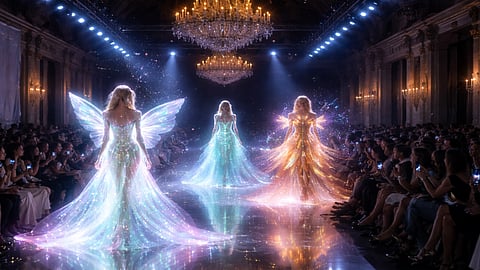
For centuries, haute couture has represented the pinnacle of exclusivity, artistry, and craftsmanship. A couture gown was not just clothing but a story hand-sewn into silk, lace, or organza. Today, however, a new designer has entered the atelier: artificial intelligence. At Paris Fashion Week, algorithms are generating entire collections, dresses inspired by centuries of art history, coats modeled on the geometries of architecture, and jewelry designed from datasets of natural forms. Unlike human designers bound by memory and training, AI systems can pull from billions of visual references across cultures, eras, and disciplines, producing pieces that feel at once familiar and alien.
Luxury houses like Louis Vuitton and Balenciaga have begun experimenting with AI platforms not to replace their creative directors, but to augment them, using machine learning to generate sketches, textile patterns, and silhouettes that human designers might never have imagined. The result is fashion that looks less like repetition and more like revelation, each garment born from the fusion of human vision and digital intelligence.
In the world of haute couture, no two garments are ever truly alike. Yet AI is pushing personalization to unprecedented levels, creating clothing that is not just bespoke but bio-responsive. Some experimental ateliers in Milan and Tokyo are working with AI platforms that analyze a client’s biometric data: height, posture, gait, even skin temperature, to produce garments tailored as much to physiology as to taste.
Beyond fit, AI systems also analyze clients’ digital footprints, reviewing past purchases, social media presence, and aesthetic preferences to suggest silhouettes and palettes that reflect both personality and lifestyle. Imagine ordering a gown that adapts its shade under shifting light, or a suit designed to regulate body temperature in real time.
For the ultra-elite, this convergence of couture and code transforms fashion into an intimate extension of selfhood. In a world where exclusivity is increasingly defined by personalization, AI ensures that luxury is not only rare—it is uniquely yours, as singular as a fingerprint.
Fashion has always thrived on spectacle, and today’s stage is no longer confined to the runway. AI is helping luxury houses expand into the metaverse, where virtual couture collections are modeled by digital avatars and showcased in immersive environments. Dior recently partnered with AI designers to create digital gowns for virtual galas, while Gucci has experimented with AI-generated sneakers that exist only in augmented reality. These pieces may never be touched or worn, yet they command prices rivaling their physical counterparts because they carry the same essence of rarity and cultural cachet.
What makes AI-driven virtual fashion especially enticing for luxury is its impermanence: garments can be coded to exist for a single event, a fleeting moment of digital brilliance never to be replicated. For brands, this opens new revenue streams; for collectors, it introduces a new form of status. To own an AI couture piece is to own a fragment of digital mythology, where exclusivity exists entirely in code.
“AI in fashion is projected to influence $275 billion in global luxury sales by 2030.”
McKinsey Fashion Report 2025
For all the excitement around algorithms and metaverse collections, the essence of couture remains deeply human. Behind every AI-generated sketch lies the hand of a couturier who interprets, edits, and refines. At Chanel’s Paris atelier, designers experiment with AI to generate initial concepts but rely on artisans to bring them to life through embroidery, draping, and hand-finishing. Similarly, Balenciaga uses machine learning to test silhouettes but preserves the final act of tailoring as a deeply human ritual. This interplay of technology and tradition is not a compromise; it is a dialogue. AI offers breadth of imagination; humans offer depth of meaning. Together, they expand the boundaries of what fashion can be without eroding the emotional resonance of craftsmanship. For clients, the reassurance is clear: while AI may influence what lands on the sketchpad, it is still the couturier’s hands—and the maison’s legacy—that transform an algorithm into wearable art.
Looking ahead, the fusion of haute couture and AI suggests a future where imagination itself becomes the ultimate luxury. Already, experimental labs are training algorithms on datasets that include not just fashion archives but also natural phenomena, scientific imagery, and even emotion-recognition data. The result: garments that shift color based on the wearer’s mood, or collections designed to evoke collective nostalgia. The boundaries of couture may no longer be dictated by fabric and thread but by creativity itself, with AI offering an infinite canvas for exploration. For clients, this evolution means exclusivity is no longer about rarity alone but about experience, the feeling of wearing something no one else in history, human or otherwise, could have imagined. In the coming years, AI may not replace designers but elevate them into a new role: curators of possibility. Couture, once the most human of arts, may find its future in the delicate duet of artistry and algorithm.
Inspired by what you read?
Get more stories like this—plus exclusive guides and resident recommendations—delivered to your inbox. Subscribe to our exclusive newsletter
The products and experiences featured on RESIDENT™ are independently selected by our editorial team. We may receive compensation from retailers and partners when readers engage with or make purchases through certain links.